
Executive Summary
The following report intends to justify which methodology is best suited to plan, execute, and monitor the Renewable Energy Project by Pinnacle Processors. Its target audience consists of the project sponsor, the director of green energy, the Tobago House of Assembly secretariat for the division of infrastructure, quarries, and the environment, citizens of Tobago, local communities, and environmental nongovernmental groups. It aims to provide relevant information to engage with identified stakeholders for further discussions of potential events.
An examination of the existing literature indicates that the Agile methodology, rather than the Waterfall methodology, will be most effective for the project under consideration. This is because this approach places significant emphasis on attracting and maintaining constant communication with stakeholders, which is critical and aligns with the project’s goals. Apart from that, it offers considerable flexibility, which is an advantage. The report’s structure consists of a justification of the chosen methodology, an analysis of the PRINCE 2 framework, its limitations, and alternative approaches. These actions will help form a more comprehensive and effective conclusion and recommendations for incorporating elements of the Agile methodology.
Introduction
When creating and promoting a project, companies must identify several key aspects that will determine its effectiveness. One of the most important aspects is the allocation of project management methodology, which largely affects project delivery and success. This is because it provides a basis for each action and step included in it, thereby determining its organization and form.
At the moment, two main methodologies are most commonly used for Agile and Waterfall project activities (Egri, Marian, and Veres, 2023; Marques et al., 2023). Despite having similar goals, they use different principles, tools, and techniques to carry out the company’s initiative. Thus, this report focuses on Agile as the most preferred approach for the Renewable Energy Project by Pinnacle Processors and aims to provide recommendations for its implementation.
To highlight the main recommendations, it is first necessary to determine the sequence of the research topic. Thus, the first step is to highlight the rationale for choosing the Agile project methodology for Pinnacle Processors’ Renewable Energy Project. The next step is to conduct a more complete analysis of the chosen approach. This aspect includes both positive and negative aspects, which are important to consider when choosing it. In addition, it is also important to understand the difficulties that managers may face when implementing the methodology. After these procedures, a conclusion will be drawn based on the data obtained, and recommendations will be developed on how they can add value to the organization while respecting project management.
4Justification
The next step in this report is to justify using the Agile methodology for a Renewable Energy Project. It is worth noting that the uniqueness of this method lies in its creation as a response to more traditional approaches (Dursun & Goker, 2022; Thesing et al., 2021). In other words, Agile is characterized by greater flexibility and interaction among the parties involved (Gaborov et al., 2021). In this approach, “project’s objectives are defined in less detail at the start of the project, and a project execution schedule is also prepared roughly – the project is divided into equal iterations with assigned parts of the project scope to be created” (Stare, 2014, p. 297). In other words, the project is based on implementing the most important operations and functions. Less significant tasks will be completed as the project develops and becomes established.
The basic principle of this design methodology is presented in Fig. 1. In this figure, one sees that each stage involves short delivery iterations, each based on a continuous learning process. For the Renewable Energy Project, this approach will be most valuable, as it involves multiple stakeholders, regulatory approvals, and procurement processes.
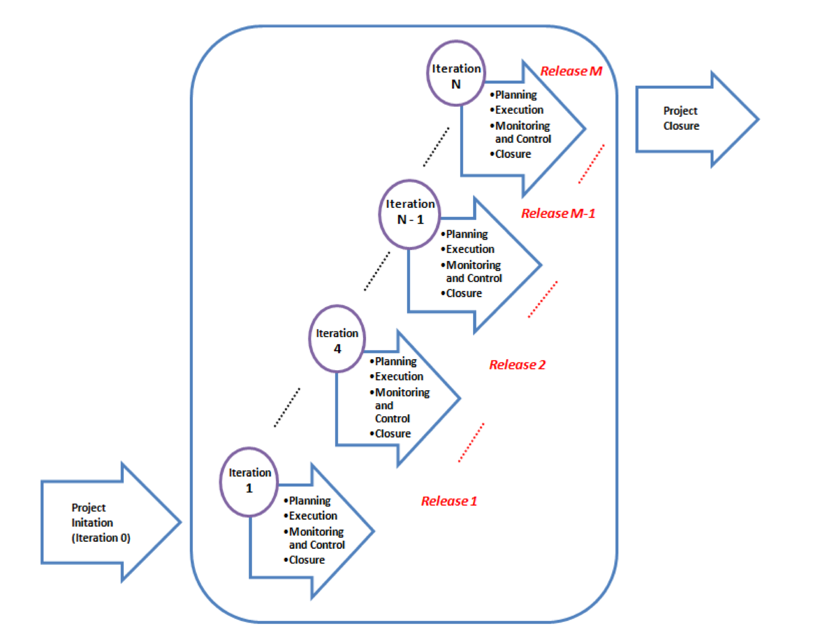
 quot;.” width=”813″ height=”636″/> Figure 1. “Agile project management method process” (Salameh, 2014).
Agile will help managers and participants adapt more quickly to potential changes in these processes (Ng, Khalfan, and Maqsood, 2022). In addition, this methodology will be more effective because it aligns with the nature of the project structure (Halani & Jhajharia, 2022). Hence, when it is developed on the basis of the principle of moving from more significant to less significant, stakeholders can start seeing tangible results early on.
Analysis of Chosen Methodology
In this section of the report, the main focus is on the research and evaluation of several aspects of the chosen methodology. This action will further highlight why the Agile approach is crucial to the project’s success. To do this, company managers need to choose the most appropriate approach for analyzing the main features, processes, principles, domains, and themes. In this context, the chosen approach is the Dynamic Systems Development Method (DSDM). Thus, several main reasons will be provided below why the Renewable Energy Project might be suited for the selected methodology.
The Dynamic System Development Method, or DSDM, is one of the most commonly used approaches within the Agile methodology. This is because it is based on similar concepts and provides meaningful feedback for evaluation and implementation. In addition, it differs significantly from the alternative SCRUM approach in its organization (Fig. 2). Therefore, it is not a closed sequence of actions but instead pays attention to different aspects of project implementation simultaneously. At the same time, it does not imply a complete violation of the connection between them, but rather a joint contribution to the overall process of each action.
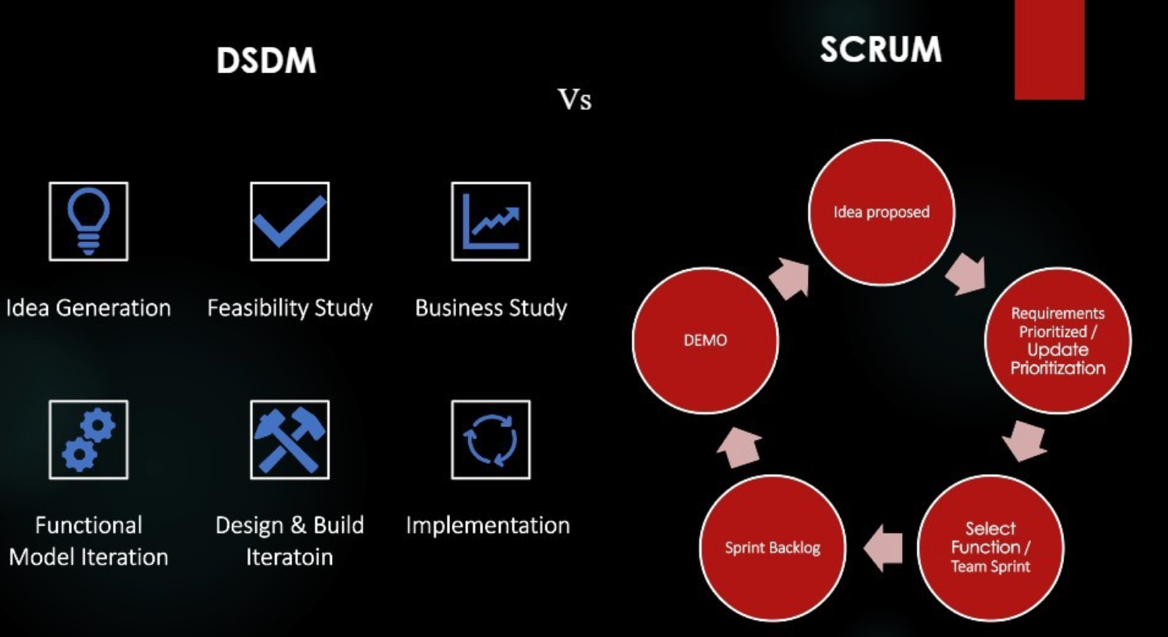
 quot;.” width=”1168″ height=”637″/> Figure 2. “Comparison of DSDM and SCRUM approaches” (Hunnell, 2022).
The uniqueness of the chosen analytical approach lies in the fact that, despite its iterations, it has a consistent structure. Thus, it is indicated that “DSDM has three sequential phases pre-project, lifecycle, and post-project” (Chapram & Solutions, 2018, p. 513). Thus, despite the lack of consistency of actions within the framework of this project methodology, it implies the existence of specific actions to achieve success. This information is useful, as it provides a basis to build upon when conducting the proposed Renewable Energy Project.
It is also worth noting that this approach to the methodology provides an opportunity to receive the fastest feedback and rebuild the project to satisfy stakeholders as much as possible. Research stated that “DSDM can perform in this manner largely because of its strict adherence to governance and the scope of a DSDM project is prioritized rationally from most important to least” (Hunnell, 2022, para. 2). The first characteristic has particular value for the Renewable Energy Project, as it is based on ensuring the stability of the unloading environment. This aspect requires strict adherence to governance to limit the promotion of harm or the disruption of the activities of the parties involved in the project.
As part of the DSDM approach to project management, it is worth highlighting several leading principles that underlie it. The first of these is to focus on the business needs, in other words, taking into account the interests and goals that the project sets for itself. Hence, for the Renewable Energy Project, this characteristic is especially relevant, as it entails the creation of a comprehensive Green Supply Chain forum for solar energy in Tobago. This process includes strict adherence to the necessary norms and requirements on the part of the company to minimize negative environmental impact and to comply with corporate social responsibility, which requires strict governance. Another leading principle is never to compromise quality (What is DSDM? 2024). In this case, quality is critical, as the project has a broad impact on both the company and the parties involved.
In addition, a large number of stakeholders are involved in the project under consideration, and the emphasis is on communication with them. Collaboration should be recognized as an important, distinct principle (Natarajan & Pichai, 2024). According to one of the planning considerations, which is to create an effective continuity project, this aspect is of particular relevance. This is because communication is key to regular updates, feedback, improvements, and the approval of requirements. As part of the project activity, it “ensures timely and appropriate collection, dissemination, storage, and ultimate disposition of project information among project stakeholders” (Ssenyange et al., 2017, p. 78). Thus, because stakeholder involvement and engagement are of particular importance to the Renewable Energy Project, the Agile approach will be most efficient.
The Agile approach is based on the principle of iterative development and management. Although this characteristic may seem illogical to many, it has significant advantages. The main point is that project managers can provide continuous refinement and improvement. This success indicator will be achieved through feedback and changing requirements (Wynn & Maier, 2022).
In addition, this approach will ensure the company’s continuous development through learning and adaptation to new conditions. However, the main difficulty in this context may be maintaining project stability due to the need to define the main points correctly. In other words, it is important for managers to accurately identify the most valuable aspects of their activities and build on them.
The high degree of adaptation of the DSDM approach to project management also offers advantages in risk management. The leading advantage in this case is continuous risk assessment and adjustment of mitigation strategies. Thus, managers have the opportunity to identify the threat promptly, choose actions to limit it, and ensure that negative impacts are minimized in the project’s outcomes.
This principle applies to the Renewable Energy Project, as it entails a high degree of risk, such as delays in acquiring and procuring panels, abrupt technical glitches, and unstable legal frameworks. Therefore, DSDM can help create a structured framework to solve these problems. Despite this, the main disadvantage of this aspect is the project’s high dependence on stakeholders. This fact indicates the high value that an error may have.
Within the framework of the methodology under discussion, it cannot be denied that when choosing a DSDM approach, an additional strategy may need to be integrated. This is because a mixed approach can provide even greater mitigation of difficulties and risks and achieve the most valuable results (Farahat & Defina, 2022). Thus, within the framework of the project under discussion, another methodology that can address the issue is PRINCE2. This method can provide advantages for the project in question, such as limiting the challenge of balancing flexibility with adherence to project constraints.
A distinctive feature of this approach is a strong emphasis on control. Research showed that “PRINCE2 demands a project management framework that has an organized and controlled project plan before starting, one that maintains its organization through the project life cycle” (Malsam, 2021, para. 5). Thus, like DSDM, it highly values quality and the need to follow all requirements and norms of governance.
This is especially important for the field of sustainability and reducing negative environmental impacts. Minimizing risks for the company also stems from defined stages, deliverables, and roles that must be established when bringing the project to life. Thus, it is assumed that this mixed approach can mitigate risks associated with complex stakeholder management.
One potential issue with applying Agile methodology to the Renewable Energy Project is the complexity of regulatory approvals and compliance requirements. This aspect is complicated primarily by the fact that the company operates in the energy sector. Thus, if managers want to carry out project activities related to the creation of new energy infrastructure, they must comply with government regulations, environmental standards, and local norms. The main problem and difficulty in this context is that the company needs to spend a significant amount of time collecting various agreements and approvals. Therefore, a large portion of this resource can be spent on this rather than on more important tasks.
In this area, in addition to the potential waste of time in obtaining regulatory approvals, the problem may also arise from non-compliance with various requirements and norms. This issue can lead to problems such as legal penalties, project delays, and reputational damage (Impact of non-compliance on organizations, 2021). Therefore, when implementing a project, despite its iterative nature due to the choice of an Agile approach, it is necessary to prioritize monitoring compliance with all necessary indicators of project activity (Breyter, 2022). In this way, managers will be able to ensure compliance and, most importantly, limit the possibility of legal risks and negative consequences associated with its absence.
4Conclusion
In conclusion, this report outlined the key characteristics and considerations to keep in mind when using the Agile methodology as part of the implementation of the Renewable Energy Project. It has particularly focused on this approach, as it considers it the most appropriate for this kind of initiative. One reason for this is that the Agile methodology is based on a high degree of stakeholder engagement (Effective ways for stakeholder management in agile, n.d.; Managing stakeholders in agile projects, 2023). In addition, it provides an opportunity to make the project more flexible to changes, which minimizes risks. These characteristics can provide advantages such as interaction with all involved parties, valuable regional communication, and the opportunity for continuous learning and development.
It is also worth pointing out that the study of Agile methodology through DSDM has shown that it has a leading position in the quality of work and results. In many ways, this aspect is achieved through effective governance, which is especially valuable when implementing environmental sustainability projects. The greatest success of the chosen approach can be achieved by incorporating an aspect such as the PRINCE2 methodology. A literature study has shown that it is also based on compliance with requirements and effective governance, which will help reduce potential risks for the project. Based on the information received, several recommendations can be identified that will add value to the organization in project management.
Recommendations
The first recommendation is to create a hybrid approach based on DSDM while simultaneously having elements of the PRINCE2 methodology. The company can ensure the smoothest implementation of the initiative under consideration and mitigate risks associated with non-compliance and violations of requirements for project participants (Farnham, 2022; Memon, 2024). The benefit to the project is that it ensures the smooth flow of all activities within it and prevents harm to stakeholders. The most important characteristic is ensuring that such an indicator ensures project teams stay aligned with the goals and processes within the project, and are responsible for changing priorities,
The next recommendation is to hold regular meetings with project participants. This is because it is necessary to report on management’s success, as this will provide an opportunity to transform and make changes in other areas of the project (Varajao et al., 2022). This aspect implies the creation of communication channels for all stakeholders (Safapour et al., 2019). This will ensure a productive exchange of information and positively impact engagement. Additionally, establishing communication includes receiving feedback, which is critical when implementing a project such as the Renewable Energy Project.
Reference List
Breyter, M. (2022) ‘Waterfall, agile, and hybrid delivery frameworks,’ In Agile product and project management: A step-by-step guide to building the right products right. New York: Apress, pp. 127-160.
Chapram, S.B. and Solutions, Z.I. (2018) ‘An appraisal of agile DSDM approach,’ International Journal of Advanced Studies in Computers, Science and Engineering, 7(5), pp. 512-515.
Dursun, M. and Goker, N. (2022) ‘Evaluation of project management methodologies success factors using fuzzy cognitive map method: waterfall, agile, and lean six sigma cases,’ International Journal of Intelligent Systems and Applications in Engineering, 10(1), pp.35-43.
Effective ways for stakeholder management in agile (n.d.).
Egri, M.D., Marian, L.O. and Veres, C. (2023) ‘Research on the agile and waterfall approaches in improvement projects,’ Review of Management & Economic Engineering, 22(4), pp. 399-402.
Farahat, A.M. and Defina, D. (2022) ‘Novel adaptive approach for applying and combining traditional waterfall and agile project management methodologies,’ In Abu Dhabi international petroleum exhibition and conference. Abu Dhabi: SPE.
Farnham, K. (2022) How to avoid the consequences of noncompliance in business.
Gaborov, M. et al. (2021) ‘Comparative analysis of agile and traditional methodologies in IT project management,’ Journal of Applied Technical and Educational Sciences, 11(4), pp.1-ArtNo.
Halani, K.R. and Jhajharia, K. (2022) ‘A quantitative study of waterfall and agile methodologies with the perspective of project management,’ In Contemporary challenges for agile project management. Pennsylvania: IGI Global, pp. 111-133.
Hunnell, T. (2022) DSDM vs. SCRUM a comparison.
Impact of non-compliance on organizations (2021).
Malsam, W. (2021) What is PRINCE2? Principles, aspects, roles & processes.
Managing stakeholders in agile projects: Mastering effective engagement (2023).
Marques, J.A.L. et al. (2023) ‘Effectiveness analysis of waterfall and agile project management methodologies–a case study from Macau’s construction industry,’ Revista Gestão em Análise, 12(1), pp.23-38.
Memon, M. (2024) Project risk management: A guide to mitigating risks in 5 steps.
Natarajan, T. and Pichai, S. (2024) ‘Transition from waterfall to agile methodology-An action research study,’ IEEE Access, (99), p. 1.
Ng, P.L., Khalfan, M. and Maqsood, T. (2022) ‘Traditional and Agile software development project management methodologies,’ In Managing information technology projects: Building a body of knowledge in it project management, Cyprus: WSP, pp. 71-104.
Safapour, E. et al. (2019) ‘Identifying effective project-based communication indicators within primary and secondary stakeholders in construction projects,’ Journal of Legal Affairs and Dispute Resolution in Engineering and Construction, 11(4).
Salameh, H. (2014) ‘What, when, why, and how? A comparison between agile project management and traditional project management methods,’ International Journal of Business and Management Review, 2(5), pp. 52-74.
Ssenyange, K. et al. (2017) ‘Project communication a dimension for improved project performance: The case of selected public university projects,’ Journal of Resources Development and Management, 30, pp. 77-84.
Stare, A. (2014) ‘Agile project management in product development projects,’ Procedia-Social and Behavioral Sciences, 119, pp. 295-304.
Thesing, T., Feldmann, C. and Burchardt, M. (2021) ‘Agile versus waterfall project management: decision model for selecting the appropriate approach to a project,’ Procedia Computer Science, 181, pp.746-756.
Varajao, J. et al. (2022) ‘Success management–from theory to practice’, International Journal of Project Management, 40(5), pp.481-498.
What is DSDM? (2024).
Wynn, D.C. and Maier, A.M. (2022) ‘Feedback systems in the design and development process,’ Research in Engineering Design, 33(3), pp. 273-306.