
Calculating the Average Redshift for Stars and Galaxies
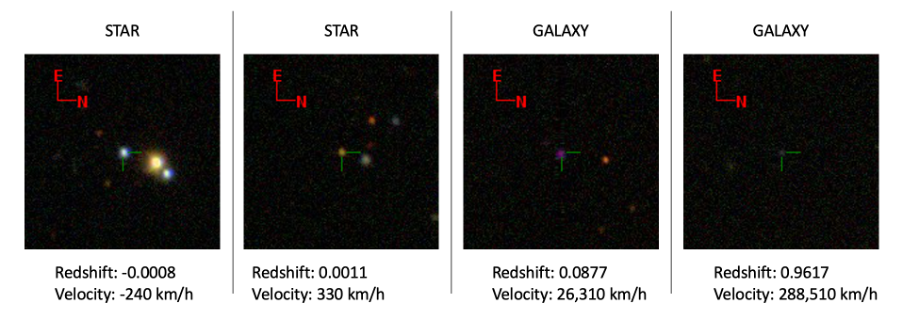
The original coordinates (179.6892, -0.4544) were used to search the list of spectra of stars and galaxies. BOSS: 3776 / 55209 were used, and a zero value for Zwarning was set as the filter, ensuring that faint objects would not be included in the sample. Both the redshift value and the speed of light (300,000 km/h) were used to calculate the velocities of the star or galaxy — the results of the calculations are shown in Figure 1.
Comparing Redshifts for Stars and Galaxies
The data obtained can be analyzed a little deeper. In particular, the average redshift for two stars is 0.0002, and for two galaxies, 0.5247. This implies that the average redshift of galaxies from the sample is about 3.5 thousand times higher than for stars. The main reasons for this observation may be the farther distance to the galaxies from the observer, the presence of the cosmological redshift, which does not affect the stars, and the slight shift of the stars compared to the velocities of the galaxies. In particular, since it is known that galaxies at greater distances tend to move away from the observer at higher velocities, the redshift of such galaxies will be higher.
Cosmological redshift is associated primarily with the universe’s expansion phenomenon, namely the increase in the distance between galaxies, which leads to an increase in the observed wavelength. Finally, the velocities of stars, as a rule, are significantly lower than those of galaxies, so the observed redshift will be higher for galaxies. Thus, the detected results are expected and consistent with theoretical notions.
In addition, as the data shows, the galaxy with the highest redshift had a velocity of 288,510 km/h, indicating opposite motion toward the observer. In other words, this galaxy was moving away from the observer at the specified speed. At first glance, this is quite a high value, close to the speed of light. However, it should be understood that the calculated speed is only the speed relative to the observer and does not reflect the absolute speed. It follows that the actual speed of this galaxy may be lower or higher, and additional observational factors should be considered.