
Introduction
The project aims to develop an automated teller machine (ATM) that enables bank clients to interact electronically with the bank and conduct financial transactions. A well-structured and disciplined management organization would be preferred to successfully implement this project on time and within budget. The organization should ideally follow the waterfall model as the project management methodology, given the project’s requirements and constraints. By implementing the project procedures, the chances of completing the project on time and within budget are likely to increase, while also effectively handling any scope increases that may arise.
Project Requirements
- The cash dispenser needs a key-operated switch that allows the cashier to start and stop the unit.
- The magnetic strip reader for debit cards must be compatible with the ATM.
- The ATM user interface must have an interactive screen for the customer’s convenience.
- Envelope depositing capability is a need for any modern ATM.
- The cash-dispensing feature of the ATM must be set to disburse in $20 increments.
- A printer attached to the ATM is essential for producing receipts for customers.
- The cash dispenser may only take cards issued by the same bank.
Functional Requirements
- The bank employee presses the “on” button and enters the cash balance into ATM 1. As a result, a “Welcome” screen is displayed on the ATM. The client slides their debit card into the card reader.
- If a different financial institution issues the card, it will be declined and returned to the consumer, accompanied by an explanation that the card was not accepted. However, if the card is valid, the next step is to request the customer’s PIN.
- The client inputs their PIN. The consumer is prompted to try again if the PIN is entered incorrectly. After three unsuccessful attempts, the card is ejected. On the other hand, if the customer’s PIN is valid, a menu appears with options such as Account Balance, Withdraw, Deposit, and Transfer.
- If the consumer selects “Account Balance,” the balance will be displayed digitally or printed. They will then be asked if they require any further transactions or payments. If the response is “Yes,” a new menu appears with options to check the account balance, make a withdrawal, or add funds. If the response is “No,” the card is ejected, and the “Welcome” screen reappears.
- When the consumer selects “Withdrawal,” a menu showing $20 increments up to $300 is presented, or they can input the withdrawal amount manually. If the consumer selects a bank option, the bank verifies the availability of funds in the client’s account. Upon confirmation, the cash is dispensed from the slot, and a receipt is issued.
- After completing the desired transaction, the consumer is prompted whether they need to perform any additional actions. If the answer is negative, the card is removed from the reader. However, if they choose “Yes,” a new menu appears with the options “Account Balance,” “Withdrawal,” or “Deposit.”
- If the consumer selects “Deposit,” an interactive screen guides them to enter the deposit amount and instructs them to seal the bank’s envelope. Once the client inserts the sealed envelope into the deposit slot and closes it, the deposit is successfully made. A receipt is generated and provided to the customer upon completion of the transaction.
- Lastly, the card is removed from the reader if the consumer indicates no further transactions. However, if they choose the option to continue, a new menu appears, allowing them to select “Account Balance,” “Withdrawal,” or “Deposit.”
External Interface Requirements
- User interface.
- Hardware interface: printers and network connectors.
- Software interface: access to customer data and network software.
Performance Requirements
- A message should be shown on the ATM informing users if there is no money within.
- For 15 seconds, all error messages must be shown.
- After two minutes, the debit card should be returned if the bank has not responded.
- Only when sufficient funds are in the account and following bank withdrawal limitations can withdrawals be permitted.
Attributes
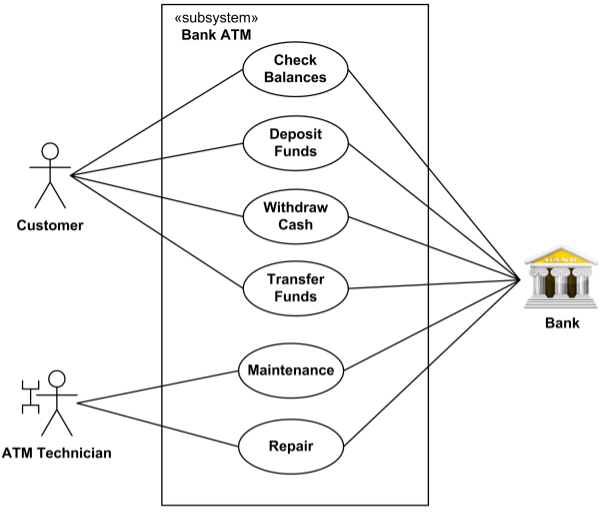
The actors are:
- Customers
- ATM technician
- ATM.
ATMs are convenient because they allow users to perform rapid self-service activities, such as deposits, cash withdrawals, bill payments, and transfers between accounts. The technician’s primary duties include setting up, maintaining, and repairing ATMs and other electronic office equipment that dispense cash and enable users to check their bank accounts. The technician, also known as a field technician, often needs to disassemble the ATM to diagnose and repair issues.
The decision to employ the Waterfall Model for this project’s software was made because the requirements are specific and do not require frequent alterations. Every phase of the waterfall model begins immediately after the previous step has been completed and tested, making it straightforward to understand (Mathis et al., 2022). The waterfall model is simple to comprehend and control. The waterfall technique’s requirements, design, implementation, verification, and maintenance phases have specific objectives. To better appreciate the adaptability of contemporary approaches, it is helpful to have a basic grasp of the history and structure of the Waterfall approach.
These are the cases:
- Balance check
- Funds depositing
- Money transfers
- Withdrawing money
- Repair and maintenance.
The user should take out their debit card, swipe it to withdraw funds from their account, and then double-check their balance to confirm the funds were deducted. These are a few test cases that will be utilized throughout the process.
For several reasons, this project would not be outsourced, as it is relatively straightforward. The development of this program necessitates access to the client database; yet, there is no need to further complicate the project by raising concerns about its safety. It would also be simpler to maintain the system.
This project must be delivered on time and within budget to be executed properly. Customers of the bank should begin using their debit cards as soon as possible. Given the variety of banks available, customer satisfaction typically draws individuals to a particular institution.
Thankfully, this project has no gray areas. It can only extend an ATM’s capabilities beyond checking your balance, making deposits, withdrawals, and money transfers across accounts (Song et al., 2021). However, in the future, it could be necessary to pay bills or exchange money for cryptocurrencies. Then, it will be straightforward to integrate these functionalities into existing applications.
Conclusion and Recommendation
The implementation strategy determines each actor’s responsibility for database access. Three classes should be created for each actor to handle interactions with other actors and with databases. The implementation strategy determines the structure and functionality of these classes. Once the actor classes are created, they should be added to the website. Immediately apply CSS (Cascading Style Sheets) styles to enhance the website’s appearance. Using CSS enables users to modify a web page’s colors, layouts, fonts, and other elements (Devi Soorya & Sreelatha, 2021). Additionally, functionality and CSS styles should be added to the website, including data retrieval, modification, user authentication, and other database access tasks.
References
Devi Soorya, S., & Sreelatha, K. S. (2021). Application of queuing theory to reduce waiting period at ATM using a simulated approach. IOP Conference Series: Materials Science and Engineering, 1145(1), 012041.
Mathis, F., Vaniea, K., & Khamis, M. (2022). Can I borrow your ATM? Using Virtual Reality for (Simulated) in Situ Authentication Research. IEEE Xplore.
Song, S., Tian, Y., & Zhou, D. (2021). Reverse logistics network design and simulation for automatic teller machines based on carbon emission and economic benefits: A study of the Anhui Province ATMs industry. Sustainability, 13(20), 11373.