
Introduction
It is challenging for companies to enter and survive in the aviation industry, as it requires significant investments and high competency levels to become profitable. However, Emirates Airlines, which is a Dubai-based firm founded in 1985, was able to capture a significant portion of this market in a relatively short period through intelligent positioning and decision-making (Alcácer & Clayton, 2014).
The Competitive Advantages of Emirates Airlines
The firm prides itself on various premium services offered to its customers. In just three decades, Emirates Airlines expanded its operations significantly and now has over 120 destinations and more than 190 aircraft in use (Alcácer & Clayton, 2014). While competitors may pose a risk to the firm, Emirates Airlines can leverage its strengths and take the top position in the industry. Therefore, the competitive advantages of Emirates Airlines lie in its best-in-class services for clients regardless of their reason for travel and the company’s widespread reach.
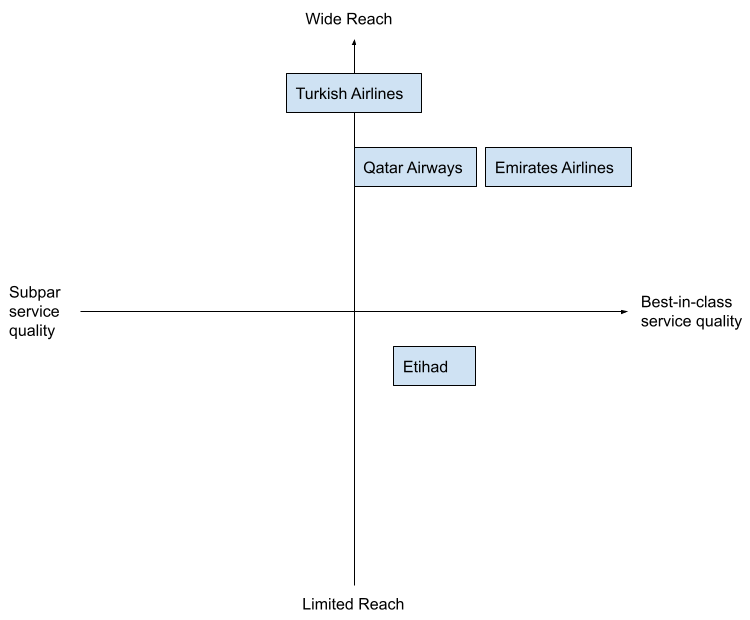
Despite its rapid growth, Emirates Airlines has to defend its position from many firms that follow a similar business strategy. The Gulf region, where Emirates is based, now presents international and domestic passengers with numerous choices of airline companies (Alcácer & Clayton, 2014). First, the firm must respond to the threat from its competitors’ partnership activities. Being the third-largest airline in the world, the company benefits significantly from its geographical position at the hub of significant flight pathways. Yet, the alliance between Qatar Airways and Turkish Airlines overshadows Emirates’ capacity and reach (Alcácer & Clayton, 2014).
To sustain its competitive advantage, Emirates Airlines has to find a partner who complements its destinations with numerous new ones. Exploring the possibilities of adding a network of airports from smaller companies in the aviation industry, such as Virgin Atlantic, can add value to both firms. The capacity of each flight path can also be improved via additional investments based on consumer demand projections. Expanding the number of aircraft dedicated to a particular destination can give the firm a higher market share.
Furthermore, the quality of Emirates Airline services may be outstanding, yet the variety can be upgraded beyond this point. The differentiation approach to class seatings can create specific offers that may be attractive to a particular portion of travelers. For example, amenities for business class seats can include premium options that cater to clients from a target region. It is also vital to take note of Emirates’ competitors’ ability to copy its differentiation strategy, as their capability for high-end services is not dissimilar (Alcácer & Clayton, 2014). Emirates Airlines must continue to outpace its rivals by continuously developing new features that enhance its flights.
Conclusion
In conclusion, Emirates Airlines has a solid position in the aviation industry, which it holds via best-in-class services and many different destinations available. The constant growth of this organization is solid proof of its competency. However, other regional firms are now following a similar trend by expanding their reach while improving the quality of premium and economic offers. In turn, Emirates Airlines has to seek partnership opportunities and differentiate its services further to capture a substantial market share.
Reference
Alcácer, J., & Clayton, J. (2014). Emirates airline: Connecting the unconnected (9-714-432). Harvard Business Publishing.