
Introduction
Cultural borders are irrelevant to art, and people open their minds to cross borders and seas when they stand in an art gallery to look at a work of art. It needs to comprehend better and appreciate one another’s civilizations, ideas, beliefs, values, and perspectives. We may learn about a society’s dress, attractiveness, and religious norms through an art display.
Art sparks debate and discussion about both other civilizations and our own. We are motivated to explore our creative outlets through art, which also ably represents human achievement. Art museums enable us to explore the homes and cultures of others through paintings, sculptures, drawings, photographs, and textiles.
Sunflowers by Vincent van Gogh
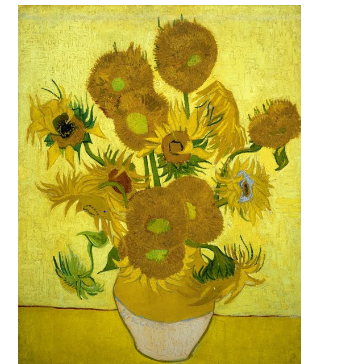
One of the four artworks downloaded from the Google Arts and Culture website is Vincent van Gogh’s Sunflowers. Beautiful sunflowers in a small container can be seen in the image. A little flower pot remains perched next to the wall. The sculpture is positioned in an open area, allowing the flowers to sag to the sides (van Gogh).
To depict a genuine flower, the artist has arranged the plants in the picture. To emphasize the look of the sunflowers, van Gogh uses the fair value of the blended colors, displaying a softer tone and great intensity. White, light and dark green, light and dark yellow, black, and light blue are used in the image.
The artwork makes the most of the four paintings’ most vivid hues. Van Gogh relies on yellow in “Sunflowers,” but he balances the image using tints and shades of this bright color. The artist also features green, orange, and a touch of red and blue.
Blue and orange are opposite colors in the color wheel based on pigment, as are red and green. Opposite colors create balance and contrast in the image because they are symmetrically placed in the color wheel. The artist designs the flowers in a white container to emphasize and set them apart from the background.
The artwork resembles a plant and is not constrained in height or breadth. The fact that specific blooms in the piece are shorter than others highlights their diversity in length. The piece of art has a rough texture and is painted in a traditional canvas painting style.
The recurrent usage of flower stems and heads in the picture demonstrates harmony. Gogh draws attention to the inflorescences’ dark brown hues to make them stand out in a vibrant color combination. The graphic beautifully illustrates balanced objects and the areas they inhabit.
Arrival of a Train by The Gare Saint-Lazare
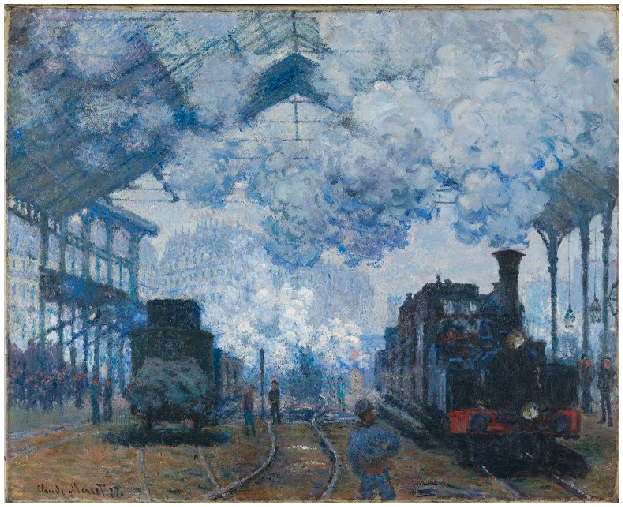
The Gare Saint-Lazare: Arrival of a Train is an art drawn by Claude Monet. The artwork shows two trains at a common point on the rail line. The train on the right is arriving, while the one on the left is leaving the crossing point. Although the picture has two trains, the artist focuses on the train on the right (Monet).
Saint-Lazare depicts two trains to illustrate the distinction between arrival and departure, marked by the train’s front and rear. The image of the train is unclear, but from what can be observed, the train blows smoke through the chimney as it arrives. On the right and left sides of the train are images of people. The presence of the people standing beside the train signifies that they are waiting for the arriving train. Of all the four pictures, this is the dullest and most uneven.
Here, Monet decided to concentrate on the glass-and-iron railway shed because it included an attractive blend of manufactured and organic elements. The soft colors evoke an organic feel, and their opposite, in the rising steam from confined engines and sunshine filtering through the vast, transparent portions of the top, is a contrasting effect. With his paintings of the station, Monet began what would eventually become a well-established habit of painting the same subject matter repeatedly to capture minute and temporal climatic changes. However, the series also marked his final attempt to depict urban life; moving forward in his career, Monet would mostly paint landscapes.
Compared to the other three artworks, this picture is unique because it takes the form of a train with smoke billowing toward the sky. The style of the image is a painting done using uneven, faded colors, including dark blue, grey, black, red, and white. The artist uses fuzzy and unclear colors to show how the train’s smoke pollutes the environment.
Monet paints the smoke color foggy white to emphasize the arrival sign. The smoke also matches the background of the picture, thus bringing more harmony. The painting is created using oil and canvas medium, and the image’s composition effectively balances the elements.
Delightful Land by Paul Gauguin
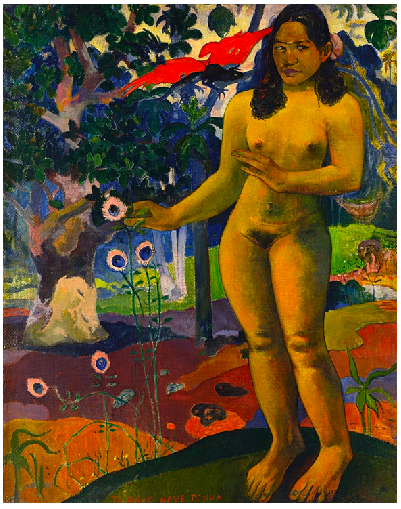
Oil on canvas. Musée d’Orsay, Paris. Source: Google Arts & Culture.
Delightful Land (Te Nave Nave Fenua) by Paul Gauguin represents a beautiful land where a woman figure stands. The precious land has multiple attractive elements, including a woman figure, trees, flowers, a flower bed, and sand. The picture forms an environment of various components that make it charming (Gauguin).
Gauguin highlights a woman’s figure to show the land’s real beauty. The artwork assumes the style of a painting in oil and canvas medium. Gauguin employs gradation by creating several images to show the intention of his painting. The photos show various hues, including brown, green, pink, black, and blue.
The woman is standing on a raised ground, and tall flowers and short plants are on her side. The woman holding a flower can be interpreted as a way the artist calls the viewer’s attention to the pretty flowers. The flower plants are all green, with some opening pink flowers with blue bases.
The red soil displays a different painting style and a vast and small tree behind the human figure. The stem and branches of the enormous tree are light brown, while the leaves are green to reveal nature’s charm. The small tree and the red soil sit in the shade of the enormous tree as a show of beauty, even in the absence of sunlight.
Furthermore, Gauguin emphasizes the pleasant land by placing the image of the beautiful woman on the front. The woman’s figure is left naked to show physical attraction associated with the land’s loveliness. When the artist names the image as precious land, it could mean he was talking about the composition of the whole environment.
The Bather by Paul Cezanne
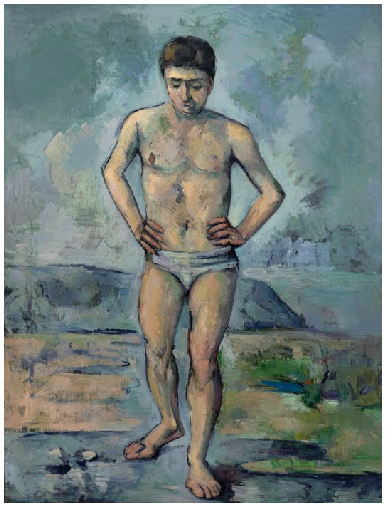
Oil on canvas. Museum of Modern Art (MoMA), New York. Source: Google Arts & Culture.
The Bather by Paul Cezanne depicts a man wearing only underwear. The man in the picture looks like an adult due to the development of various body parts, especially the chest and legs. He is standing with both of his hands, holding his waist firmly. The bather stands barefoot on the rock beside a river while facing down (Cezanne). Holding the waist could be interpreted as finding it difficult to enter the water to bathe.
Like Delightful Land, the artwork assumes the form of a human figure in a drawing style. Cezanne combines darker and lighter shades to differentiate the human figure from the background. The human picture is also painted in oils and canvas using brown color with a little dark brown mark indicating human aspects of the body. The drawing also has a middle gray value with low-intensity background colors to signify the irrelevance of the background section.
The uneven distribution of colors helps the artist achieve the artwork’s balance. Furthermore, using a brighter color for the human figure allows the artist to emphasize the subject matter. The way the figure stands could indicate the challenge or reluctance shown by the man toward getting into the water to bathe. The shape of the figure is tall and less wide, thus delivering more representation of a human.
Conclusion
The entire fabric of our civilization has been influenced by art throughout history. These structures serve as monuments to human knowledge and experience. The accomplishments of man and his aspirations are memorialized in art museums. They serve as evidence of man’s quest to transcend himself.
It must better understand and respect one another’s cultures, ideologies, worldviews, and opinions. An exhibition of art may teach us about a community’s attire, beauty, and religious customs. It prompts discussion and debate regarding both past and present civilizations.
Works Cited
Cezanne, Paul. The bather [Website]. Google Arts and Culture. 1889. Web.
Gauguin, Paul. Delightful land (Te Nave Nave Fenua) [Website]. Google Arts and Culture. 1892. Web.
Gogh, Vincent van. Sunflowers. [Website]. Google Arts and Culture. 1890. Web.
Saint-Lazare, Gare. Arrival of a train. [Website]. Google Arts and Culture. 1877. Web.