
Introduction
In the graphic novel Borders, written by Thomas King and illustrated by Natasha Donovan, the universal conflict between maintaining cultural identity and the bureaucratic systems put in place is presented. In the story, the mother and son, both Aboriginal Canadians, attempt to cross the border into Salt Lake City, United States. When they reach the border between Canada and America, they identify themselves to border officials as Blackfoot, not Canadian or American. This causes an issue at the border and puts them in limbo between the two countries.
The story provides powerful commentary about social justice, cultural identity, and belonging. The interactions among the mother, the son, and the border officers shape the story’s main themes, while details such as food enhance the storytelling by providing context and shaping the characters’ connection to their cultural identity.
Novel Analysis
The representation of Indigenous people in literature has been significantly limited, as such authors often do not have access to the resources available to the majority. These limitations have been attributed to the persistent domination of non-Indigenous cultures in establishing ideas, beliefs, and assumptions about what it means to be a member of a group (Datta 2). Thus, White institutions, both American and Canadian, have overwhelmingly pushed the creation and definition of the main representation of racial minority groups, including Native peoples (Eason et al. 71). As a result, since it is not the Indigenous groups that dictated their representation in the larger population, the outcome entailed essentially harmful and inaccurate ideas and biased understandings permeating contemporary society. It is important to note that the prejudice and adverse perceptions of Indigenous people are well-known, which is why, in Borders, the mother and the son were aware of the challenges they may endure when crossing the border.
From the very beginning of the story, it is clear that the mother is adamant about preserving their cultural identity as they cross the border. The narrator mentions, “I had to dress up, too, for my mother did not want us crossing the border looking like Americans” (King 134). The mother took care to pack a lunch of sandwiches, potato chips, and some fruit for the road (Figure 1). As a reminder of their previous trip with Letitia, the narrator’s older sister, who moved to Salt Lake City, they, too, stopped at Coutts, a convenience store and a gas station.
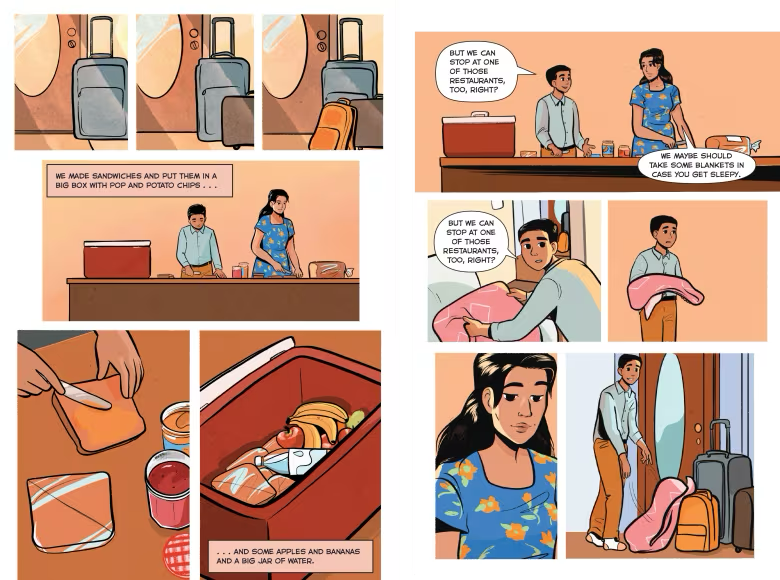
When the narrator was seven or eight years old, he got an Orange Crush at Coutts, and this time he got the same drink, remembering the last time he saw his sister. This moment is significant when it comes to living remotely from one’s family. Something as simple as getting the same can of pop can bring back memories and make a person reflect more deeply on their life and relationships.
The theme of food runs as a thin red line throughout the story, with no direct descriptions. However, the narrator’s concerns about stopping at a restaurant or about having enough food after spending the night at the border could point to his anxiety about the pressure of crossing the border. When they arrive at the border with America, they are asked about their citizenship, and the narrator’s mother insists that it is Blackfoot. The boy notes that it “would have been easier if my mother had just said ‘Canadian’ and been done with it, but I could see she wasn’t going to do that” (King 135).
Indeed, from the standpoint of practicality, it would have been easier if the woman were more flexible in defining her and her son’s citizenship. However, from the perspective of social justice and the right to one’s cultural identity, adhering to a colonialist standard would entail upholding oppressive practices (Garcia-Olp 47). The border control standards did not take into account that Indigenous peoples are neither Canadian nor American; instead, they were native to the land before the settlers came. To cross the border quickly and peacefully, an Indigenous person would have to push their pride away and agree that their citizenship is Canadian.
More food-related anxiety occurs when the mother and the son park at the border to spend the night, and one of the border control officers comes to check on them. The boy interrupts the conversation, saying they were out of ham sandwiches and that “hamburgers would be even better because they got more stuff for energy” (King 142). His concerns are ignored again, and later that night, he asks his mother, “Do you think Mel is going to bring us any hamburgers?” (King 142). His mother does not seem concerned about food and looks up at the night sky, remembering the stories his mother would tell him about the stars. The boy gets to eat only in the morning when the TV crew arrives at the location, and there is a van and a table set up with some sandwiches, fruit, and orange juice.
The boy’s preoccupation with eating shows that he is too young to realize the gravity of the situation. His mother stood her ground and even caught the attention of the news media, reaching thousands, or even tens of thousands, of people. The sign of luck comes when Mel came over, “and gave us a bag of peanut brittle and told us that justice was a damn hard thing to get, but that we shouldn’t give up” (King 143).
The narrator says that he would have preferred lemon drops, but the gesture was nice. On their way back, when the two bring Mel a green cap with “Salt Lake” written on it, the office gives them more peanut brittle. Thus, the focus on food rather than the full extent of the situation characterizes the narrator as naïve and probably too young to understand what happened.
Conclusion
To conclude, Borders illuminates the struggle to defend one’s cultural identity when the dominant identity is imposed on minority groups. The narrator’s mother is persistent in her efforts; she stands her ground and refuses to choose a citizenship other than Blackfoot, her Indigenous heritage. Even though the narrator is a little too young to understand the roots of the problem that they endured on their journey, the example that his mother sets for him is crucial so that he lives in an environment that teaches him to be proud of his heritage and ethnic belonging.
Works Cited
Datta, Ranjan. “Decolonizing both Researcher and Research and its Effectiveness in Indigenous Research.” Research Ethics, vol. 14, no. 2, 2018, pp. 1-24.
Eason, Arianne, et al. “Reclaiming Representations & Interrupting the Cycle of Bias Against Native Americans.” Dædalus, the Journal of the American Academy of Arts & Sciences, vol. 147, no. 2, 2018, pp. 70-81.
Garcia-Olp, Michelle. “How Colonization Impacts Identity Through the Generations: A Closer Look at Historical Trauma and Education.” Electronic Theses and Dissertations, 1487.
King, Thomas, and Natasha Donovan. Borders. Little, Brown Ink, 2021.
King, Thomas. “Borders.” Pennersf Files.