Abstract
Customer satisfaction ranking has declined, particularly in North American airlines, following the COVID-19 outbreak. The decline in overall consumer satisfaction has been attributed to many issues, which numerous studies have covered. Nevertheless, customers’ preferences regarding seating have never been considered in any research that has been carried out. As a result, the current research has regarded the customer’s preferred seating arrangement to ascertain whether or not this factor impacts the customer’s level of happiness. The study’s findings showed that a customer’s seat preference did not influence their level of satisfaction with an airline after doing a chi-squared test on the major North American airlines using data derived from JD Power 2022.
Introduction
The contentment of passengers is consistently at the forefront of airlines’ minds. Dissatisfied or disengaged customers will inevitably result in fewer passengers and lower revenue. Clients must have a positive experience every time they travel. The most prominent factors that could contribute to a positive experience and increased customer loyalty include on-time flights, quality in-flight entertainment, an expanded selection of food (both in quantity and quality), and increased legroom (Sefanov, 2018). However, in recent times, the subject of whether or not the seat preference of the consumer can judge customer pleasure has been brought up.
Despite how much attention the flight itself receives, it is just one facet of the customer’s overall experience. The customer experience includes everything from booking the ticket on the company’s website or through its mobile app to checking in luggage at the airport or using the company’s mobile app to waiting at the terminal (Monmousseau et al., 2020). Since the introduction of airport kiosks that allow passengers to check in, upgrade their seats, and even request flight adjustments, airlines have significantly emphasized providing self-service options to their customers.
Literature Review
Study analyses of service quality models and investigations of potential techniques for evaluating aviation service quality have been conducted. As a result, many customer service analysts have concluded that providing excellent service is crucial to retaining loyal customers (Poškuvienė et al., 2022). Due to the nature of the service, aviation customer service has stricter criteria than other industries. Refining client needs and expectations become crucial in pursuing top-level customer service, enabling businesses to focus their customer care efforts on meeting customers’ wants rather than just meeting minimum standards. Furthermore, the aviation industry has a unique set of challenges regarding customer service, necessitating a more thorough and detailed approach to training employees.
A theoretical investigation of customer requirements or service criteria is insufficient for investigating service quality. The theoretical study by Pokuvien et al. (2022) found that customers’ perceptions of service quality varied for several reasons. As a result, service quality models are used to learn about customers’ expectations or to locate service gaps; these models also aid in conducting analyses and bettering processes. Furthermore, the research on customer service models revealed that they had not been adapted for aviation (Poškuvienė et al., 2022). This is due to the following: their focus on a single service aspect, the absence of a link between components, the overlooked role of personnel in customer service, and similar issues.
Saudi Arabia’s low-cost carriers (LCC) face intense competition and stringent requirements. Whether or not customers of a no-frills airline are satisfied and loyal can be attributed to the quality of service. Hassan and Salem (2021) studied the traveler and aviation market in the kingdom to determine how LCCs’ service quality influences customers’ satisfaction, loyalty, and perceptions of the airline. The study found that customer contentment, airline reputation, and loyalty significantly correlated with service quality.
All other aspects of service quality could be predicted by how quickly they responded to customers’ needs, making responsiveness the most crucial element of service quality (satisfaction, loyalty, and brand image). Brand recognition and customer dedication to an airline were related to the presence of physical products and the airline’s reputation for dependability. It is clear from these findings that LCCs need to focus their future strategic plans on increasing the quality of their services across the board, especially in the area of responsiveness.
As a result of the COVID-19 pandemic, the airline industry collapsed around the world. Losses were incurred by nearly every airline in the world because their primary source of revenue—air transportation—was restricted. Many air companies had declared bankruptcy. However, the demand for air travel is expected to skyrocket after the storm passes as people return from vacations abroad.
Hulliyah (2021) undertook a study to determine what makes the aviation sector so competitive and successful. The research compared various categorization models, including KNN, Logistic Regression, Gaussian Neighbor-Boundary, Decision Trees, and Random Forests. With a threshold of 0.7, the Random Forest Algorithm in this study achieved a 99% accuracy, and the In-Flight Wi-Fi Service significantly contributed to customer satisfaction.
This study of the relevant literature has shown, in general, that a significant amount of research has been performed to investigate the factors that influence levels of customer satisfaction. Although the review literature has concentrated on various factors to establish what factors influence customer happiness, they have neglected to employ seat preference as the determining factor. Since there has not been a lot of research done on this topic, the primary focus of this investigation will be on client preferences regarding seating arrangements.
Methods
Runway incursions, pilot weariness, and a lack of available crew members are just a few of aviation’s many challenges. An issue that needs more attention is how customers are satisfied. Although security and profit are crucial, a company cannot survive without its clients. CNN reports that consumer satisfaction is down from the COVID-19 high point (Street, 2022). The ability to choose one’s seat is one metric for customer happiness. It will be determined if there is a preferred seating option based on the JD Power rankings of 2022 (2022 North America Airline Satisfaction Study, 2022). For this reason, a non-parametric chi-square test statistical test was used. There is an assumption that all data points are uncorrelated and that no data point is less than 5.
Hypothesis
Customers’ seat preference affects their overall happiness with the flight.
Null Hypothesis
There is no difference in seat choice for customer satisfaction.
Results
A statistical hypothesis test known as a chi-square test is applied in this study to analyze contingency tables of the sample sizes of American Airlines. To put it another way, the primary goal of this test is to determine whether or not the categorical variables (two dimensions of the contingency table) may be considered independent in their ability to affect the test statistic (values within the table). Due to the test statistic being chi-squared distributed under the null hypothesis, it may be said that the test is valid for this particular study.
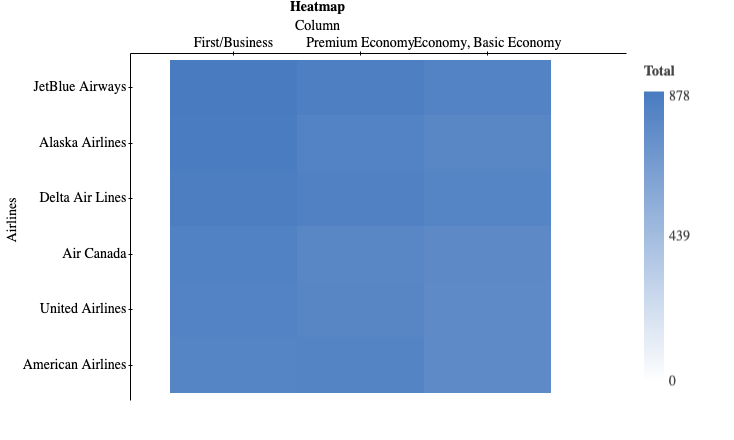
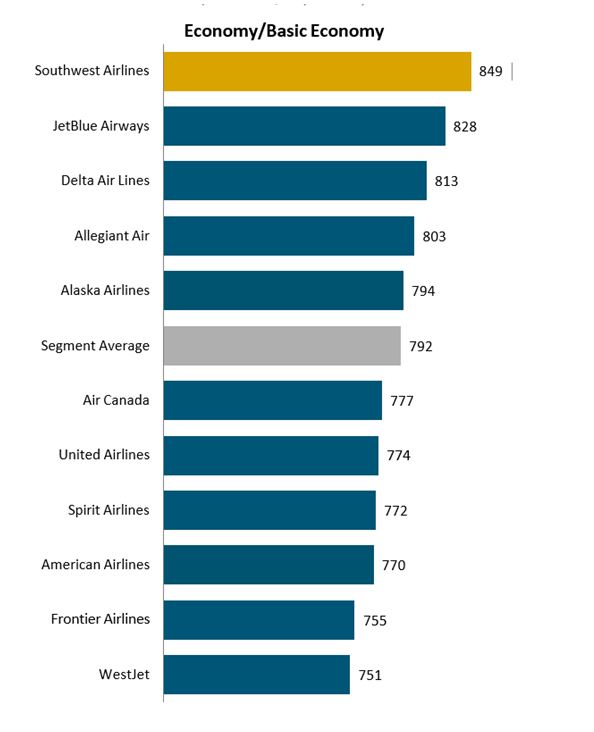
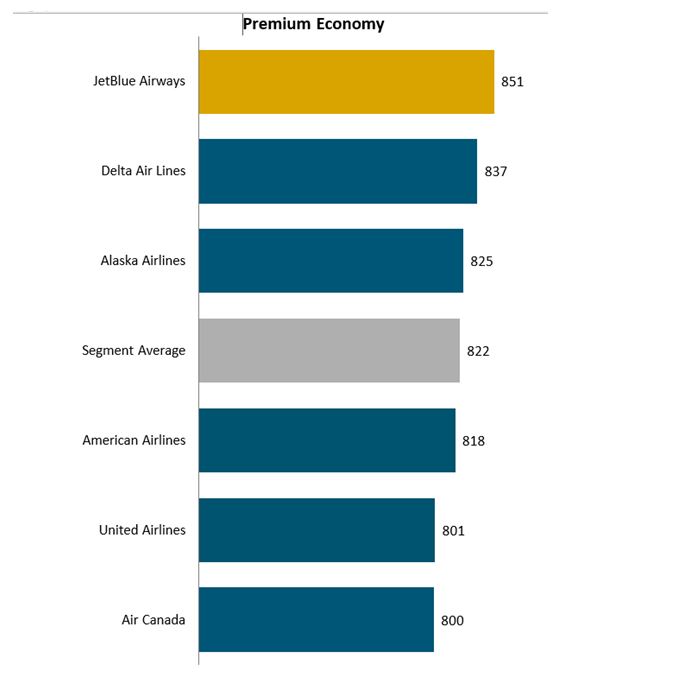
Since p>0.05, as shown in Table 1, it leads to the rejection of the alternative hypothesis and accepts the null hypothesis to conclude that the choice of seat has no bearing on performance. JetBlue, however, continues to have higher rankings overall, as shown by the heatmap (see Appendix I). Since the statistical test failed, it will be necessary to determine how distinctively different each seat affects the customer satisfaction rating (see Appendix II, III, and IV). Furthermore, details comparing current airport operations to those in COVID-19 will be required for future studies.
Conclusion
The analysis of the relevant literature led to the discovery that many different aspects influence customer satisfaction ranking. The first component is the views of the consumers, which then leads to the utilization of service quality models to learn about the customer’s expectations or to find service gaps. Second, the customer’s level of satisfaction, the airline’s reputation, and the customer’s loyalty all correlate substantially with the level of service provided. Finally, the availability of Wi-Fi services on board typically contributes to an increase in the customer satisfaction score. All these reviews have failed to factor in customers’ seat preferences, leading to this study.
This study has revealed that although the customer ranking of North American airlines has declined, the customer’s seat preference has not caused it. North American airlines are raising ticket prices due to rising fuel expenses and increased leisure travel demand, decreasing customer satisfaction. The JD Power 2022 North America Airline Satisfaction Study found that load volume is growing. People are willing to take a middle seat to leave their homes, even if increasing pricing could damage airline brands. Therefore, this research has shown that other factors can affect customer satisfaction, but seat preference cannot.
References
2022 North America Airline Satisfaction Study. J.D. Power. Web.
Hassan, T. H., & Salem, A. E. (2021). Impact of service quality of low-cost carriers on airline image and consumers’ satisfaction and loyalty during the covid-19 Outbreak. International Journal of Environmental Research and Public Health, 19(1), 83. Web.
Hulliyah, K. (2021). Predicting airline passenger satisfaction with classification algorithms. IJIIS: International Journal of Informatics and Information Systems, 4(1), 82–94. Web.
Monmousseau, P., Marzuoli, A., Feron, E., & Delahaye, D. (2020). Impact of covid-19 on passengers and airlines from passenger measurements: Managing customer satisfaction while putting the US air transportation system to sleep. Transportation Research Interdisciplinary Perspectives, 7, 100179. Web.
Poškuvienė, L., Čižiūnienė, K., & Matijošius, J. (2022). Analysis of customer service quality models and for their approbation opportunities in aviation. Periodica Polytechnica Transportation Engineering, 50(3), 285–292. Web.
Sefanov, E. (2018). Customer satisfaction in the airline industry. Perficient Blogs. Web.
Street, F. (2022). US airline passengers aren’t happy. Here’s why. CNN. Web.
Appendices