
Introduction
Using statistical analysis to inform business decisions is a viable strategy to mitigate decision bias and enhance the reliability and validity of results. Businesses that implement statistical analysis have the potential to achieve higher productivity and corporate culture effectiveness (Shahid et al., 2019). Within the scope of this paper, the focus of statistical analysis is on employee burnout.
Strictly speaking, burnout should be understood as “the state of being extremely tired,” with consequences including reduced motivation to work, decreased employee performance, and even physical and mental health problems (CD, n.d.; Gabriel & Aguinis, 2022). Burnout is not a desirable outcome for employees and employers, so efforts should be directed toward combating this condition. The statistical analysis presented in this paper helps identify patterns and trends in the problem of burnout, as well as pinpoint groups that appear to be more vulnerable.
For the analysis, a survey measuring both demographic attributes and components of burnout was administered to 117 employees. The sample was comprised of 52% women (n = 61), 42% men (n = 49), and 6% individuals of unspecified gender (n = 7). Regarding age distribution, the sample was predominantly represented by employees between 40 and 49 years of age (38%, n = 45) and those over 50 (36%, n = 42); there were significantly fewer employees under 40. Descriptive statistical analysis, including cross-tabulations and frequency definitions, was conducted to help determine differences in numbers between different demographic groups.
Results of the Analysis
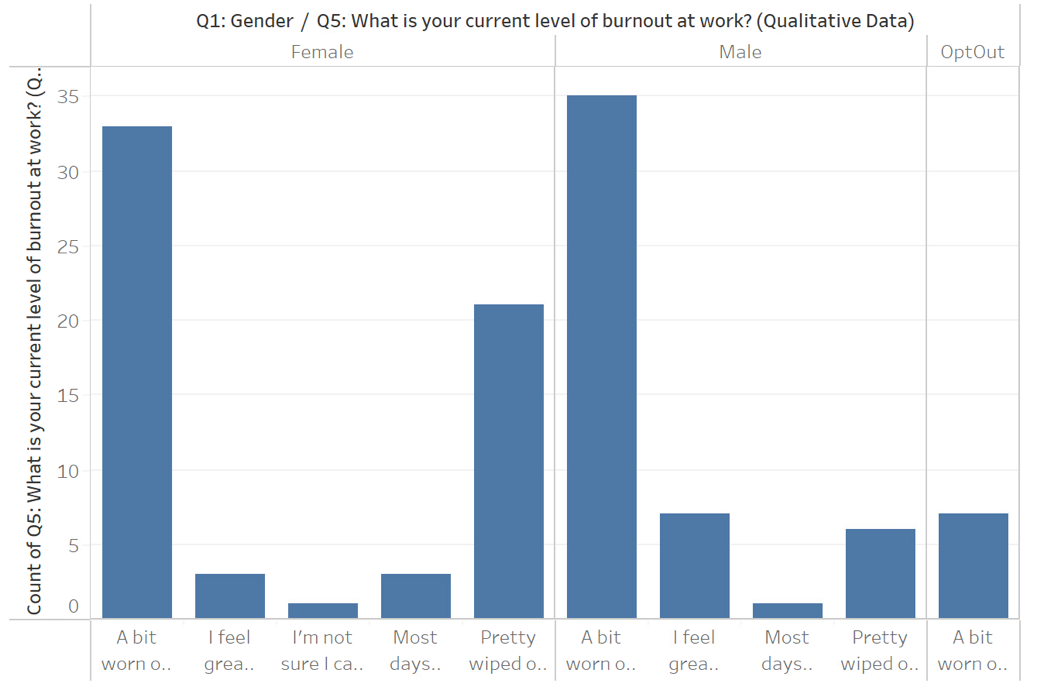
The first research interest examined the relationship between gender and perceived employee burnout. Figure 1 shows a histogram of gender burnout: at first glance, the patterns for men and women are similar, but differences are observed. In particular, more men (71%, n = 35) are tired at the end of the day, several days a week (“A bit worn out at the end of the day, several days a week”) than women (54%, n = 33).
Interestingly, however, there were no people among men in general who did not envision the next day (“I’m not sure I can make it another day”), which was the highest degree of perceived burnout. At the same time, in the sample, among those who felt great every day and were full of energy, there were more men (14%, n = 7) than women (5%, n = 3). This implies that, to a greater extent, men show various patterns, and a comparably large proportion of them appear both on the verge of burnout and with fuller energy. However, being nearly exhausted daily was more common for women (34%, n = 21) than men (12%, n = 6).
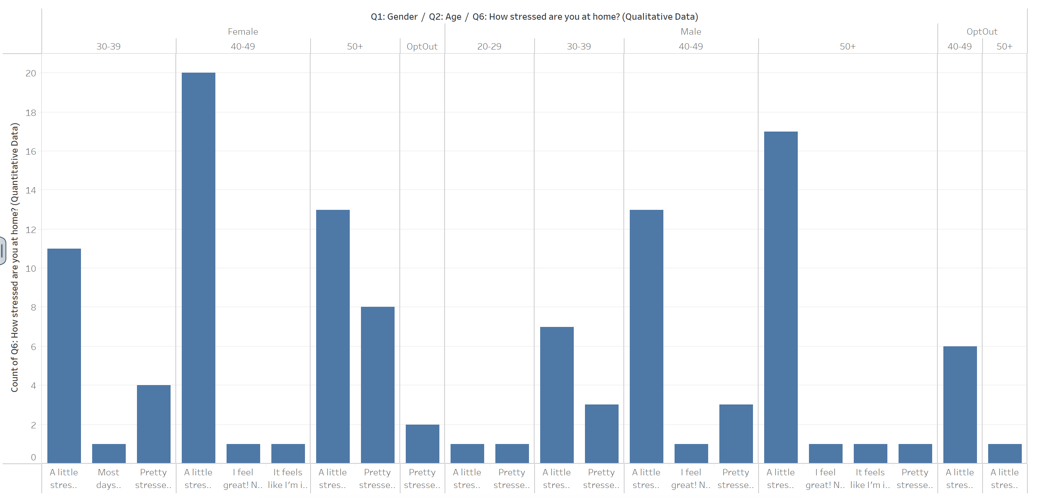
Investigating age-gendered stress levels felt by employees at home after work was also interesting. Figure 2 shows the results of analyzing each of the distributions. As can be seen from the data, males had more age groups that experienced stress: younger males reported stress as opposed to younger females. The most represented female subgroup (33%, n = 20) were employees between 40 and 49 who experienced little stress felt periodically. The most represented male subgroup (27%, n = 13) were employees of the same age who felt stress in the same way, but there were fewer of them than females in the same cohort.
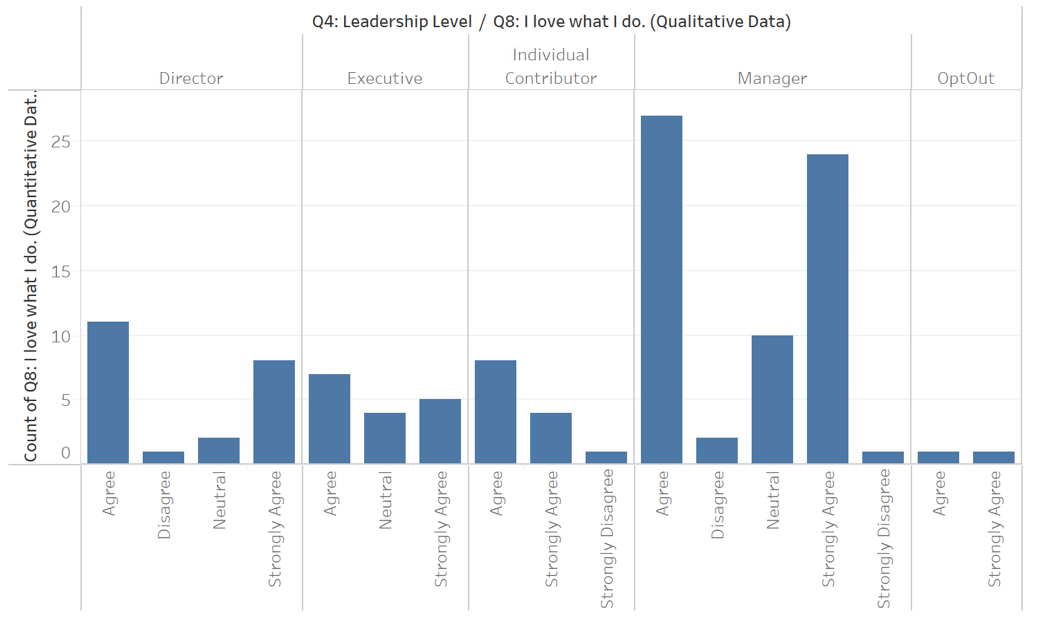
As Figure 3 shows, leaders at different power levels had differential perceptions of likability for their performance. Overall, more leaders always “agree” that they liked doing their work than “strongly agree.” This may indicate that some barriers prevent complete agreement and love of the activity. Of all leadership roles, employee managers (38%, n = 24) were likelier to indicate that they “strongly agree” that they love what they do. However, directors (36%, n = 8) were also close to the leadership level in this response.
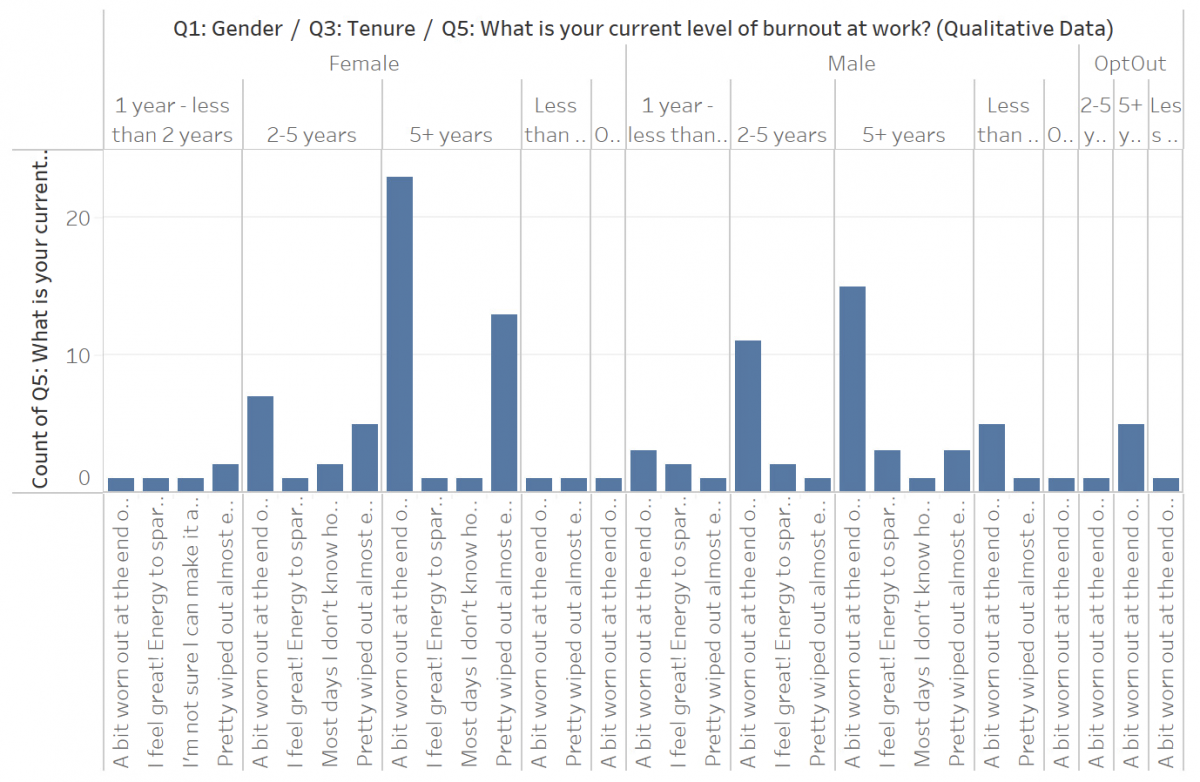
The study of the distributions of professional burnout of employees depending on their gender and work experience was of interest. Figure 4 shows the results plotted on a single histogram. As can be seen, of all employees who have worked for more than five years and feel great every day (n = 4), there were fewer women (25%, n = 1) than men (75% n = 3).
Recommendations
The results of the conducted statistical analysis showed findings that should be evaluated in terms of practical value. It was found that women are more likely than men to feel exhausted and worn out every day. It was also shown that fewer more experienced women in the sample felt significant than men with the same characteristics. It may follow that additional professional help from an organizational psychologist is needed for women, who are generally more vulnerable to burnout (Oswald et al., 2020).
At the same time, it has been shown that men between 40 and 49 systematically experience stress, which they perceive as life’s periodic ups and downs. To remedy this, training for employees of all genders and ages on dealing with stress is recommended, which includes meditation and mindfulness practices (Heath et al., 2020).
Interestingly, managers and directors were more likely to love their jobs fully, while leaders in other positions had barriers to this feeling. In other words, a more detailed examination of the work practices of the leaders in each cohort is recommended to identify and address the barriers. Thus, two critical areas for focus in the company are providing professional and focused psychological support and stress management training.
References
CD. (n.d.). Exhaustion. Cambridge Dictionary. Web.
Gabriel, K. P., & Aguinis, H. (2022). How to prevent and combat employee burnout and create healthier workplaces during crises and beyond. Business Horizons, 65(2), 183-192. Web.
Heath, C., Sommerfield, A., & von Ungern‐Sternberg, B. S. (2020). Resilience strategies to manage psychological distress among healthcare workers during the COVID‐19 pandemic: A narrative review. Anaesthesia, 75(10), 1364-1371. Web.
Oswald, F. L., Behrend, T. S., Putka, D. J., & Sinar, E. (2020). Big data in industrial-organizational psychology and human resource management: Forward progress for organizational research and practice. Annual Review of Organizational Psychology and Organizational Behavior, 7, 505-533. Web.
Shahid, N., Rappon, T., & Berta, W. (2019). Applications of artificial neural networks in health care organizational decision-making: A scoping review. PloS One, 14(2), 1-22. Web.