
Introduction
The application of environmental science has grown in popularity in recent years and is linked to the notion of green buildings. According to environmental science, buildings must preserve and use energy sustainably. Commercial building energy regulations govern the energy efficiency of non-residential buildings.
In the United Kingdom, a significant proportion of energy codes are based on either 1) the 90.1 energy standard, published by ASHRAE and the Illuminating Engineering Society, or 2) the International Energy Conservation Code (IECC), published by the International Code Council, both of which are revised every three years (Vierra, 2022). Some European countries, such as Finland, create their own codes. This research aims to look into the various challenges and opportunities associated with environmental science in building design.
Impact of Environmental Science on the Design of a Building With Respect To Human Comfort
Environmental science is used in building design and construction to guarantee that human safety and comfort are never compromised. Safety implies that dwellings might be made comfortable or secure by using environmental science in building concepts. In order to provide enough light in the rooms and reduce heat loss from the inside, ventilation systems and windows are built to let in as much sunshine as possible.
The UK Department of Buildings and Safety advises that walls should have an R-21 value, insulated doors an R-10 value, and ceilings an R-38 value (Vierra, 2022). A higher value indicates less heat flow when measuring the resistance to heat flow using the R factor. As a result, employing environmental science increases human comfort and security rather than compromising it.
Factors Affecting Indoor Environment within Buildings for Human Comfort
Before designing and constructing a building, a few environmental factors must be considered. These factors include the availability of a grade that allows water to drain naturally rather than artificially and the accessibility of enough surface area for solar heating. The other factors also include the renovation of existing structures to lessen their environmental impact and the use of materials that do not use excessive natural resources in their manufacture (McMullan, 2018). Other requirements include using materials for roofs that do not hold water and dry themselves out.
Energy-efficient windows often eliminate the need for bulky, expensively insulated windows. Energy loss is decreased by ensuring a 35–40% passive solar heating rate and the lowest A/C penalty (Vierra, 2022). It is crucial to optimize the quantity of natural light that enters the rooms by strategically placing windows, skylights, and glass doors in the space.
Any ducts for forced air should be installed within the conditioned chambers, and they should be sealed using a material such as mastic. Airflow is enhanced in bigger rooms by adding ceiling fans, and solar water heating systems and heat recovery facilities decrease electricity consumption. The aspects affecting thermal comfort are shown below.
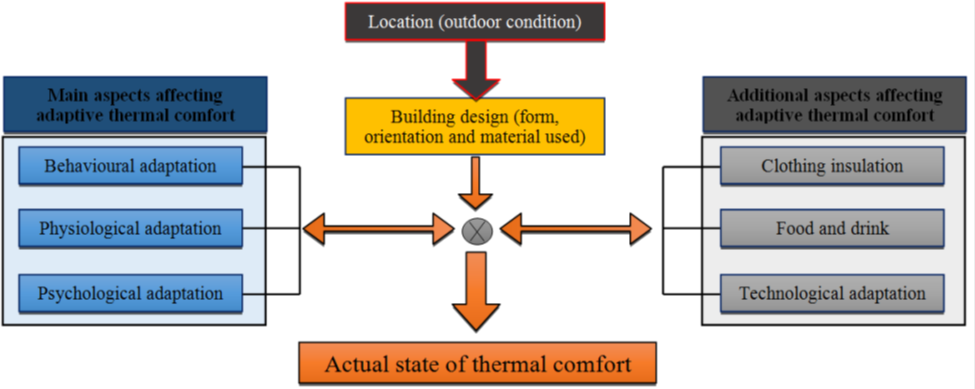
Figure 1 illustrates both the primary and additional factors affecting adaptive thermal comforts. The main category includes behavioral, physiological, and psychological adaptations. On the contrary, such aspects as clothing, food, drinks, and technological adoptions exist under additional factors. Notably, the requirements of the heat assessment body mandate that the building design combines with the heating system to create a regulated thermal control unit in structures.
Selecting Materials for Environmental Compliance
In order to develop an ecologically friendly structure, construction materials are crucial. The material must be safe in addition to being stiff enough to support the weight of the structure. It is possible to utilize products made from agricultural and recyclable garbage rescued. Use drywall clips that eliminate corner studs, engineered stair stringers for lumber waste reduction, fiber-cement siding, slate shingles, fiberglass windows, and waste pipes made of vitrified clay are some products that reduce material waste. Moreover, non-VOC compounds and quickly renewable materials, including cotton, natural paints, jute, and coir, are used for compliance purposes.
Performance Specification in Relation to Building Codes
The UK government has established statutory building requirements, which builders must follow for their work to be certified as safe and ecologically acceptable. In the UK, the government mandated the rating of codes as a requirement for all new construction beginning on May 1, 2008 (Kapoor et al., 2021). The code is used to rate a building’s sustainability on a scale of 1 to 6 stars by comparing it to other categories. Specific minimal criteria must be met for elements like water and energy usage, as well as the influence of dwellings on the environment. The following table provides a few examples of specifications.
Table 1: Examples of specifications in relation to building codes
The code regulates not just the structures but also the R-factor-designated residential appliances that are in use.
Fundamentals, Codes, and Regulation Analysis
Heat
Significant alterations to thermal components (walls, roofs, or floors) often need building regulations permission, and the thermal insulation of the element must be improved to an appropriate level. 2010 Building Regulations Section 2.3.3 specifies walls as thermal components (Designing Buildings, 2022b). The environment in which the building is constructed has a significant impact on the thermal and ventilation design. McMullan (2018) suggested that the best temperature for indoor thermal comfort is 25.6°C (Celsius in the Northern temperate zone) based on the code ISO-7730. Thermals should be aimed at preventing interior heat from radiating out in cold, snowy areas (Designing Buildings., 2022). Therefore, the drywall must be put on the roof and walls to create an air column and keep heat from escaping.
Doors, windows, and vents should all have enough insulation and be heat-efficient. These systems should ideally allow air circulation in humid environments so that hot air from below can rise to the top and move out, carrying condensation. Depending on the type of dwelling, buildings typically need 5–10 cfm of fresh air ventilation per person, as indicated in the code ISO-7730 (Designing Buildings., 2022a). Building fresh air ventilation, a crucial component of indoor air quality must meet accepted building codes and standards for quantity, design, and testing. This level of moisture puts the community at risk for serious growth of water mold, which can be expensive to remove.
Light
Lighting systems must comply with the rigid and obligatory code of standards IECC 2018 and ASHRAE/IES 90.1-2016. It is necessary to have a wide variety of lighting controls, all of which must be effectively verified and documented (Vierra, 2022). The design power cannot exceed the limits, and the owner must get all lighting and control system-related documentation. When developing ecologically friendly structures, light is a crucial component. Large glass windows with glazing and fully operable doors provide light inside. Utilizing a skylight also allows for the entry of natural light. It is necessary to strike a balance between allowing light and reducing heat loss since these characteristics enhance heat loss.
The most pervasive theme is the need to turn off or lower illumination when it is not necessary. Many rooms need occupancy sensors, and daylight areas, sometimes even secondary ones, need their management. The standard commissioning criteria include functional testing and documentation (Dong et al., 2021). These standards encourage the installation of a more robust control system as a way to increase the amount of power that can be used for interior lighting or to make the building more efficient.
Sound
The study of sound’s generation, manipulation, propagation, reception, and impact is the domain of the scientific discipline known as acoustics. Only in public halls, conference rooms, and theatres do acoustics come into play; this is a separate area of architectural design. The British Code 4142: 2014, the method for assessing industrial noise impacting mixed residential and industrial areas, is primarily used to estimate the risk that nearby households may face if a new industrial noise emitter is installed (McMullan, 2018). As such, building acoustics is an important topic because it affects both the comfort of occupants and the quality of the interior environment. The Integrated Pollution Prevention and Control (IPPC) regulation mandates that all industrial activities in specific sectors do noise evaluations and attempt to decrease noise pollution (Chudley et al., 2019).
In this case, the surroundings will always have sound sources, so using new information about noise management in buildings is critical. The most common unit of measurement for ambient noise is the decibel (A). Reverberation time (RT) is the time needed for a sound source to stop producing sound in space across a specific dynamic range, often considered 60 dB (Dong et al., 2021). The Sabine formula connects the RT to the room’s characteristics.
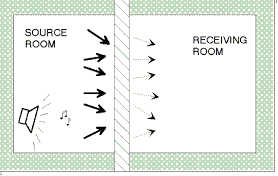
From the figure above (see Figure 2), the thick material enhances the floor’s mass and resistance to sound transmission. Therefore, in the decoupling of sound control, a break in framing or a robust drywall connection interrupts the sound wave’s path of vibration, forcing it to stop. In essence, the size, form, and materials used in constructing the enclosure and the room are fundamental variables influencing a room’s reverberation time. This reverberation time is affected by everything inside the enclosure, including people and their things.
Moisture and Airflow
Most nations’ building standards specify requirements by mandating a minimum amount of external air flow through a structure. According to the code ISO-7730, humidity or moisture is defined as the absolute water content represented as water vapor pressure in the air, affecting a person’s evaporative heat loss (McMullan, 2018). The regulatory standards for ventilation flow rates in residential buildings are typically based on a building’s humidity balance.
All the humidity produced inside the building must be retrieved by ventilation to prevent further damage to the construction from rot or mold, as well as to avoid the health risk that results from the formation of such mold. According to Chudley et al. (2019), the code ISO-7730 has highlighted the acceptable humidity range. At moderate temperatures (26°C and above) and moderate activity (about two meters), excessive or even mild humidity might cause discomfort for inhabitants.
In addition, ISO-7730 has added heat sensation, moisture, skin dryness, and eye discomfort to the factors that impact human sweating. Regarding the upper limit of indoor airflow, the regulation under standard ASHRAE 44 states that the relationship between airflow and enhanced comfort has yet to be demonstrated (Ching, 2014). Building codes often require a ventilation rate of 0.5 ACH or less for homes (Elnaklah, Walker, and Natarajan, 2021). The code is also applied to other regulations concerning airflow and construction building services.
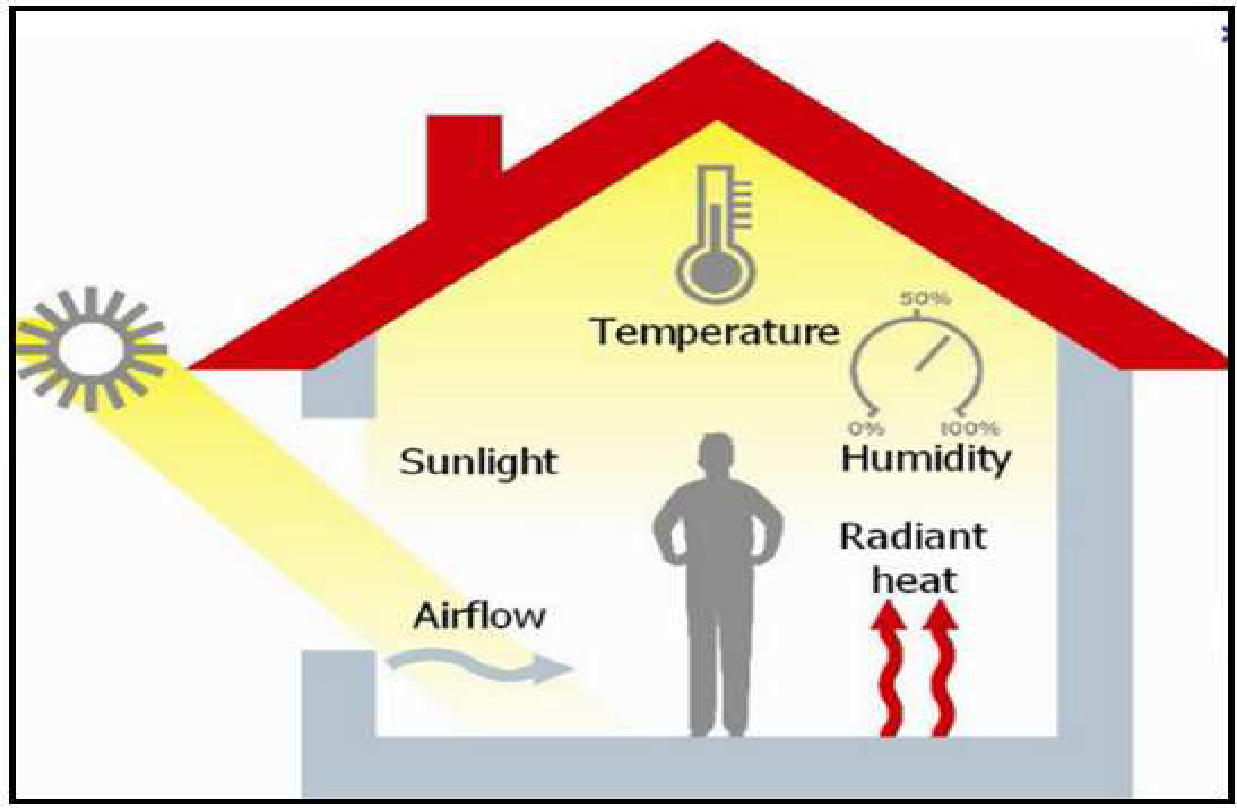
From the diagram above (see Figure 3), the human body attempts to maintain a comfortable environment via physiological processes by allowing airflow within the indoor environment, a window for direct sunlight, and regulated room temperature. Radiant heat is also delivered, which modifies the moisture content of the room, thus resulting in the human being adjusting by perspiration and shivering. Therefore, the regulation requires that all aspects are met before a building should be occupied.
Conclusion
In conclusion, the research analysis explored significant parts of green building and ecologically sustainable building design, and it has investigated many aspects of how environmental science might influence building design. Regulations and legislation, as well as other features and building materials, have also been covered. The primary objective of building codes is to set minimum requirements for protecting the public’s health, safety, and general welfare regarding the construction and habitation of buildings and structures. Model building codes offer safety from tragedies brought on by fire, structural failure, and general wear and tear. These regulations mention the requirements for all facets of building and non-building structural construction.
Reference List
Ching, F. (2014). Building construction illustrated. 5th edn. New York, N.Y: John Wiley & Sons.
Chudley, R., Greeno, R. and Kovac, K. (2019). Chudley and Greeno’s building construction handbook. 12th edn. Landon: Routledge.
Designing Buildings. (2022a) Building codes. Web.
Designing Buildings. (2022b) Building regulations. Web.
Dong, X. et al. (2021) ‘Effect of thermal, acoustic, and lighting environment in underground space on human comfort and work efficiency: a review,’ Science of The Total Environment, 786(1), p. 147537. Web.
Elnaklah, R., Walker, I. and Natarajan, S. (2021) ‘Moving to a green building: Indoor environment quality, thermal comfort and health,’ Building and Environment, 191(1), p. 107592. Web.
Guo, W. and Qian, K. (eds.) (2022) Proceedings of the 2022 International Conference on Green Building, Civil Engineering and Smart City. New York, NY: Springer.
Kapoor, N. R. et al. (2021) ‘A systematic review on indoor environmental quality in naturally ventilated school classrooms: a way forward,’ Advances in Civil Engineering, 1(1), pp. 1-19. Web.
Khan, M. A. et al. (n.d.) Noise control in residential buildings. Web.
McMullan, R. (2018). Environmental science in building. 8th edn. New York, N.Y: Springer.
Pelsmakers, S. (2019). The environmental design pocketbook. London: RIBA Publishing
Vierra, S. (2022) Green Building Standards and Certification Systems. Web.