
Interpretation of the Curve
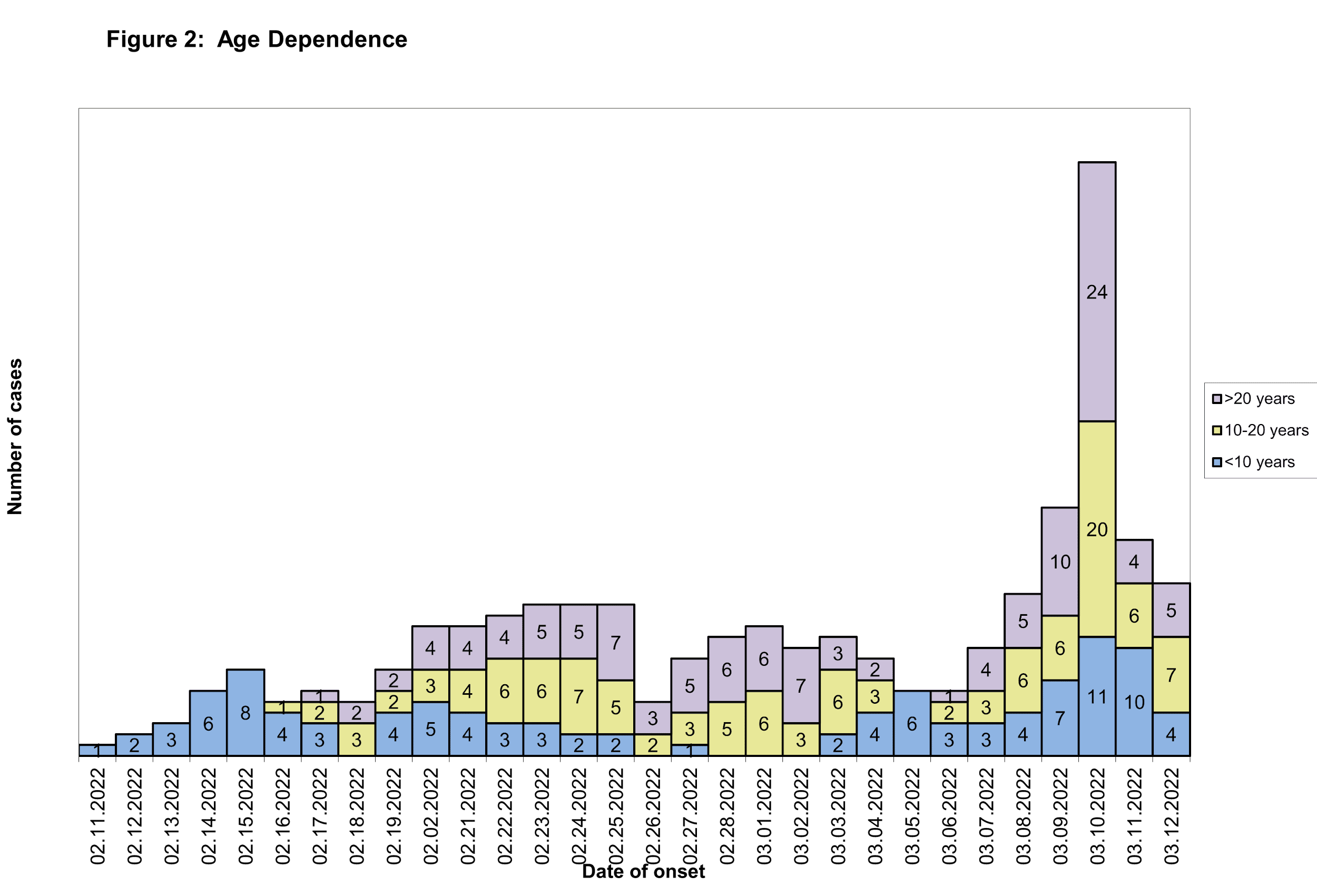
An epidemiological curve is a statistical diagram used in epidemiology to visualize the number of disease cases at a disease onset date and monitor the progress of an outbreak. Thanks to the epigram, it is also possible to consider the incidence process, which refers to the number of recent cases of a particular disease that develop in people over a specific period. Hand, foot, and mouth diseases are known to be common in children aged 5 years and younger (Centers for Disease Control, 2021). However, regardless of age, anyone can contract this highly contagious virus through contact with children. Figures 1 and 2 present an epigram of the Hand, Foot, and Mouth Disease, or HFMD, reported cases in February and March 2022.
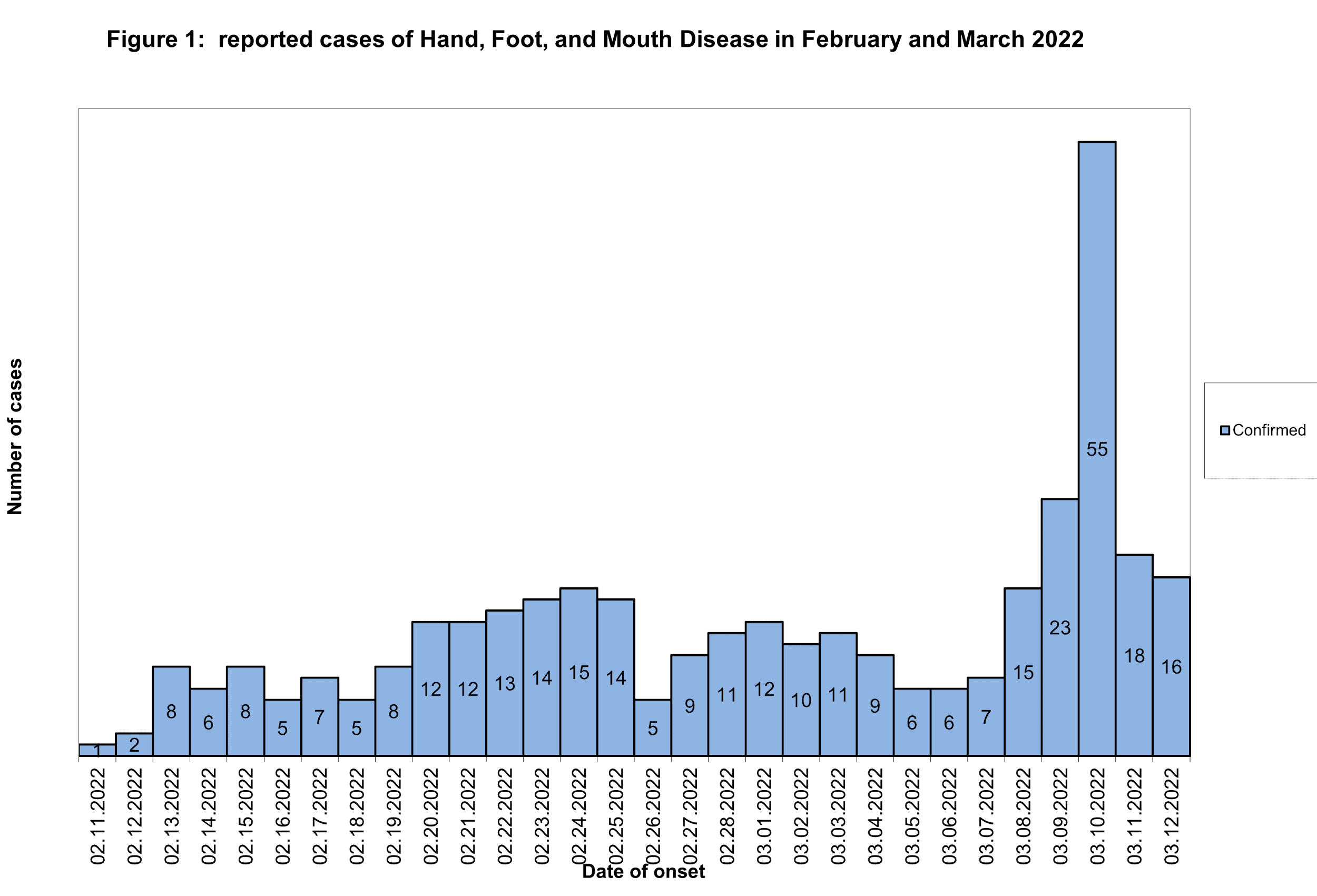
According to the epigram built based on the data, the occurrence of HFMD increased in the presented period. In terms of age, partial ups and downs can be observed among young children (under 10 years of age), relatively linear incidence development among adolescents, and a sharp incidence among adults. Based on the data obtained, which is visible in the graphs, the increase in cases begins with the transmission of the disease by children, from whom older people become infected.
These viruses are relatively widespread among the population, but more often affect children under 5 years of age. The disease is more common during the spring-autumn period, and there is sometimes a seasonal increase in incidence upon the return of children from holiday resorts. Airborne droplets transmit the infection, utilizing a fecal-oral transmission mechanism (National Library of Medicine, 2022). In addition to sneezing and coughing, transmission factors include toys, utensils, and household items.
Identification of the Incubation Period
According to the characteristic clinical picture, the disease is called hand-foot-mouth syndrome (or enteroviral vesicular stomatitis with exanthema) and is a symptom complex. It consists of lesions of the oral mucosa – enanthema, and a rash on the upper and lower extremities – exanthema (Nixon & Ting, 2021). It is an acute infectious disease caused by RNA-containing viruses of the picornavirus family: Coxsackie viruses A16, A5, A10, A9, B1, B3, and enterovirus 71 (Fletcher, 2022). The same symptoms manifest during the incubation period of viral stomatitis in children and adults, and last approximately 5-10 days (HFMD).
As seen in the epigram, the outbreak occurs on the 10th day after infection and two weeks later. Viruses of this family are pretty stable in the external environment – they can remain viable at room temperature for up to 2 weeks (Xu et al., 2019). Everything will depend on the individual characteristics of the body and the immunity of the patient, who is contagious from the moment the virus is introduced during the entire illness, so there may be an increase in the incidence.
Hand, foot, and mouth disease is a contagious viral disease most common in infants and young children. However, adults can also develop the disease if exposed to the virus. Hand, foot, and mouth disease can cause the same symptoms in adults as in children. The infection is more often asymptomatic in adults than in children, but may not manifest similarly (Hand, Foot, and Mouth Disease in Adults 2022).
Based on the analysis of the epigram, the carriers of the infection are children who are the first to become infected with the virus and subsequently infect the adults around them. Typically, adolescents between the ages of 10 and 20 experience symptoms of HFMD about a week later (on days 6-7), when the incubation period passes after the first recorded case in children under 10 years of age.
Procedure for the Investigation of Hand, Foot, Mouth Disease
The first step in the research is to define whether the reported cases are unusual and can be identified as an outbreak. Baseline surveillance data is a valuable resource for making this decision. The next step is to characterize the extent of individual clinical signs and symptoms and collect epidemiological information on people, locations, and periods of spread (Gozzi et al., 2020).
Information about possible cases should be organized as a linear list and summarized by time, person, and place. If the outbreak’s source is obvious and still poses a possible threat to public health, proper control actions should be taken as soon as possible. For example, the public should be informed about the spread of the disease and introduced to isolation and quarantine of the sick, if necessary.
Any disease outbreak, including seasonal spikes in HFMD incidence, goes through the standard stages: from detection to decline. In the first stage, when the curve is flat, and the spread of the disease occurs only among one age group, the situation is easy to underestimate. At the stage of accelerating growth, the scale of the incidence, on the contrary, is easy to overestimate if one does not know about the epidemiological curve. However, as can also be seen in graphs 1 and 2, having reached a peak, the spread of the disease is declining, and the main task of physicians is to prevent high peak values.
References
Centers for Disease Control and Prevention. (2021). Hand, foot, and mouth disease. CDC.
Fletcher, J. (2022, June 29). Hand, foot, and mouth disease in adults: Symptoms and treatment. Medical News Today.
Gozzi, N., Perrotta, D., Paolotti, D., & Perra, N. (2020). Towards a data-driven characterization of behavioral changes induced by the seasonal flu. PLOS Computational Biology, 16(5).
Hand, Foot, and Mouth Disease in Adults. Pennmedicine. (2022).
HFMD. NHS. (n.d.).
National Library of Medicine. (2022, May 10). Hand foot and mouth disease. NCBI.
Nixon, R., & Ting, S. (2021). Clinical features of viral exanthems. Australian Journal of General Practice, 50(4), 231–236.
Xu, Z., Hu, W., Jiao, K., Ren, C., Jiang, B., & Ma, W. (2019). The effect of temperature on childhood hand, foot and mouth disease in Guangdong Province, China, 2010–2013: A Multicity Study. BMC Infectious Diseases, 19(1).