
Introduction
This laboratory work investigated the balance of forces leading to a state of equilibrium. In particular, in the course of the experiment, pulleys were placed on the Force Table, which was weighted with weights of different masses. Under the action of gravity, the pulleys’ center of gravity shifted regularly until it reached the equilibrium state.
It is noteworthy that the study of the superposition of forces is possible with the help of coordinate algebra containing the rules of addition and subtraction of vectors. Thus, an equilibrium state in algebra meant that the vector sum of forces would be equal to zero; otherwise, the equilibrium was not reached. The purpose of this paper was to use the Force Table to examine the vector sum of forces in more detail in several trials.
Data and Analysis
The tables below show the results of direct measurements of the angles and weights of weights in each of the three tests, which allowed visual equilibrium to be achieved on the Force Table; the equilibrium forces were determined by placing the central intersection between the strands at the center of the Force Table.
Table 1: Results of direct measurements in each of the three tests
In the coordinates, “Mass vs. Angle” vector diagrams were plotted for each of the measurements, as shown in Figure 1. A protractor was used to create the diagrams, which means that it can be stated that all angles were measured correctly and in compliance with the coordinate grid. A pixel grid was used as the length of each vector (absolute value), which also indicates that the length of each of the arrows in the figure below is correct. In addition, Figure 1 contains free-body diagrams showing the direction of the force vectors for each Force Table in each of the three tests.
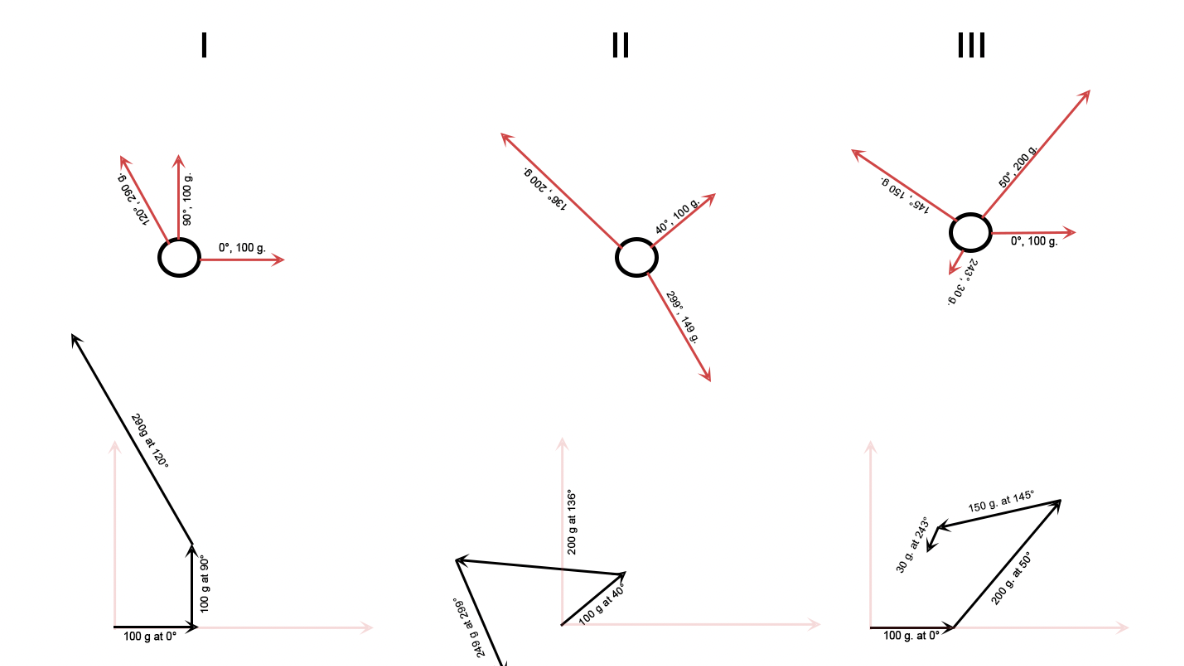
For the obtained vectors, it is possible to rewrite them as corresponding coordinates in the system (length, angle), in which the horizontal axis defines the mass, and the vertical axis defines the degrees of the angle. For the reliability of vector coordinate measurement, each of the vectors in the vector diagram was placed in the vector diagram and measured in isolation, allowing the signs in front of the coordinates to be determined without interruption. Table 2 below contains information about the coordinate pairing for each of the vectors used in the three tests.
Table 2: Coordinate pair for each vector in each of the three tests
For the obtained coordinates, it becomes possible to calculate the vector sum based on the rules of coordinate addition. If the system was in equilibrium, the resulting vector sum would be zero; on the contrary, the resulting vector would not be zero for a non-equilibrium system (CueMath, 2021):
First test:
- Fresult=(100+0-145,0+100+255)=(-45,355)
Second test:
- Fresult=(78-200+62,65+20-140)=(-60,-55)
Third test:
- Fresult=(100+130-147-14,0+154-33-31)=(69,90)
As one can see, none of the result vectors for the three tests was zero. Theoretically, neither system approached proper equilibrium, which means that the balance of forces was imaginary. It is noteworthy that measurement uncertainty may have played a role since uncertainty corresponds to the presence of errors and systematic errors in measurements and, consequently, calculations. In other words, the higher the measurement uncertainty, the more likely the final result was less accurate.
Conclusion
In the present work, the principle of equilibrium of forces realized through their superposition on the Force Table was evaluated. The rule of coordinate addition of vectors was used to determine the truth of equilibrium: if the equilibrium was reached, the resulting vector was supposed to be zero. However, the work showed that for all three measurements, the resulting vector was always far from zero. It follows that the real equilibrium between the forces was not reached.
Reference
CueMath. (2021). Zero vector (null vector). CueMath. Web.