
Introduction
Since the beginning, nurses have helped people and communities achieve the best possible health outcomes. Nurses with advanced degrees are given increasingly greater responsibilities in the current fight to reduce health inequities. Nurses must pay close attention to social determinants of health (SDOH) to recognize and address conditions that affect a person’s health and well-being. This includes conditions in areas where people live, work, learn, and engage in leisure activities.
One of the five critical areas identified by the Centers for Disease Control and Prevention (CDC), education, is one of the critical issues related to SDOH that will be examined in this photo essay (Office of the Assistant Secretary for Health [OASH], 2023). It will cover the strategies and duties of advanced degree-holding nurses in addressing this health inequity and the effects of this critical issue on both individual and community health.
Definition and Examples
Healthy People 2030 defines SDOH as the conditions in which people live, learn, work, and play that affect various health risks and outcomes. This definition encompasses five key areas: neighborhood and built environment, health and healthcare, social and community context, and economic stability, each of which presents several pressing issues (OASH, 2023).
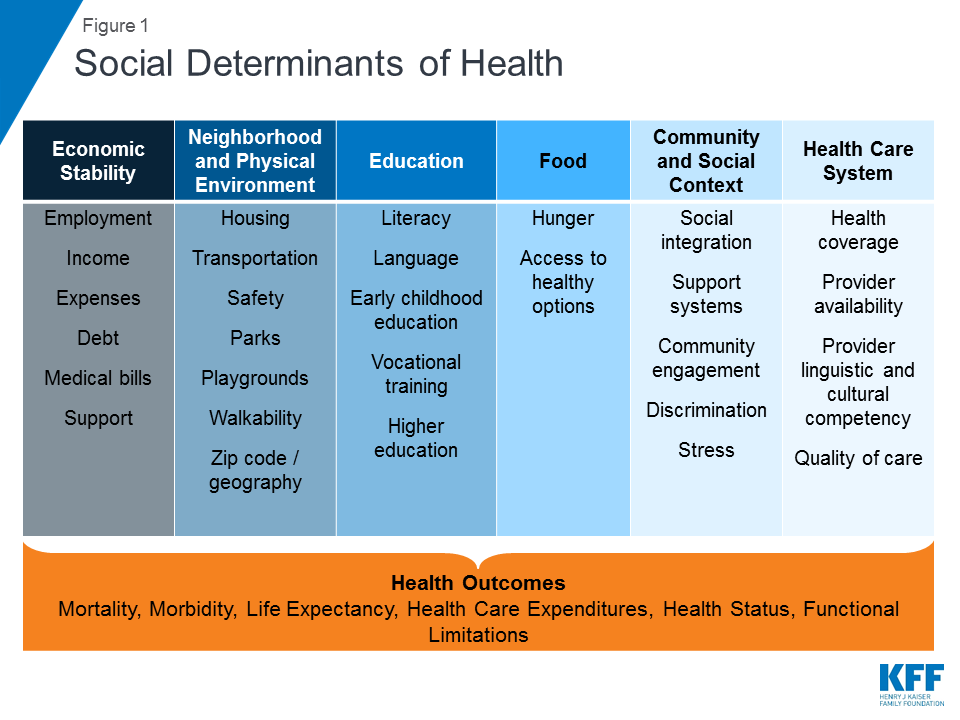
Education is essential to an individual’s and a community’s health. For instance, students from higher-income families graduate from high school at a rate of 75%, compared to 35.4% for those from lower-income families (Kwon et al., 2023). This is because children from higher-income families have better access to education than those from lower-income families (Singh et al., 2017). Budget cuts in education, increased class sizes, and the closure of public schools have exacerbated this disparity. The social determinants of health, along with their primary challenges, are illustrated in Figure 1.
Impact on Personal Health
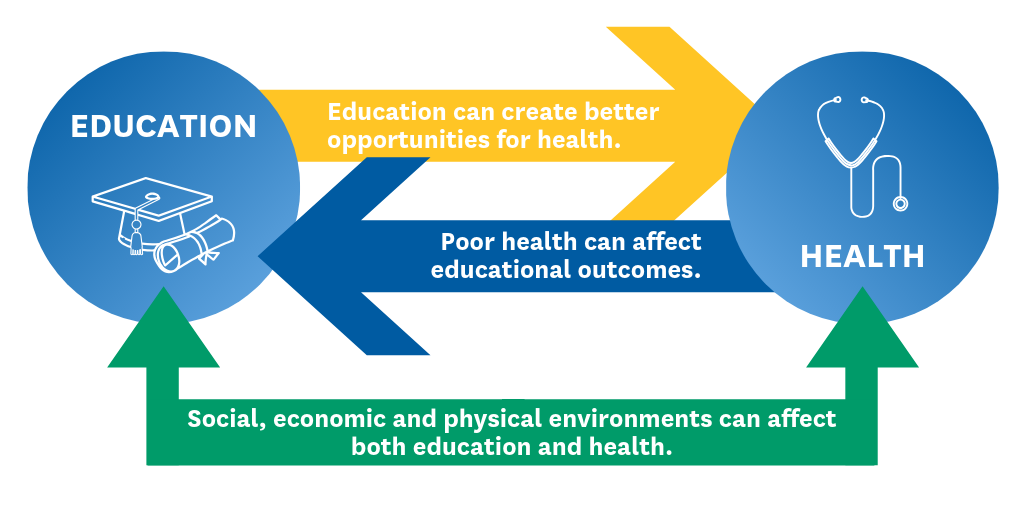
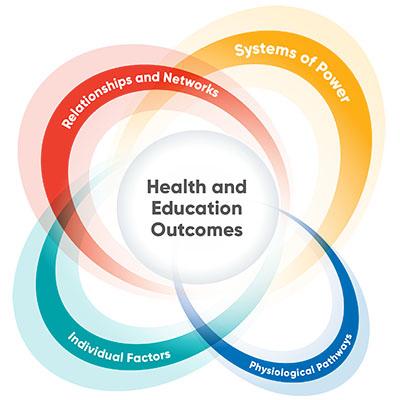
The lack of access to high-quality education has a direct impact on the personal health of individuals. Lack of access to high-quality education limits job opportunities, resulting in poverty and poor health, as illustrated in Figures 2 and 3. People without access to quality education are more likely to experience various health problems. These include behavioral problems and mental health conditions such as depression, anxiety, and substance abuse (OASH, 2023). Furthermore, they are more likely to suffer from physical health issues, which include obesity, diabetes, and heart disease. Poor educational outcomes can cause physical and mental health issues throughout a person’s life.
Impact on Community Health
Additionally, education has a direct impact on the health and prosperity of a community. In places with strong educational systems, better public health outcomes are more prevalent, including lower smoking and obesity rates, greater access to wholesome foods and healthcare services, and longer life expectancies (CDC, 2022). In contrast, places with weaker educational systems experience the opposite. For instance, low-income areas may lack access to resources such as wholesome foods and medical care, which could result in higher rates of obesity, smoking, and other health problems (CDC, 2022). Poor educational opportunities can also strain these communities and increase crime, violence, and drug abuse.
Inequalities and Disparities
The fact that some populations are more frequently and more severely affected by a lack of access to high-quality education only exacerbates educational inequality. For example, compared to non-minority populations, minority and immigrant populations typically have lower rates of educational attainment (CDC, 2022). As a result, these populations may have a higher chance of poverty and health inequalities. These populations may therefore be more likely to experience poverty and health disparities. Figure 4 illustrates how inequality has led to differences in educational attainment.

APRN Role and Responsibilities
Given the circumstances, advanced practice nurses are responsible for utilizing their knowledge and skills to help resolve the issue. Nurses have a special and significant role in addressing health inequities associated with SDOH (Hickey et al., 2023). Nurses can better understand and address the social determinants of health in their communities due to their unique position. They can work to make health education more widely available, encourage healthy behaviors, and advocate for laws that promote good health.
Advanced-degree nurses are especially well-suited to take the initiative in addressing health disparities and inequalities. They have the knowledge, abilities, and training to identify, diagnose, and effectively treat complex health disparities and their underlying causes (Hickey et al., 2023). They are skilled at integrating evidence-based practices into healthcare and can use this knowledge to create and implement educational initiatives and public health policies.
APRN Strategies
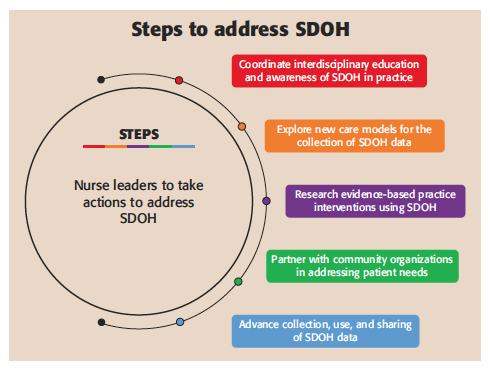
Advanced-degree nurses can address health disparities linked to SDOH by using various strategies and tools. One of the most effective strategies is to support policies that promote and facilitate healthy behaviors, as well as those that enhance access to high-quality education and healthcare services (Phillips et al., 2020). As illustrated in Figure 5, this could imply advocating for increased funding for institutions and initiatives that assist at-risk populations and provide health education to these groups. Inequities caused by social determinants of health can also be identified and addressed by nurses. To combat poverty and better match educational resources with the needs of vulnerable populations, collaboration with neighborhood partners may be necessary.
U-Mary Mission, Vision & Values/Graduate Nursing Competencies
The mission and vision of the University of Mary are to provide an excellent education in a community of shared Christian values and to establish the world’s best Catholic university. They work to prepare nurses who are compassionate, skilled, Christian-centered, global healthcare leaders whose principles have been shaped and informed by the past, present, and future (University of Mary, n.d.). Their graduate nursing competencies are founded on this mission.
The graduate nursing program’s core competency is “Transform Care and Influence Systems to Improve Population Health.” This competency acknowledges that global health promotion knowledge, community-based and healthcare system-level interventions, health outcomes-impact initiatives, and policy change measures have a far-reaching effect on the population’s health (University of Mary, n.d.). Nurses aware of the social and environmental determinants of health that contribute to health disparities are being trained at the University of Mary. They can initiate discussions about the social and environmental determinants of health, utilizing their knowledge and strategies supported by evidence at the federal, state, and local levels.
Conclusion
To reduce health inequities, nurses with advanced degrees should prioritize addressing the social determinants of health as a key factor in their practice. One such crucial area that can negatively affect an individual’s health and community health is education. However, nurses with advanced degrees are well-positioned to advocate for health-promoting policies that can significantly impact the health of populations and improve access to high-quality healthcare and education. Nurses can play a crucial role in ensuring that everyone has the chance to lead happy and healthy lives by taking a multifaceted approach to tackling this complex and vital issue.
References
CDC. (2022). Social determinants of health.
Csapat, D. Y. B. (2020). Education & Inequality.
Europe, S. F. C. (2020). What are the everyday roles and responsibilities of a nurse? Shoes for crews Europe.
Gerson, J. (2021). Understanding social determinants of health: Coding WHO policy papers for central themes. MAXQDA.
Hickey, M. T., Stillo, M., & Marquez, C. (2023). An interprofessional clinical experience to address social determinants of health. Journal of the American Association of Nurse Practitioners, 10-1097.
Kwon, J., Han, E.-J., & Kim, H. K. (2023). An analysis of the effects of the income level of the family caregivers for the recipients in long-term care facilities on the willingness to pay for use of better services: A cross-sectional study. Journal of Korean Gerontological Nursing, 25(2), 103–115.
OASH. (2023). Social determinants of health.
Peterson, A. (2019). Educational equity is health equity. ETR Blog.
Phillips, J., Richard, A., Mayer, K. M., Shilkaitis, M., Fogg, L. F., & Vondracek, H. (2020). Integrating the social determinants of health into nursing practice: Nurses’ perspectives. Journal of Nursing Scholarship, 52(5), 497–505.
Quynh, L. V. (2023). What does education have to do with health? Colorado Consumer Health Initiative.
Singh, G. K,, Daus, G. P., Allender, M.; Ramey, C. T., Martin, E. K., Perry, C., De Los Reyes, A. A, Vedamuthu, I. P. (2017). Social determinants of health in the Unites States: Addressing major health inequality trends for the nation, 1935-2016. International Journal of Maternal and Child Health and AIDS 6(2), 139-164.
Tiase, V., Crookston, C. D., Schoenbaum, A., & Valu, M. (2022). Nurses’ role in addressing social determinants of health. Qgdigitalpublishing.
University of Mary. (n.d.). Mission & Identity | University of Mary in Bismarck, ND.