
Background
The success of any organization directly depends on its leadership. In the current competitive business environment, leaders are expected to develop a clear vision and strategic objectives that should be achieved within a given period. According to Keller and Schaninger (2019), these long-term goals should be achieved within three to five years, enabling the firm to transition from one level of success to the next. It is expected that once a Chief Executive Officer (CEO) and his board of directors develop these strategic goals, they should lead the organization in realizing them.
As the bearers of the vision developed, they understood the current state of the firm, how it should change, and how their set strategies would facilitate the needed change. They understand how different stakeholders should play distinct roles in a coordinated manner to drive change. To that end, Norenberg (2020) explains that, at a minimum, the CEO and the board of directors should be given at least five years before a change can occur at the helm of the company. Some of the most successful multinational corporations have been retaining their top leaders for over 10 years.
When the top leaders are retained for a relatively long period, they instill a sense of stability within the company. The longer an employee spends in an organization and within a specific management unit, the better they understand the problems the firm faces and how to solve them. When top management is allowed to spend more time in their managerial position, they will draw on their experience and utilize the available resources to facilitate the necessary growth.
Gallagher (2019) argues that a firm with a reputation for retaining its top managers for a relatively long time will attract some of the best talent in the industry. Every top manager would want to make a positive mark in the company they lead, ensuring they leave a lasting legacy. However, that can only happen when they are granted enough time to develop their strategic objectives and implement them fully (Academic Conferences & Publishing Inter, 2019). When it comes to replacing the top leadership, they will have the opportunity to choose from the industry’s finest leaders.
A preliminary analysis of ABC Company shows that within the last five years, it has had three CEOs and three boards of directors. It means that some of these top leaders did not last for a year in their positions. Dentico (2019) explains that such frequent changes in leadership convey a negative image to investors and other stakeholders, who may perceive that the company has lost its direction in the market.
The frequent changes demonstrate that the firm failed to take the time to vet these leaders before they ascended to power, and their inadequacies became noticeable only once they started working at the firm (Gallagher, 2019). The report also indicates that, within the same period, the company’s market share has declined in the highly competitive food industry in Saudi Arabia. It is a further confirmation that leadership is lacking at this firm. With the drop in the market share, it is expected that the firm’s share price will fall.
The rationale for this study is to explain the impact of frequent leadership change on a firm’s performance. The preliminary review of the literature conducted during the proposal development revealed that many scholars agree that frequent changes in a firm’s leadership negatively impact a company’s performance (Hussain et al., 2018). Several reasons have been cited to help explain how such changes negatively affect the firm. It is important to note that these studies do not suggest that a firm should not replace an incompetent leader. They suggest that a firm should take the time to select the right person for a position, and once selected, they should be allowed to achieve the desired goals. Through this study, the researcher will confirm these claims by collecting and analyzing data from primary sources.
Aim and Objectives
The primary aim of this study is to investigate the impact of frequent leadership change on a company’s performance. The investigation will focus on ABC Company, which has had three CEOs and three boards of directors within five years. The study will investigate whether the current decline in the firm’s market share is related to the frequent changes in leadership. It will help in diagnosing the possible causes of frequent changes in the top management unit at the selected company and how they can be minimized to help protect the market share in this competitive food and beverage industry. The following are the specific research questions the study seeks to answer to ensure study objectives are realized:
- Does a frequent change of top management have the potential of affecting strategies, objectives, the way of execution, and outcome expectations of a firm?
- What are the probable causes of frequent changes in the management unit at ABC Company?
- How can the frequency of management changes at this company be minimized?
Outline Methodology
When planning to conduct a research project, it is advisable to articulate the method that will be used to collect and process data from various sources. In this study, the researcher relied on data from primary and secondary sources. Secondary data was obtained from books and journal articles available in the school library and online databases. Primary data was obtained from a sampled population of those who understand the issue being investigated.
The data collected was analyzed using mixed-method research. Quantitative analysis enabled the understanding of the problem’s magnitude and the relationship between the variables. Qualitative data made it possible to explain the nature of the problem and possible ways of managing it.
Literature Review
Leadership and change are two concepts that have garnered the attention of scholars over the past several decades. The stability and success of any organization significantly rely on its leadership. The top management unit of any organization has the critical responsibility of setting a vision and taking various steps to ensure its realization.
It is common for a new leader to develop a new vision once they assume management of the firm. It takes several years to achieve some of these visions and missions. For an organization that constantly changes its leadership, it may be difficult to have and achieve a specific mission. When operating in a highly competitive business environment such as the food and beverage market, a firm can easily lose its market share to rivals that have a more stable management unit. In this section, the researcher reviews the work of other scholars in this field.
Understanding the Concept of Leadership
It is essential to begin by defining the concept of leadership and understanding its importance in an organization’s success. According to Pratt (2022, para. 1), leadership refers to “the ability of an individual or a group of individuals to influence and guide followers or other members of an organization.” The scholar further explains that leadership entails making sound and difficult decisions, developing a clear vision, setting achievable goals, and offering subordinates the tools and knowledge necessary to achieve the vision.
Gumus et al. (2018) agree with this argument, stating that in every organization, the leader’s vision defines the path that employees take. It may not be easy for one leader to achieve a vision set by other leaders, as they may not fully understand its significance and how it should be realized. It explains why it is common for every new leader to develop new strategic goals that should be realized within a given period while they are in office.
Leadership in an organization is as unique as the individuals holding those positions. Dentico (2019) explains that it is almost impossible for two leaders to embrace a uniquely similar leadership pattern in an organization, even if they share the same principles and vision for the organization. Hussain et al. (2018) share this opinion, stating that one manager of an organization would feel that the best approach to governance is to embrace the principles of transformational leadership. Such a manager believes that the only way to motivate workers and ensure they achieve improved performance is to challenge their current capabilities and help them enhance their skills.
A second leader would likely consider adopting some aspects of dictatorial governance. Such individuals feel that workers can only achieve the set targets when they are closely monitored at work (Gallagher, 2019). They will ensure that they develop strict policies that every employee must observe and that any failure will be punished.
A third leader may adopt Laissez-faire as the most suitable form of governance, particularly if they believe their subordinates are highly skilled and capable of achieving improved performance with minimal supervision (Henry, 2021). Such a leader would avoid any dictatorial tendencies in their governance and would create platforms that enable employees to share and discuss their views about the strategic direction of the firm. Subordinates would be made to feel that they have a significant role to play in defining the direction their firm takes.
The leadership approach an individual adopts depends on the cultural practices to which they are exposed for a long time. According to Akbar et al. (2021), dictatorial forms of governance are highly prevalent in China. Society has embraced a culture of totalitarianism, where the views of the leader are not to be challenged. Employees are not expected to contradict those who are in power.
Alqatawenh (2018) reaffirms this line of thought, stating that although the country boasts the largest labor union in the world, the All-China Federation of Trade Unions (ACFTU), it is a state-run entity. It means that it will follow the strict guidelines and regulations of the government. It is less likely to be permitted to organize industrial action against the government’s wishes. As such, Chinese executive is used to working in an environment where their views and commands are not challenged. They can develop new policies in their organization without facing any significant opposition.
The leadership environment in the United States is significantly different. Gallagher (2019) argues that in the US, democracy in the political sphere has infiltrated the business environment. Employees feel that their views and concerns should be respected when developing new policies in an organization. They believe that those in positions of power have a responsibility to consider the concerns and views of everyone.
In such an environment, a leader who seeks to implement dictatorial policies may encounter significant obstacles. These employees can easily transition from one company to another, especially those who are highly skilled and in high demand in the industry (Akbar et al., 2021). The labor unions in the country are also independent of government control and can organize industrial action capable of paralyzing a firm’s operations.
Understanding this concept makes it easier to comprehend the importance of reducing leadership changes within an organization. When a manager from these two countries is contracted to govern a firm in Saudi Arabia, each of them will likely have a sharply different approach to leadership. They will base their strategies on the skills and experience that they have gained in their respective countries.
One leader will introduce leadership principles that involve inclusiveness and an open-door policy when making critical decisions. Another leader will introduce a culture of absolute authority, where the decisions of those at the top must be respected without question. In the new country, certain cultural values and practices shape the effective leadership style. When changing the top leadership unit of a firm, these factors must be considered because they will directly impact the firm’s normal operations.
When Change Is Necessary
Change is a force that an organization cannot avoid. Gallagher (2019) explains that the dynamic business environment forces a firm to make changes in various aspects of its operations, including its governance approach. The leadership structure of a firm is one area where change may be needed. The overall focus of this study is on how frequent changes in a firm’s top leadership may negatively affect its operations.
However, it is important to note that there are cases where a change in leadership is essential to facilitate the continued growth of a firm. Henry (2021) supports this argument, stating that one of the reasons a firm may consider changing its leadership is when a leader has completed their term in office, and having a new leader is the only way to redefine the organization’s focus and prepare it for greater success.
When a visionary leader takes over, they will come up with brilliant ideas designed to facilitate the rapid growth of the firm. With the right support from all the stakeholders, such a leader would guide the firm to new heights (Yue et al., 2019). After some time, they reach a point where they have exhausted their ideas and can no longer think of new ideas that can facilitate sustainable development. At such a point, such a manager should opt to move to the board of directors and allow a new visionary leader to take over governance.
Change of leadership may also be necessary if the current one fails to meet expectations. When an organization appoints an individual to a given position of power, they are expected to achieve specific goals within a given period. Gallagher (2019) acknowledges that sometimes a board of directors fails to select the most qualified candidate for the position of CEO.
When it becomes apparent that such an individual is unable to hold such a high and critical position of power, it becomes necessary to make the change. A firm cannot hold on to an underperforming CEO primarily because there is a desire to achieve stability in that office. The problem arises only when a series of mistakes occurs in selecting the right candidate for the job, and the process has to be repeated.
Change at the helm of an organization may be caused by the demands of employees. According to Dentico (2019), the top leader of an organization is expected to guide the subordinates and the entire organization toward the path of success. However, there are cases where employees feel that a certain leader is unable to provide the needed leadership. In such cases, they must be replaced to restore employee confidence in the organization’s leadership. Employees can only trust a leader whom they know can make informed decisions and offer them the needed support and guidance to facilitate the overall success of the organization.
The expansion of a firm may necessitate the need for a new leader. According to Farahnak et al. (2020), some individuals possess unique skills that enable them to guide small firms through rapid growth, ultimately achieving great success in the market. However, when the firm reaches a certain level, it becomes unable to facilitate further growth. A firm that operates exclusively in the city of Riyadh requires a different leadership approach than one that operates throughout the entire country of Saudi Arabia or the Middle East market. It reaches a point where it becomes unavoidable for the firm to change leadership due to its rapid growth, even if the current leader is well-liked by employees.
The argument presented by these scholars strongly suggests that it is an unavoidable force. In the context of leadership, it is essential to periodically update the top management team based on various factors. Even some of the most successful CEOs have to be replaced for a firm to enjoy sustainable growth. The scholars argue that new leaders bring new ideas that can help transform a firm to the greatest levels of success. The information from the scholars also points out the fact that changes in the external environment may make it necessary to have a new leadership within a firm capable of understanding the new trends and responding to them accordingly.
Possible Causes of Frequent Change in Leadership
There are cases when a change in leadership is not only necessary but also healthy for the growth and sustainability of a firm. However, there is an unhealthy case where a firm frequently changes its leadership in a manner that affects the overall performance of the firm. Stachowicz-Stanusch and Mercurio (2019) believe that mistrust is one of the primary reasons why a firm’s leadership can be changed frequently. The board of directors should trust the CEO to implement policies discussed by the board and to utilize resources in the best interest of the firm.
Similarly, shareholders trust the board of directors to supervise the top management unit and to ensure that it works in their best interest. When shareholders lack trust in their board of directors, they are likely to vote for a change in the board at an annual general meeting or a special general meeting. Similarly, when the board of directors feels that the CEO is not meeting their expectations or is involved in the misappropriation of funds, they are likely to replace them before the expiry of their term limit.
Wrangles and competing interests at the top leadership level of a firm are another possible cause of frequent change in the management unit. Keller and Schaninger (2019) explain that when departmental heads are impatient to become the firm’s top leaders, they may use every means possible to achieve their goals. Some of them may deliberately sabotage their superiors to ensure their own ascension to power. They will find reasons to suggest that the current leadership is weak and should be replaced to ensure the firm achieves its desired levels of success. Norenberg (2020) warns that if such a culture is tolerated, every manager who becomes the CEO of the firm will face the same problem and will be forced out of office after a short period in power. The instability created by such constant changes makes it nearly impossible to set and achieve strategic goals.
A highly demanding board of directors and shareholders may be a reason for frequent change in an organization. In an organizational setting, the interests of various stakeholders may conflict (Akbar et al., 2021). Customers want the best quality products at the lowest possible price, which can harm a company’s profits. Similarly, employees would prefer high salaries and allowances without having to work for a long time within a firm. On the other hand, a firm’s top management unit is focused on maximizing the highest level of profit possible, which would require reducing employee salaries and increasing product prices as much as possible.
Similarly, the board of directors and shareholders would want a regular and large payout in the form of dividends for their investments in the firm. In the interest of the firm, most of the profits made should be reinvested to facilitate growth, rather than making huge payouts to investors. These conflicting interests require a leader who can ensure that they are effectively managed, allowing the singular goal of meeting and exceeding customers’ expectations to be achieved. When shareholders become greedy and fail to recognize the need to focus on growth, they can easily effect a change in leadership. It is also possible that the employees can force change if they feel that the management is failing to take care of their interests.
The inability of the board of directors to select the right candidate for the top managerial position in a firm can be a reason for frequent leadership changes. The position of the CEO is highly demanding (Stachowicz-Stanusch & Mercurio, 2019). One is expected not only to possess interpersonal skills but also to have the ability to understand numbers, manage conflicts, articulate their vision, and guide the entire team towards realizing it.
It is common for the board to base its decision on one’s skills with numbers and their success in the finance department. However, it may soon become apparent that they lack interpersonal skills critical for a CEO. The individual will have to be dropped because they cannot formulate a vision and lead the entire team toward realizing it. If such mistakes in appointing the top leader are frequent, then the change of these top managers will also be frequent.
The scholars identify various reasons that may force a firm to have frequent changes of leadership. The scholars explain that under normal circumstances, an organization would not desire a constant change of top managers because it creates instability. It also gives a negative image of the firm in the market. However, sometimes it may not be avoidable, especially when those who are appointed to these positions fail to meet expectations. These top leaders directly define the direction that the firm takes in the market, and if they demonstrate a lack of skills and experience needed to achieve the desired goal, then the only option may be to replace them.
The Impact of Frequent Change of Leadership
It was necessary to review the literature that explains how frequent leadership affects an organization. According to Stachowicz-Stanusch and Mercurio (2019), frequent leadership change causes instability within an organization. A leader is expected to develop a vision and then guide subordinates toward its realization.
Achieving a strategic goal takes time. When a leader’s term is terminated prematurely, it means that the path that had been developed will have to be abandoned. The employees will get a new leader who will define a new path that has to be developed. When such changes occur frequently, they cause instability within the organization.
Frequent change in leadership causes fear and tension at the highest level of the management unit. Henry (2021) explains that when a new leader ascends to power, knowing that their predecessors were dismissed after only a few months, they develop a fear that they may be the next to be forced out of office after a short while. Instead of focusing on how to enable the firm to achieve success, they will focus on how to avoid being fired.
Norenberg (2020) states that when a CEO is gripped with fear, they tend to act irrationally. They will see enemies in their subordinates instead of seeing facilitators who can enable them to achieve their goals. They will feel that one of these subordinates could be preparing to take over their positions, and as such, would make every effort to stop that from happening. It means that instead of focusing on strategic goals that would facilitate success, they will focus on how to eliminate their perceived enemies.
A drop in the performance of an individual employee is another potential impact of frequent leadership transitions within an organization. A study by Norenberg (2020) reveals that every leader has a unique approach to governance. When a firm appoints a new CEO, its employees must adapt to the new governance style and the resulting culture.
It takes time for an individual to master and conform to a new governance structure. If the change is frequent, it forces employees to go through a constant transition that is not healthy for their productivity. Instead of learning about emerging technologies and concepts relevant to their field, they will be spending time learning how to work under different leaders.
A decline in employee performance will have a direct impact on an organization’s overall performance. The preliminary study of ABC Company revealed that its market share had declined over the last five years. It is the same period that the company has been changing its CEOs and boards of directors frequently. It means that when a new set of leaders comes to power, they develop a vision and a mission that is to be realized within a period of three to five years (Stachowicz-Stanusch & Mercurio, 2019).
However, they are not allowed to achieve these goals. They are forced out of office prematurely, which means that another new set of leaders must come in and start the process once again. The focus shifts from understanding the unique needs of customers and meeting them in the best way possible to understanding how new leaders should be created at the firm.
Employee rebellion is another potential consequence of frequent leadership changes within an organization. Employees are often the most directly affected group in the event of a leadership change. Henry (2021) argues that whenever a new leader ascends to power, they often believe that the previous regime failed, and part of the failure was attributed to the poor performance of employees.
As such, they are likely to be tough on their subordinates, believing that doing so is the best way to combat laziness and ensure that they do not face the failure that their predecessors suffered. Every time a new leader comes, employees will be subjected to frustration and new demands, some of which may be unrealistic (Schwarzmüller et al., 2018). It reaches a level where these employees can no longer take in such oppression. They would rebel against the new leadership, which would have a direct impact on the firm’s operations.
Frequent changes in leadership within an organization can negatively impact its competitiveness in the market. A critical analysis of the report by Akbar et al. (2021) shows that when a leader is fired from one firm, they often develop a need to seek revenge because they feel betrayed and unfairly punished. They will seek ways of ensuring that the former employer suffers some form of damage. One way to achieve this goal is to work for a rival firm and share the trade secrets of the former employer (Keller & Schaninger, 2019). Given that they held the top managerial positions at their former organizations, they are likely to have access to some of the critical data and information that defines the success of their former employer.
These scholars argue that frequent changes in leadership within a firm have a direct negative impact on its performance. The review reveals that such constant changes lead to instability within an organization. Whenever a leader is brought into an organization, they have a vision and strategic goals that they want to achieve. When they are replaced prematurely, the resources used to initiate the implementation of their strategies will be lost, as the new leader will have a different vision and a strategic path that the firm should take.
Theoretical Perspective
The constant change of leadership is detrimental to an organization’s success. Norenberg (2020) argues that there are cases where change is unavoidable to achieve specific goals. However, care should be taken to ensure that the new leadership is vetted and confirmed to be capable of the task ahead, thereby eliminating the need for regular adjustments. Scholars have developed theoretical models that help understand why frequent change may be detrimental to a firm’s success. It is necessary to analyze the impact of such frequent changes using various models.
The Kubler-Ross Change Curve
The theory explains the several stages that an individual or organization goes through every time a change is introduced. As shown in Figure 1, every time a change is made, the initial reaction is shock or surprise at the event. In the context of an organization, the employees will be shocked at the decision that has been made. The emotion then changes from shock to denial, as many would find it difficult to believe the incident. They will try to find evidence to support their feeling that the change they heard about is not true.
When they finally confirm that it is true, they go to the next stage of frustration. They come to realize that the change is genuine and that they must adapt to a new leadership system and form of governance. The emotion then changes into depression, which is the worst stage in this process (Keller & Schaninger, 2019). They feel that their views and concerns are not valued at the firm when making such changes. The depression stage is characterized by low energy and an unwillingness among employees to make an effort to achieve the desired goals.
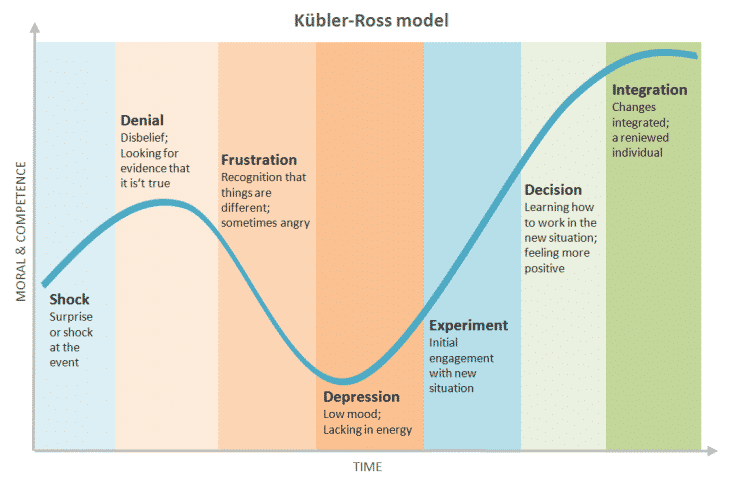
The longer an employee or employees take at the depression stage, the longer the poor performance will be registered. They will reach the experiment stage, where they begin forming new engagements with the new situation. The next stage is the decision, where they learn how to work in the new system. They get to accept the new reality and embrace a positive attitude toward it. Gumus et al. (2018) state that the length of time it takes employees to progress from the depression stage to the decision stage depends on the new leader’s ability to help address their concerns and convince them that everything will be okay. The final stage is integration, where everyone adopts the change and learns to work effectively within the new system. It is the point at which their performance reaches its maximum.
Examining this model, constant leadership change within an organization may have a profoundly negative impact on the organization. Every time a new leader is introduced, a series of emotional instability occurs among the employees. The shock, denial, frustration, and depression stages are characterized by significantly low performance in the workforce. It takes time for them to reach the experimental and decision stages to regain their strength. It may take as long as one year or more for employees to embrace a new leader.
If another change is made when the new management unit is just getting accepted, then they have to go through the curve of emotions again. When they realize that the change is becoming too frequent, a sense of despair sets in at the very bottom of the curve during the depression (Demircioglu & Chowdhury, 2021). They get the feeling that the organization is not keen on creating stability at the firm. Some of the best-performing employees may even consider quitting the firm to find an organization that will assure them of leadership stability.
The Satir Change Model
The Satir change model also explains the challenges associated with constant leadership change. As shown in Figure 2, every time a change is introduced in an organization, various feelings directly affect its performance. The first one is the late status quo, where stakeholders believe that the organization is better off if things remain the same.
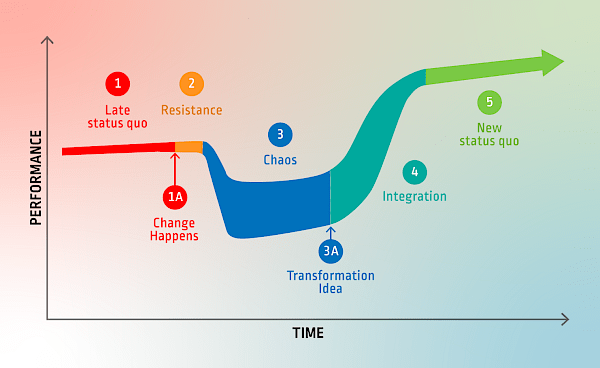
Dentico (2019) explains that people tend to feel comfortable with a system they have come to accept, even if it fails to meet the desired level of performance. The second stage is characterized by resistance to change, as illustrated in the figure below. In this stage, there will be a direct and deliberate attempt to stop the change from happening. Cases have been witnessed where employees demonstrate against new leadership if they feel the change is unnecessary and may cause instability within the firm. The change will forcefully happen against the wishes of these stakeholders.
The next phase is chaos, as employees feel that the change occurred against their wishes. This is the stage where the performance of the employees will be at its lowest. Some will deliberately sabotage their leaders to stop the change. It will take time and effort for the new leader to facilitate a move to the new stage of the transformation idea (Akbar et al., 2021). The employees get to accept the fact that change was necessary and that they need to support it.
The fourth stage is integration, during which employees learn how to work and cooperate within the new system. The last stage is the new status quo, where everyone accepts the new system and is ready to work under it. The emotional journey from the old status quo to the new one may take some time, and it is one that successful firms are keen on avoiding due to its negative impact on employees’ performance.
This theory reaffirms the negative impact of frequent changes in top leadership within an organization. It shows that every time a change is introduced, employees undergo a series of emotional challenges that directly impact their performance. It means that once the emotions are stabilized and employees accept the new leadership, the firm should ensure that the new management is retained for a sufficient period to facilitate growth. It helps in creating a sense of stability within a firm.
Conceptual Framework
Based on the information gathered from the literature review conducted above, including an analysis of changes in the context of various theoretical models, it was necessary to develop a conceptual framework for the study. The framework helps outline the relationship between frequent leadership changes in an organization and their effects. Figure 3 illustrates the framework, which outlines the nature of the relationship.
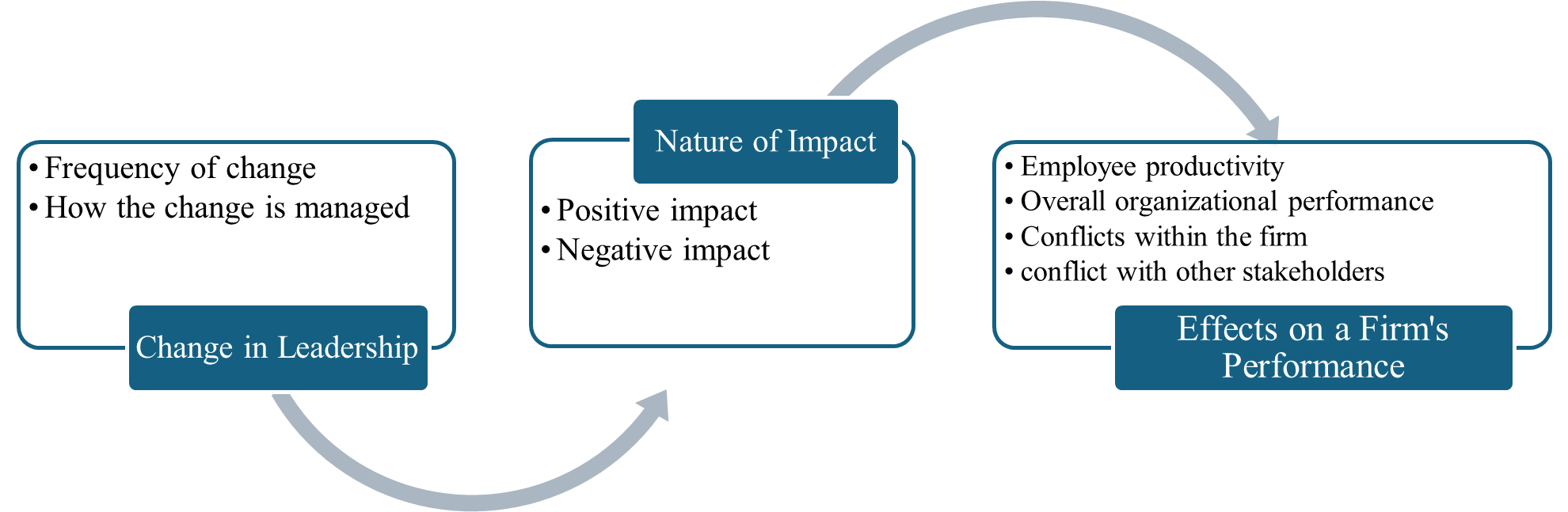
As shown in the figure above, the frequency of leadership changes matters significantly. When the frequency is unnecessarily high, it has a negative impact on the firm, resulting in a decline in factors such as employee productivity and overall firm performance. There may also be an increase in conflict among the firm’s employees.
On the other hand, when the change is properly coordinated and based on specific standards, it may have a positive impact. It can create a synergy that was previously lacking at the firm, leading to improved employee productivity and enhanced overall organizational performance. Having an effective leader will also help minimize conflicts among employees as much as possible. The conceptual framework also shows that change management is another factor that defines the impact of the change.
When all stakeholders are adequately consulted and involved when introducing change, they are likely to support it. The new system created will be more likely to succeed when the necessary measures are taken into consideration. The framework also identifies conflict with other stakeholders as another negative effect that is directly related to frequent leadership changes.
Alqatawenh (2018) explains that a CEO is the authorized employee to make alliances and strategic agreements with external stakeholders. Whenever a new person assumes office, they may want to adjust their relationship with external stakeholders. Such changes may breed conflict, especially when they involve terminating a contract prematurely. These claims, based on the review of the literature, had to be confirmed by collecting, analyzing, and interpreting data.
References
Academic Conferences & Publishing Inter. (2019). Proceedings of the 15th European conference on management leadership and governance: ECMLG.
Akbar, A., Jiang, X., Fareed, Z., & Akbar, M. (2021). Does frequent leadership changes influence firm performance? Insights from China. Economics and Business Letters, 10(3), 291-298.
Alqatawenh, S. (2018). Transformational leadership style and its relationship with change management. Business: Theory and Practice, 19(1), 17-24.
Belyh, A. (2022). Understanding the Kubler-Ross change curve. Cleverism.
Demircioglu, M., & Chowdhury, F. (2021). Entrepreneurship in public organizations: the role of leadership behavior. Small Business Economics, 57(1), 1107–1123.
Dentico, J. (2019). Throttle up: How to accelerate the impact of 21st century leadership. BookLocker.com, Inc.
Farahnak, R., Ehrhart, M., Torres, M., & Aarons, G. (2020). The influence of transformational leadership and leader attitudes on subordinate attitudes and implementation success. Journal of Leadership & Organizational Studies, 27(1), 98–111.
Gallagher, P. (2019). Change management fables: Leadership of change volume 1. PFG Publishing.
Gumus, S., Bellibas, M., Esen, M., & Gumus, E. (2018). A systematic review of studies on leadership models in educational research from 1980 to 2014. Educational Management Administration & Leadership, 46(1), 25-48.
Henry, A. (2021). Understanding strategic management. Oxford University Press.
Hussain, S., Akram, S., Haider, M., Hussain, H., Ali, M. (2018). Kurt Lewin’s change model: A critical review of the role of leadership and employee involvement in organizational change. Journal of Innovation & Knowledge, 3(3), 123-127.
Keller, S., & Schaninger, B. (2019). Beyond performance 2.0: A proven approach to leading large-scale change. John Wiley & Sons.
Norenberg, D. (2020). Executive ownershift: Creating highly effective leadership teams. Springer.
Pratt, M. (2022). Leadership: Definition. Tech Target.
Schwarzmüller, T., Brosi, P., Duman, D., & Welpe, I. (2018). How does the digital transformation affect organizations? Key themes of change in work design and leadership. Management Revue, 29(2), 114-138.
Stachowicz-Stanusch, A. & Mercurio, L. (2019). The social issue in contemporary society: Relations between companies public administrations and people. Information Age Publishing.
Vargas, R. (2022). Understanding the Satir change model. Project Management Institute, Inc.
Yue, C., Men, L., & Ferguson, M. (2019). Bridging transformational leadership, transparent communication, and employee openness to change: The mediating role of trust. Public Relations Review, 45(3), 1-13.