
Introduction
The seated statue of Pharaoh Khafre, carved from diorite stone and now located in Khafre’s Valley Temple, is a beautiful example of ancient Egyptian sculpture and is considered one of the finest works of art in the country. It depicts Khafre as a godlike ruler with a perfect physique. He is dressed in a kilt, a false beard, and a nemes headdress. Khafre is also represented wearing a nemes headpiece. The throne comprises the bodies of two stylized lions flanked by lotus and papyrus flowers.
Both of these features stand for the unification of Egypt. The stone’s polished surface represents solidity and compactness, which is appropriate given the statue’s intention to last forever. Rather than attempting to define the subjects’ human characteristics, its purpose was to reveal the divine nature of the royal family.
Description
Thirty-Word Description
A seated statue of the Pharaoh Khafre made of diorite stone, wearing a kilt, a false royal beard, and a nemes headdress. He sits rigidly upright on a throne with two stylized lion’s bodies, with lotus and papyrus plants on its sides.
Ninety-Word Description
In the statue, Khafre is depicted with a physique befitting a celestial monarch. He is seated in a frontal stance, legs crossed, arms resting on his thighs. Dressed with a nemes headdress, a uraeus snake wrapped over his forehead, a regal false beard, and a modest kilt, he is wearing.
The throne comprises intertwined papyrus and lotus plants, which symbolize a united Egypt, and the stylized bodies of two lions, representing the king’s sovereignty over his subjects. The polished surface of the diorite stone conveys a sense of solidity and compactness, fitting given the statue’s purpose: to last forever.
Visual Composition and Art
The statue was fashioned from diorite, a dark, brittle stone transported from the royal quarries in the south along the Nile. The temple of Khafre in the valley, which houses the statue, is located near the Great Sphinx (Smith, 2020). The Pharaoh is depicted sitting confidently on a throne made from two stylized lions, while wearing a simple kilt.
Lotus and papyrus plants, representing Egyptian unity, are intertwined between the legs of the throne (Spicer, 2020). Khafre dons the royal linen nemes headdress and sports the false royal beard fastened to his chin. The headpiece is embellished with a uraeus snake. The helmet protects his forehead, and the folds of the fabric that make up the headgear flow over his shoulders.
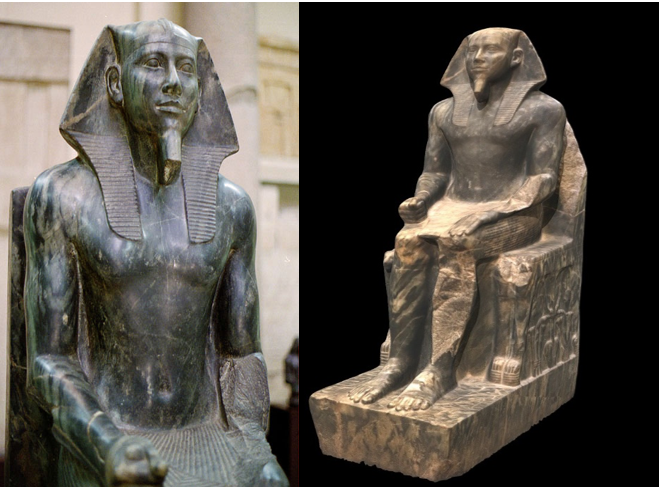
The falcon perched on Khafre’s head is a symbol that identifies him as “Living Horus.” Despite his old age and appearance, the sculptor created a beautiful face and a well-developed, flawless body for Khafre. The statue does not realistically portray the Pharaoh. Instead, it exhibits the ideal proportions that are characteristic of portrayals of god-kings. The Pharaoh was considered a deity (Smith, 2020). The purpose of Egyptian royal portraiture was not to record specific characteristics or distinctive bodily features but to declare the divine nature of Egyptian sovereignty via the medium of art.
The figure’s compactness, strength, and the fact that it has few projecting or fragile parts contribute to the aura of peace that prevails around the enthroned Khafre. At the same time, the statue’s enduring ideals are conveyed through its design. The simple slab that forms the rear of the throne is swallowed up by Khafre’s body when he is seated. His arms are positioned to follow the curve of his body and rest on his thighs, and a fragment of the original stone block still connects his legs to the chair (Smith, 2020). His legs are close together. The only thing that throws off Khafre’s frontal and bilateral symmetry is that he’s holding his hands in front of him. The sculptor has stopped all motion, so the statue seems frozen in a timeless, eternal state.
The Egyptian craftsman who carved Khafre’s monument started by drawing the sitting Pharaoh’s front, back, and two profile views on each of the stone block’s four vertical sides. He then shaped the different elements of Khafre’s body and the falcon. His assistants removed the excess stone from both sides of the structure. Since polished surfaces were achieved through abrasion, most Egyptian sculptures appear to be solid blocks. According to Roy et al. (2019), other ancient and modern artists have employed stone blocks to create dynamic, twisting human forms for various reasons.
Analysis
The seated figure of Khafre, carved from diorite, depicts the Pharaoh. The Pharaoh sits perfectly still on a throne constructed from the skeletons of two lions that have been given a stylized appearance (Smith, 2020). This figure, unearthed in the Pharaoh’s Valley temple adjacent to the Great Sphinx, is said to have been intended as a repository for Khafre’s ka, or life force. He dresses in a simple kilt and a royal linen nemes headdress that drapes in pleated folds over his shoulders and covers his forehead (Bastian et al., 2019). His chin is adorned with a fake royal beard secured to his face.
The front of the headgear has an embroidered image of a royal uraeus cobra. It is said that the falcon perched on Khafre’s head declares him to be the “Living Horus,” the divinity responsible for creating pharaohs. Despite Khafre’s elderly age, the sculptor gave him a chiseled body and a lovely visage (Spicer, 2020). The statue’s dimensions are inaccurate because the artist wanted to draw attention to the monarch’s divine nature by making it seem larger than life.
The serenity and tranquility the monument radiates are among the reasons it is so well-known. Khafre adopts a balanced, symmetrical frontal stance by resting his arms on the inner surfaces of his thighs and drawing his legs close together (Hamed, 2022). A piece of the original stone block still joins the king’s legs to his chair. This gives the sculpture a sense of continuity and reinforces its overall structure. The union of Upper and Lower Egypt is symbolized by entwined lotus and papyrus plants located in the space between the legs of the throne (Reimer, 2022).
The Egyptian sculptor would have begun by sketching the front, rear, and two profile views of the sitting Pharaoh on the statue’s four vertical faces. According to Remier (2022), the master craftsman sculpted the various components of Khafre’s body and the falcon, while the trainees removed excess stone from either side of the statue. A polished surface was achieved by subjecting the figure to abrasion, which contributed to the monument’s smooth, blocky appearance.
The ancient Egyptians saw the statue of Khafre as reflecting both the divine nature of kingship and the need for a permanent dwelling for the ka. This was mirrored in the figure itself. The choice of diorite, a stone renowned for its extreme hardness and longevity, underscores its exceptional durability and consistency (Smith, 2020). During Khafre’s lifetime and after his death, the statue would have played a crucial role in the afterlife cult established in his honor. It would have been a potent symbol of Khafre’s divinity and authority. The Great Sphinx and the nearby pyramids, including Khafre’s pyramid, would have formed a larger burial complex that honored Khafre’s eternal slumber and divine dignity.
Conclusion
The seated statue of Khafre is a beautiful piece of ancient Egyptian funeral art carved from diorite. The figure presents the Pharaoh in a celestial light, with idealized proportions that evoke a feeling of calm and eternity. The falcon behind Khafre’s head and the interwoven lotus and papyrus plants between the throne’s legs identify him as the “Living Horus.” The sculptor’s skill may be seen in the smooth finish of the diorite stone and the way Khafre’s body fits snugly into the throne. The fact that the ancient Egyptians could sculpt such a magnificent statue is proof of their faith in the pharaohs’ divine status and their superior creative and technical abilities.
References
Reimer, M. N. (2022). Androgyny in the Ancient World: The Intersection of Politics, Religion and Gender in the Art of Hatshepsut.
Roy, P., Tandel, S. K., Suman, S., Chowdhury, P., Janssens, R. V. F., Carpenter, M. P., & Zhu, S. (2019). Isomers from intrinsic excitations in Tl 200 and Pb 201, 202. Physical Review C, 100(2), 024320.
Smith, A. M. (2020). Stone working in antiquity, general techniques and a framework of critical factors derived from the construction of Solomon’s Temple in Jerusalem (Doctoral dissertation).
Spicer, M. (2020). The Evolution of Mythology: the de facto lens of Modernity.
Hamed, M. (2022). Ancient Egyptian kings under Divine Protection; Reflection in Art. Journal of Tourism, Hotels and Heritage, 4(2), 1-21.