
Abstract
This review covered the great-man, trait, contingency, behavior, path-goal, and transformational theories, as well as servant, Authentic, autocratic, laissez-faire, and democratic leadership models. Therefore, it is essential to recognize that many of these leadership models and management theories often overlap and can be effectively integrated and applied in various ways.
Additional copies will appear or be discovered by businesses that will take components from existing ones and incorporate them into their workstations. It all depends on the atmosphere individuals want for their movies and how they want their team to work. An essential awareness of what team members need to complete their tasks correctly is crucial to excellent leadership.
Leadership is one of the most complex and varied phenomena. It has been extensively studied over the years and is more important than ever in today’s fast-paced and increasingly international world. Yet the discussion of leadership remains both exciting and perplexing due to the subject’s complexity. Never have so many people worked so hard to say so little. Leadership is the most studied yet least understood topic in the social sciences. The success of every company is widely recognized as dependent on competent leadership. The value of organizational management and human capital has been increasingly acknowledged.
Introduction
According to the literature on leadership, theories have been developing, and depending on the situation in which they are applied, they remain relevant. For example, a style used in functions with high sensitivity, care, and technical competence may be required from more straightforward management-oriented portfolios (Kramer, 2019). As a result, the leadership philosophies of diverse managers are greatly influenced by their environments, workplaces, cultures, new laws and regulations, information overload, organizational complexity, and psychosocial shifts. They are about the system that works best for different situations and therefore encompasses an array of models- a set of guidelines that direct a person to lead in a particular manner (Kramer, 2019).
Leadership Theories
The Great-Man Theory
According to this belief, showing leadership is a selfless effort. A person’s combination of qualities, traits, and capabilities sets them apart from the rest of the pack (Villanova University, 2022). Its strong foundation in personality has led many businesses to turn to people who can inspire, motivate, and help others achieve a common goal to realize their dreams. The idea focuses exclusively on characteristics, not on individual behavior. It also postulates that only those with heroic qualities and potential could become group bosses.
However, subsequent events during Napoleon’s and Hitler’s reigns exposed the weaknesses and demonstrated that the idea of leadership needed to be revised. Consequently, it became clear that the great man, with all his brilliance, could be dictatorial when heading an organization that did not allow for divergent opinions. Others argued that leaders are products of their environment and that before a “great man” can remake his team, society must shape them (Villanova University, 2022). They viewed it as unscientific and primitive because leaders are molded by their times. Despite its critics, it was the predominant principle for explaining and understanding leadership until the mid-20th century.
Trait Theory
The early thinkers contended that unique physical and psychological traits made born leaders stand out from non-leaders. Its inspiration was from Carlyle and Galton’s ideas, and proponents believed that leadership results from personal characteristics (Deshwal & Ali, 2020). They thought such qualities do not only reside in a select number of people. It shared two characteristics: those based on knowledge or experience, such as charisma, and those inherited characteristics, including height, intelligence, attractiveness, self-confidence, and effectiveness (Deshwal & Ali, 2020). Nevertheless, their theories disregarded the suppositions that leadership traits were inherited or learned.
The theory was widely accepted until the early 1950s, but questions began to emerge about its suitability, as people believed that facts, rather than personal characteristics, make a leader. In 1948, Stogdill stated that leadership is a combination of elements and situations, as a person who leads in one environment may behave differently in another (Deshwal & Ali, 2020). Furthermore, settings influence individuals and enable them to demonstrate their leadership abilities. It was equally opposed because studies had not shown how specific characteristics affected leadership outcomes, such as performance, productivity, and worker satisfaction (Deshwal & Ali, 2020). Additionally, because the attributes are innate, they are not suitable for training or development.
Contingency Theory
It is more of a situational leadership approach based on the idea that there are two different kinds of leaders: task-oriented and people-oriented. The idea is grounded in adaptive management, which enables leaders to adjust their approach according to the work environment (Kovach, 2018). As a result, they must learn when to be an activity-focused manager and when to be a people-focused leader (Shala et al., 2021). It is predicated on how positively staff members view their manager, how thoroughly their jobs are explained, and the authority the leader has by virtue of their position.
According to the contingency theory, the organization’s size, the technology used, the organizational style, and the technique employed to respond to changes in design can all impact the ideal structure of a given institution. Although numerous studies demonstrate its viability, detractors assert that it has some flaws (Shala et al., 2021). It cannot, for instance, explain why individuals with particular leadership philosophies are more successful in some circumstances than others. Similarly, it qualifies how a person’s descriptions on the scale reflect their leadership style, as it concentrates so much on connections that it fails to achieve a goal.
Behavioral Theory
Behavioral theories suggest that leadership can be learned and that no one possesses distinctive traits or characteristics that set them apart from others. It emphasizes the actual behavior of the leader, rather than their qualities or characteristics, but it largely ignores the situation and environment in which they work (Benmira & Agboola, 2020). When leaders are generous, approachable, and amiable, they are believed to foster pleasant, cordial relationships with their subordinates.
Similarly, when junior staff realize that leaders treat them like family, they will be more motivated to complete tasks and activities. Today, this is exemplified by the numerous leadership-training courses that develop skills and behaviors, thereby supporting the belief that leadership is primarily learned (Benmira & Agboola, 2020). Studies have been conducted on leaders’ behavior to enable them to perform their duties effectively and enhance their effectiveness.
However, understanding, representing, and addressing individual behavior is a challenge (Benmira & Agboola, 2020). Moreover, it is reductionist in suggesting that everything can be explained through the stimulus-response relationship. Additionally, it overlooks what cannot be observed, such as emotions, internal thoughts, or cognitive biases.
Path-Goal Theory
Four styles were included in the theory’s original concept: directive, participative, supportive, and achievement-oriented (Diagram 1). It stated that a leader should clear the way for followers toward the objective by removing obstacles (Dare and Saleem, 2022). They are expected to provide task specifications that outline expectations, methods for completing the tasks, and the time required to complete them. The style was viewed as effective in situations where there is a high demand on employees to meet their targets. It requires that learning heads interested in promoting an educational culture adopt a participatory, achievement-oriented approach and respond promptly to juniors’ expectations, needs, and desires.
Despite its strengths, there is to date a lack of empirical research that provides a comprehensive and consistent practical clarification of its basic assumptions. It relies heavily on motivation and is not a practical leadership approach, as it involves some guesswork in predicting the actions a leader should take toward their followers (Slw5651, 2018). On the other hand, due to the complexity of the theory, it would be challenging to utilize it in every situation.
Transformational Theory
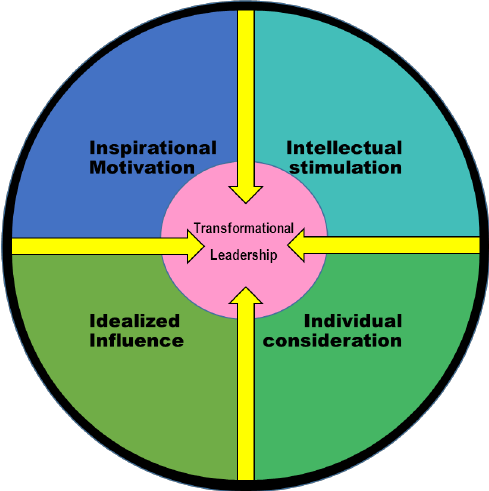
According to this view, transactional and transformational leaders can be found in politics. Former bosses are expected to employ the carrot-and-stick strategy to persuade their subordinates to perform as expected, offering incentives and rewards (Campos, 2020). Conversely, the latter leaders inspire their followers to assist one another and the entire company (Neto et al., 2019). Behaviors such as an idealized influence, inspirational motivation, intellectual stimulation, and individual consideration drive its implementation. This leadership style exemplifies how leadership is distinct from power since it is indivisible from the subjects’ needs.
The roles in transformational leadership are shared among all stakeholders, unlike previous theories where the team’s leader appears to have all the obligations (Campos, 2020). Importantly, it involves consensus-building with team members by identifying a shared vision. Thus, it also focuses on the interests of the leader and followers. Additionally, those who adopt this style possess solid internal values and ideals. They effectively promote their subjects to act in a way that encourages the progress of all and the success of the entire organization, rather than prioritizing personal interests.
However, transformational leadership is considered by critics to be weak and inappropriate. It is seen to have a broad spectrum, making it challenging to focus on the key issues. There are no accurate parameters to evaluate its success. Additionally, the factors that define its style need to be clarified, thereby creating concern about its unreliability (Campos, 2020). Since it views leadership as a personality attribute rather than a skill that people can learn, some individuals are already ineligible because they need to develop this trait. Lastly, it is seen as elitist and undermines democracy. For example, there is concern that the head may influence the organization’s future by attracting employees in a particular manner.
Leadership Models
Servant
In this leadership model, the manager prioritizes the needs of their team members or employees before considering their own. The role of a leader is to respect the diverse viewpoints of others and help them effectively achieve their objectives (Tarallo, 2018). Using this concept, managers should include employees in choices where their input is essential. This level of engagement and togetherness is expected to lead to innovation and performance. It may not work in a hierarchical setting, but it can foster a strong sense of community within a team.
Authentic
Sincerity, self-awareness, and the capacity to act from one’s actual personal perspective are the hallmarks of authentic leaders. They are conscious of their principles and try to show them in their speech, behavior, and leadership. Leaders’ credibility is believed to improve by staying honest about these values. Those who use it frequently are aware of how deeply their interactions and choices affect their teams.
Relational transparency demonstrates that sincere leaders are far more receptive to the people they lead (Johnson, 2019). They combine leadership theory and humanistic psychology to create a style that respects diversity and fosters concern for followers, resulting in positive outcomes in terms of worker motivation, satisfaction, and achievement of company goals. Lastly, data and metrics matter more to those using this approach, as they utilize this information to make informed decisions.
Autocratic
The autocratic leadership model emphasizes dominance and strong, centralized control over subordinates. The chain of command, top-down instructions, and limited collaboration between leaders and their teams strongly dictate decision-making by those at the top. The rest of the team might or might not contribute, but the final decision always rests with the managers.
It has been found to negatively influence outcome variables such as group interaction, organizational commitment, and performance (Du et al., 2020). However, seeking advice from others can be a waste of time when important decisions must be made swiftly and frequently. Yet, this model’s rigidity often necessitates stringent control, which can be advantageous and fruitful for the business.
Laissez-Faire
This approach relies heavily on the opinions of others, making it the exact opposite of authoritarian leadership. Those in authority allow their team members to be creative and autonomous, giving them the freedom to make decisions and take action (Khan, 2022). Supervision is minimal, as management relies on teammates to take the initiative and play a more significant role in the processes. This style is very laid-back, but in an environment where the talent and creativity of people are excellent, the approach can be highly successful. As long as several principles are observed, it promotes a considerably higher degree of creativity and independence, which pleases a wide range of stakeholders and employees.
Democratic
In the democratic leadership model, power and authority are vested in the entire group. It is a great deal more adaptable and can handle abrupt changes in the organizational structure better (Carlin, 2019). There is a balance in decision-making between members and their seniors through participation, listening, and discussions. Additionally, it fosters teamwork and cooperation among teammates, motivating workers and enhancing productivity. Every significant workflow phase has the appropriate decision-makers, ensuring greater quality control so that management can utilize only a portion of their resources.
Conclusion
Many of these management theories and leadership models align well and can be used in conjunction with one another in various ways. Additional versions will emerge or be found by companies that adapt elements from current models and integrate them into their own work environments. Ultimately, everything depends on the kind of atmosphere people want for their projects and how they expect their teams to operate. A key part of effective leadership is having a broad understanding of what team members need to perform their responsibilities successfully.
Reference List
Benmira, S., & Agoola, M. (2020) ‘Evolution of leadership theory,’ BMJ Journal, 5(1).
Campos, A. (2020) Transformational leadership theory.
Carlin, D (2019) ‘Democratic, authoritarian, laissez-faire: what type of leader are you?’, Forbes.
Dare, P. S., and Saleem, A. (2022) Toward success, while tackling the change in a pandemic age: path-goal theory leadership as a win-win gadget, Frontiers.
Deshwal, V. and Ali, M. (2020) ‘A systematic review of various leadership theories,’ International Journal of Commerce, 8(1).
Du, J., Li, N. N., and Luo, Y. J. (2020) ‘Authoritarian leadership in organizational change and employees’ active reactions: have-to and willing-to perspectives’ Frontiers
Johnson, S. L. (2019) ‘Authentic leadership theory and practical applications in nuclear medicine,’ Journal of Nuclear Medicine Technology, 47(3), pp. 181-188.
Khan, R. (2022) What is laissez-faire leadership and why you need it in today’s world, All New Business.
Kovach, M. (2018) ‘An examination of leadership theories in business and sport achievement contexts,’ The Journal of Values-Based Leadership, 11(2), pp. 1-16.
Kramer, L. (2019) ‘Leadership theories and models‘, Bizfluent.
Neto, M., T, R., Araújo, R., N., & Ferreira, C., A., A. (2019) ‘Leadership theories and individual performance,’ SciELO Analytics, (47).
Renjith, V., Renu, G. & George, A. (2018). “Transformational leadership in nursing.” International Journal of Scientific Research & Management Studies, 2, 112-118.
Shala, B., Prebreza, A., & Ramosaj, B. (2021) ‘The contingency theory of management as a factor of acknowledging the leaders-managers of our time study case: the practice of the contingency theory in the Company Avrios’, Scientific Research Publishing, 8(9).
Slw5651 (2018) ‘Is path-goal theory a practical leadership practice?‘, Penn State.
Tarallo, M. (2018) ‘The art of servant leadership,’ SHRM.
Villanova University (2022). The grand man theory of leadership explained.