
Stylistic Characteristics
Leonardo da Vinci created “The Last Supper,” also known as the Italian Cenacolo, for the Dominican convent Santa Maria Delle Grazie in Milan sometime between 1495 and 1498. It is one of the most well-known pieces of art in the whole world. The color palette is highly diverse, enabling us to appreciate the richness of each disciple’s character as well as the overall tapestry of the biblical story. The depth, however, is remarkable; the painting flawlessly captures the details of a three-dimensional setting (Sârbu 53). Since each component is different and has its texture, the texture also aids in creating a highly personal impression of the scene depicted in the painting.
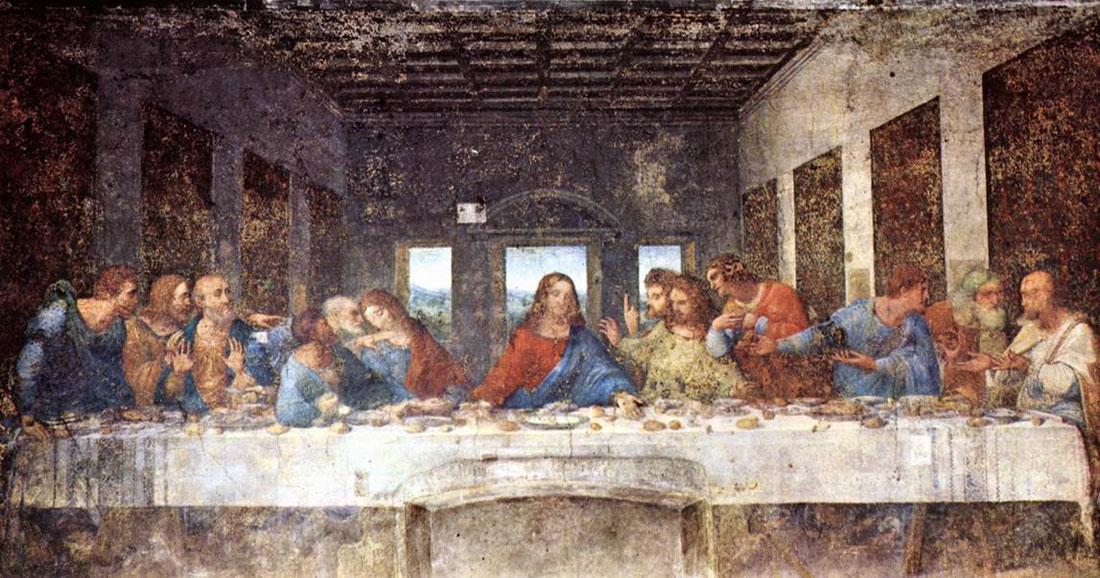
Although the artwork has a generally cheerful tone, a few gloomy areas serve as a preview of how things may turn out in the future. In his artwork, Da Vinci used several design elements. In particular, the painting’s symmetry is an explicit part of its framework. The harmonious arrangement of items on both sides of the mentioned vertical axis introduces a feeling of serenity and contemplative tranquility. Overall, “The Last Supper” deserves the title of the most critical work produced throughout the Renaissance. “The Last Supper” is centered on Christ’s last dinner with his disciples before Judas reveals Christ to the authorities, leading to his arrest.
Representation of Regional Style and Epoch
There were two distinct phases of the Italian Renaissance in the 16th century. A group of painters known as the High Renaissance gained artistic perfection1, but the Late Renaissance was a time of political unrest and the Protestant Reformation, which changed how religious art was first represented. The quality of the artwork also varied according to its location. It was often damp in several Italian cities, which caused paintings to seem more transparent.
“The Last Supper” by Leonardo Da Vinci depicts the last dinner Jesus had with his disciples before he was killed. Still, Leonardo Da Vinci is transparent and features Christ as the central focal point when he tells his followers that an apostle would betray him. The artwork by Jacopo Tintoretto is authentic to the period and depicts the banquet as a whole, including other characters who aren’t present in the biblical scenario.
Role of Composition
The components representing Christ as the center point of Leonardo Da Vinci’s “The Last Supper” include lighting, perspective lines, color, positioning, and facial expressions. Jesus and the twelve other apostles are horizontally aligned. The horizontal alignment keeps the viewer focused on Jesus by limiting their straying to the front (Motta et al. 29394). The painting’s environment mimics the spatial setting of the original interior of the room. However, it is deeper and more atmospheric. The backdrop is filled with symbolic motifs highlighting Jesus as the painting’s primary focal point. The gaping wall behind Jesus resembles a halo in architecture.
The other twelve apostles are not granted halos since their roles are not as essential. Leonardo also depicts Jesus in natural light from the outdoors. The natural light from the outdoors makes the artwork seem tranquil and pleasant. His choice to utilize oil tempera on medium dry plaster in Milan’s humidity also impacted the amount of detail visible in the backdrop. The drapery folds that provide volume to each of the figurines have vanished. The backdrop color scheme has faded and become dull.
One method Leonardo incorporates Christ as the central focus point is his placement and the emotions shown by all thirteen characters in the painting. Even though it is a two-dimensional surface, the figures seem three-dimensional. Da Vinci’s proper and calculated use of perspective creates three-dimensional figures. While Jesus maintains his cool, the other twelve disciples react to the news. John’s countenance is lost in meditation, Judas recoils from Jesus into the gloom, and Peter is suddenly snatching a knife.
Each figure’s position and attitude add to the drama inside the picture. Christ’s location in the middle of the artwork also helps to shape his significance. He makes Christ the painting’s center point, with all perspective lines intersecting at his head. Most apostles are looking at Christ, while some are too shocked to look. The apostles are sometimes represented in four groupings, with Christ alone in the middle.
Works Cited
Motta, Oriana, et al. “Leonardo Da Vinci’s ‘Last Supper’: A Case Study to Evaluate the Influence of Visitors on the Museum Preservation Systems.” Environmental Science and Pollution Research, vol. 29, no. 20. 2021, pp. 29391–98. Web.
Sârbu, Carmen. “The Transfiguration of the Visible. Leonardo’s ‘Last Supper’.” Studies in Visual Arts and Communication. 2019. pp. 51-56. Web.