
The Main Problem in the Construction Field and Its Causes
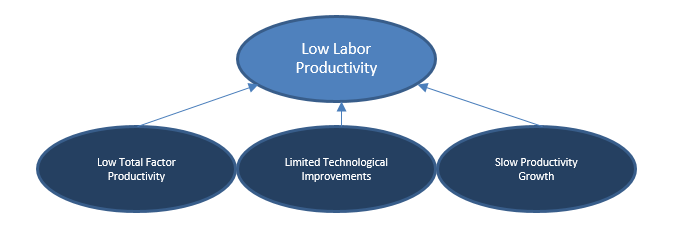
According to the McKinsey report “Reinventing Construction: A Route to Higher Productivity”, the diagram that was created describes the main problem within the construction sphere. It addresses the three major issues outlined in the report and connects them to their overall impact on the construction industry. The report’s authors highlight specific reasons they believe are the cause of productivity loss and justify their choices compared to other potential options. Productivity is considered a primary concern in changing and improving the construction industry (Barbosa et al., 2017). The report supports its conclusions with objective evidence, including data collection and diagrams.
Clarity
Every point on the diagram is clear, readable, and unambiguous. Total factor productivity, as used in the report, is explained and defined by the work. It refers to the productivity of construction when all expenses are handled (Indeed Career Guide, 2021). Limited technological improvement and slow productivity growth are tangible trends in performance discussions, which are demonstrably evident.
Entity Existence
As mentioned previously, the points taken to prove low productivity are the terms used in productivity discussions and the tangible concepts explained by the authors.
Causality Existence
The effects flow from the causes stated. Low productivity is often attributed to several causes, including the inability of labor to be applied effectively or deliver sufficient outcomes promptly. A lack of technological improvements, innovation, or adaptation prevents individuals from performing construction at a higher pace, thereby affecting productivity.
Other research has also identified a lack of innovation and slow innovation speeds as significant hurdles in achieving better results (Kadi et al., 2019). Productivity increases are generally linked to organizational growth, meaning that low productivity growth speed shows the construction industry’s growth (Bessen & Denk, 2021). At the same time, not all performance-improving measures provide sufficient incentive or change to be effective.
Cause Insufficiency
The three factors the authors focus on are not the only potential causes of low productivity. The problem of insufficient productivity depends considerably on the geographical area being considered, the specific areas of expertise involved, and the funding.
Additional Cause
The mentioned causes can be considered significant contributors to the problem. Considerations such as cost are not strongly correlated with lessened productivity, making them unsuitable for understanding low productivity.
Cause Reversal
The cause-and-effect relationship within the identified logic chain is correct. Productivity is a complex term that encompasses a range of other considerations. Therefore, productivity is also affected if any of the included criteria change. A low industry growth rate and a lack of advanced technology can all be contributing factors to low productivity.
Predicted Effect
The issues mentioned are described in relation to the problem of low productivity. Recognizing that a certain number of variables may produce more than one effect is a part of the logical thinking process (Dettmer, 2007). Other outcomes can also be observed from the three identified causes, strengthening the cause-and-effect relationship.
Other analytics have also noted the existence of these issues, notably focusing on the lack of investment and innovation (Pickett, 2019). Low profits lead to less money circulated within the industry, and less money paid to the government (Pheng & Hou, 2019). These problems make it difficult for projects to acquire finances and contribute to the national economy.
Tautology
Some of the causes identified by the authors may be an instance of circular logic. For example, the lack of productivity growth can cause low productivity, which affects the speed of productivity’s development. The authors may need to better justify this cause’s presence in the work. While the technological failings of construction have been extensively analyzed, the impact of productivity-related concerns is undermined (Alaloul et al., 2019). It is necessary to present both problems completely to find comprehensible change pathways.
Resolving the Issue of Low Productivity
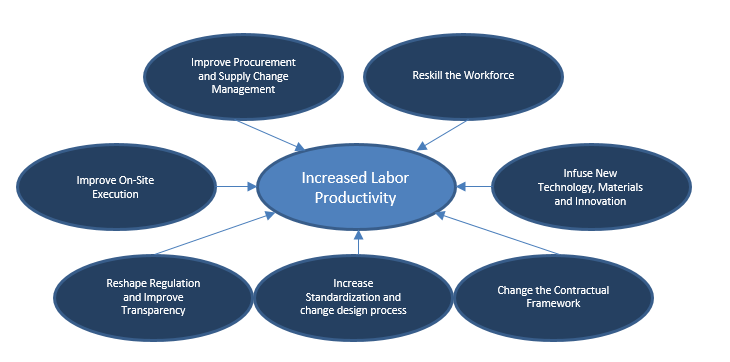
The diagram shows seven main ways that the review identified to handle the issues of low productivity. The explanations for each method are omitted for visual clarity, but additional details are provided below. According to research, diagrams can present complex instances of information in an accessible format (Gray & Schunn, 2019). Graphic learning covers a more diverse audience and brings the capability to make tangible connections between elements to most discussions (Helke, 2019). This diagram is a convenient and quick way to understand changes in the construction sphere, simplifying the presented information for further use and discussions within the constraints of considering work productivity.
Clarity
The review mentions points with clear, complete explanations that outline the specific changes necessary to accomplish the stated goal. Regulation changes include process streamlining, better budgeting, KPI usage, and tactics promoting transparency. Standardization and design improvements make it easier to use designs in projects and reuse them in the future. Similarly, all other recommendations are made thoroughly.
Entity Existence
All the recommendations proposed by the authors are tangible concepts used in the construction industry and other areas. For example, KPIs are an essential tool for increasing efficiency, performance, and task coordination (Ellis, 2020b). Similarly, considerations like standardization were previously shown to be essential and practical tools for achieving better outcomes in construction(Ellis, 2020a). Ensuring transparency and proposing uniform standards of practice and strategy, among other things, are all practical ways to achieve professional improvement.
Causality Existence
Every potential improvement includes a thorough explanation that explains the potential benefits of the change or justifies it by setting a precedent. Adjusting different variables that affect performance is necessary to increase performance. Some variables have been discussed for years, such as the need for a skilled labor force (Build Up Subeditor, 2022). This may include the skills workers possess, how materials are used, and how the industry is regulated.
Cause Insufficiency
The authors have identified at least seven causes to produce the necessary effect. They can influence the construction industry thoroughly and correct its various mistakes.
Additional Cause
The report’s authors argue that the introduced changes will improve performance, reduce construction costs, and improve the reliability of schedules.
Cause Reversal
Productivity is a collective measure that can be influenced by internal factors within the construction industry. These include how the workers perform their duties, the speed at which projects are completed, and the ability of project designs to be used effectively, among other considerations. Therefore, it would be impossible to reverse the cause-and-effect relationship.
Predicted Effect
Specific predicted effects will emerge due to changes to productivity and measures taken to facilitate them. That includes a more cost-effective construction field and the ability to improve the industry’s profits. Saving costs has been one of the primary goals in the current age (Silka, 2017). Therefore, pinpointing specific pathways to achieve this goal is especially important.
Tautology
Some terms, such as standardization, are improved throughout the recommendations. However, they cannot be considered tautologies because they apply to different parts of the construction process.
Conclusion
In conclusion, the changes introduced by the report can be deemed significant and effective in improving construction productivity. It is important to note that bringing positive changes to productivity will include organizational changes and technological improvements, all of which will work together to create a better productive environment.
Reference List
Alaloul, W.S., Liew, M.S., Zawawi, N.A.W.A. and Kennedy, I.B. (2019). Industrial Revolution 4.0 in the Construction industry: Challenges and Opportunities for Stakeholders. Ain Shams Engineering Journal, 11(1).
Barbosa, F., Woetzel, J., Mischke, J., Ribeirinho, M.J., Sridhar, M., Parsons, M., Bertram, N. and Brown, S. (2017). Reinventing construction through a productivity revolution. McKinsey.
Bessen, J. and Denk, E. (2021). From Productivity to Firm Growth. Technology & Policy Research Initiative.
Build Up Subeditor (2022). Overview Article – Fostering the demand for a skilled labour force in the construction industry. Build Up.
Dettmer, W. (2007). The logical thinking process: a systems approach to complex problem solving. New Delhi: Infotech Standards India.
Ellis, G. (2020a). Construction Standardization: A Game Plan to Success. Digital Builder.
Ellis, G. (2020b). Essential Construction KPIs to Improve Profits and Productivity. Digital Builder.
Gray, W.D. and Schunn, C.D. (2019). Proceedings of the Twenty-fourth Annual Conference of the Cognitive Science Society. Routledge.
Helke, C. (2019). Why are diagrams so important? Atlassian Community.
Indeed Career Guide. (2021). Total Factor Productivity (TFP) With Definition and Formula.
Kadi, A.J., Kamal, E.M., Yusof, N. and Rasoolimanesh, S.M. (2019). The Effect of Innovation Barriers on Construction Firms’ Innovation Orientation. The European Proceedings of Social and Behavioural Sciences.
Pheng, L.S. and Hou, L.S. (2019). The Economy and the Construction Industry. Construction Quality and the Economy, pp.21–54.
Pickett, T. (2019). Why Is Productivity in the Construction Industry Declining? Pickett Fence Virtual Services.
Silka, D. (2017). Modern methods of cost saving of the production activity in construction. IOP Conference Series: Earth and Environmental Science. IOP Publishing.