
Introduction
Rose Marie Basque has been operating Slick’s Hair Salon and Boutique in Membertou for almost 4 years, and she feels pressure from regional competition. While the enterprise has a solid customer base, the Sydney, Nova Scotia, area has many hair salons that offer a range of similar services and products, potentially drawing more consumers away from Rosie’s business (Stevens, 2016). Thus, Rosie wonders how to expand her business and what tactics to employ to reach more people. The problem, in this case, is to determine the marketing strategy, differentiation, or alternative that will enable Rosie to attract new customers and expand her salon.
Situation Analysis
One must analyze the market to understand the most effective approaches to addressing the issue outlined in the case study. The beauty industry offers a wide range of services, and customers’ choices may be influenced by factors such as the quality of work, products used, promotional strategies, and more. Moreover, financial, political, and legal aspects may affect Slick and limit its outreach.
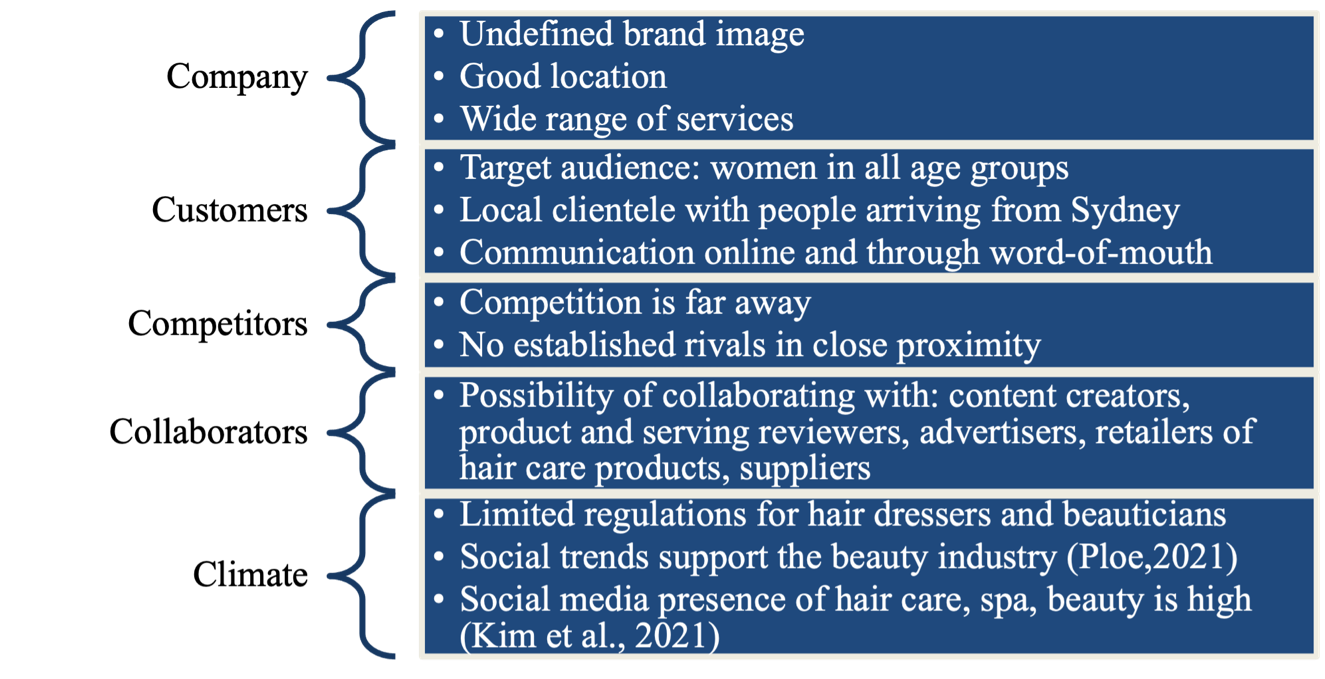
The situation analysis includes the SWOT (strengths, weaknesses, opportunities, threats) analysis to investigate the current state of the business. Then, an analysis of the industry environment is completed using Porter’s Five Forces. Finally, the roles of customers and other segments within the beauty industry are examined using the 5C framework.
SWOT
Strengths
- Extensive range of services
- Combination of salon services and boutique products
- Good location on the main road
- Tax exemptions
- Ample parking
- No immediate competition.
Weaknesses
- No effective marketing strategy
- Located within another Indigenous community
- Lack of social media presence
- Unclear online appointment possibilities
- One location.
Opportunities
- Online booking
- Many unexplored marketing strategies
- Home visits
- Barber and grooming services for men
- Makeup, lashes, and similar new services.
Threats
- Home visit hairdressers and stylists
- Competition in the region
- New salons
- Rising costs of materials and increasing wages
- Online sellers of boutique goods.
Porter’s Five Forces
Bargaining Power of Supplier
In the case of Slick’s, suppliers may include manufacturers of hair care products, styling tools and devices, as well as clothing, accessories, and jewelry that the boutique sells. On the one hand, the choice of available products is rather broad, which reduces suppliers’ power and allows the brand to switch between goods easily (Martin, 2023). On the other hand, rising material costs can affect the business’s profitability, and customers’ preference for specific products can strengthen suppliers’ power.
Threat of Substitute Products or Services
In the hair salon industry, the threat of substitution is exceptionally high – customers may choose to visit another business if it offers the same services at a comparable quality level. If the area has few salons, the threat depends on customers’ mobility and access to other regions, as well as on price differences. Slick’s is located in a business center in a tax-exempt area, which significantly reduces the risk of customer defections.
Bargaining Power of Buyers
The power of buyers in the beauty industry is extremely high overall. However, customers may have less influence on the business if they are unaware of pricing norms or available products. For example, if consumers know which hair care products are best suited to them, they may demand lower prices, choose an alternative business, or leave negative reviews. In this case, the power is significant, as salons rely on good feedback and word-of-mouth marketing (Kim et al., 2021). If customers form a good relationship with the salon’s workers, the business may grow and attract more clients while also catering to the consumers’ specific needs.
Threat of New Entrants
The threat of new entrants is relatively high, as small salons or individual home-visit hairdressers can operate on limited budgets. Moreover, as the area currently lacks any other hair care businesses other than Slick’s, there is likely to be sufficient available property to open another salon for hair care. Another type of threat is a large chain of salons opening a new location near Slick’s. The main barriers for new entrants can include obtaining licenses for cosmetology and other practices, acquiring the necessary skills to deliver high-quality results, and securing suitable locations for a salon.
Competitive Rivalry
As can be seen from the factors above, the competitive rivalry is relatively high in the industry; however, Slick’s location provides a significant advantage. Customers have limited choices in the area due to the lack of competitors, although they may travel to another location if necessary. However, the salon is impacted by suppliers’ costs, consumer reviews, and the threat of new businesses and individual professionals.
5C
Courses of Action and Alternatives
The analyses above show that Rosie can take several courses of action to grow her business. Given the low local competition, Slick’s can enhance its online presence to increase brand recognition and establish a platform for attracting young adult clients. Second, creating an online booking system and making it easy to use can distinguish the business and help it compete with potential new entrants.
The third strategy is to expand the offered services to a barbershop, a specific type of hair care and beauty service for men. Another option would be to add makeup artists and lash extension specialists to the staff, creating a comprehensive beauty treatment experience. Promotions and special offers, such as packaged deals, home visits, and sales, are alternative ways to market the salon and reach new audiences.
Decision Analysis
Online Branding
The analysis of the proposed decisions relies on the cost-benefit ratio and the potential of the strategies to attract new customers. The first proposed decision is online branding, which may include many steps based on Slick’s focus. The beauty industry currently has a significant online presence, with brands actively participating in social media trends while defining their own niche through images, videos, and posts (Kim et al., 2021). To achieve this goal, Slick’s would need social media profiles on such platforms as Instagram, TikTok, or Facebook.
Furthermore, the salon may create a website with information about its products, services, personnel, and booking process to connect with social media. This strategy is cost-effective, as social media is free to use, and it can even bring revenue to the brand (Kim et al., 2021). Potential expenses include hiring a social media manager and investing in website hosting and web design. This strategy can be integrated with online booking, which can be incorporated as part of the website or featured on social media platforms.
Launching New Services
The second potential decision is to offer new services, differentiating the business into a barbershop or a makeup and lashes salon. This strategy involves hiring new workers or training existing personnel, which requires significant time and financial resources. Moreover, these services require more space, occupying a portion of the salon.
Rosie may need to invest in remodeling, new furniture, or a new location for the business expansion. In the future, the business may generate more revenue in the form of new clients – an increased flow of male clients or more clients seeking a full-service option that includes hair and makeup.
Decision Making and Implementation or Recommendation
The decision analysis indicates that expanding the brand’s media presence appears to be a profitable option that does not require a significant financial investment. Thus, it is recommended that Slick’s Salon review its brand image and develop a plan to enhance its social media presence and online growth. The following steps are suggested:
- Establish business accounts on social media (Instagram, Facebook, TikTok).
- Hire a social media manager to oversee the accounts and create content.
- Create a website for the salon with information and booking features.
- Participate in social media and search engine advertisement programs using existing accounts.
- Incentivize customers to leave reviews of the salon and offer discounts to new customers.
- Collaborate with local brands and social media influencers to spread awareness about the business and strengthen the relationship with the community.
The strategy can be implemented in several months, establishing Slick’s as a recognizable brand and increasing its recognition in the area. Furthermore, Slick’s may attract customers from other regions and grow its young adult customer base. An advertisement that combines collaboration, posts, and search engine results covers a broad range of consumer interests and caters to a wide audience. Overall, the media presence of Slick’s Hair Salon and Boutique can grow the business and open more opportunities for future expansion.
References
Kim, Y. J., Lee, J. H., Lee, S. G., & Lee, H. H. (2021). Developing sustainable competitive strategies in the beauty service industry: A SWOT-AHP approach. Sustainability, 13(19), 10852.
Martin, M. (2023). How Porter’s Five Forces can help small businesses analyze the competition. BND.
Ploe, M. (2021). The 5 C’s of marketing, explained (infographic). Brafton.
Stevens, K. (2016). Case studies in aboriginal business: Slick’s Hair Salon and Boutique. Purdy Crawford Chair in Aboriginal Business Studies.