
Introduction
People are often mistakenly used to thinking more positively about the past than the present. A few years ago, life seemed better for one person and the entire planet. However, such judgments are often erroneous because human memory tends to embellish the past.
In addition, individuals often take certain world events out of context, leading to incorrect conclusions. In any situation, positive moments can be found by analyzing what reveals their more important essence (Benneworth, 2020). This way, people can learn not to make hasty decisions and conclusions. The question is whether the life of people on earth is getting worse every year or whether they cannot remember exactly what happened in the world before.
The Goal of the Video
The purpose of the video is to determine if 2017 was the worst year in history, as many people used to believe. To do this, the author analyzes various factors and events that occurred to compare them with those of the next year and the past 30 years. The video is well presented, so the speaker is engaging to listen to throughout the lecture.
Proving the fallacy that there is nothing good in the current realities and that progress has been established is also the speaker’s goal. To do this, he compares the previous thirty years by analyzing events that have taken place, including terrorist attacks, wars, human casualties, and pandemics. In the video, the speaker draws numerous parallels with history, noting, for example, that before the 17th century, no more than 15% of the European population could read and write (Pinker, n.d.). This parameter is obviously much more optimistic in the modern world. This confirms the Roser, M. & Ortiz-Ospina study in Figure 1 (2018).
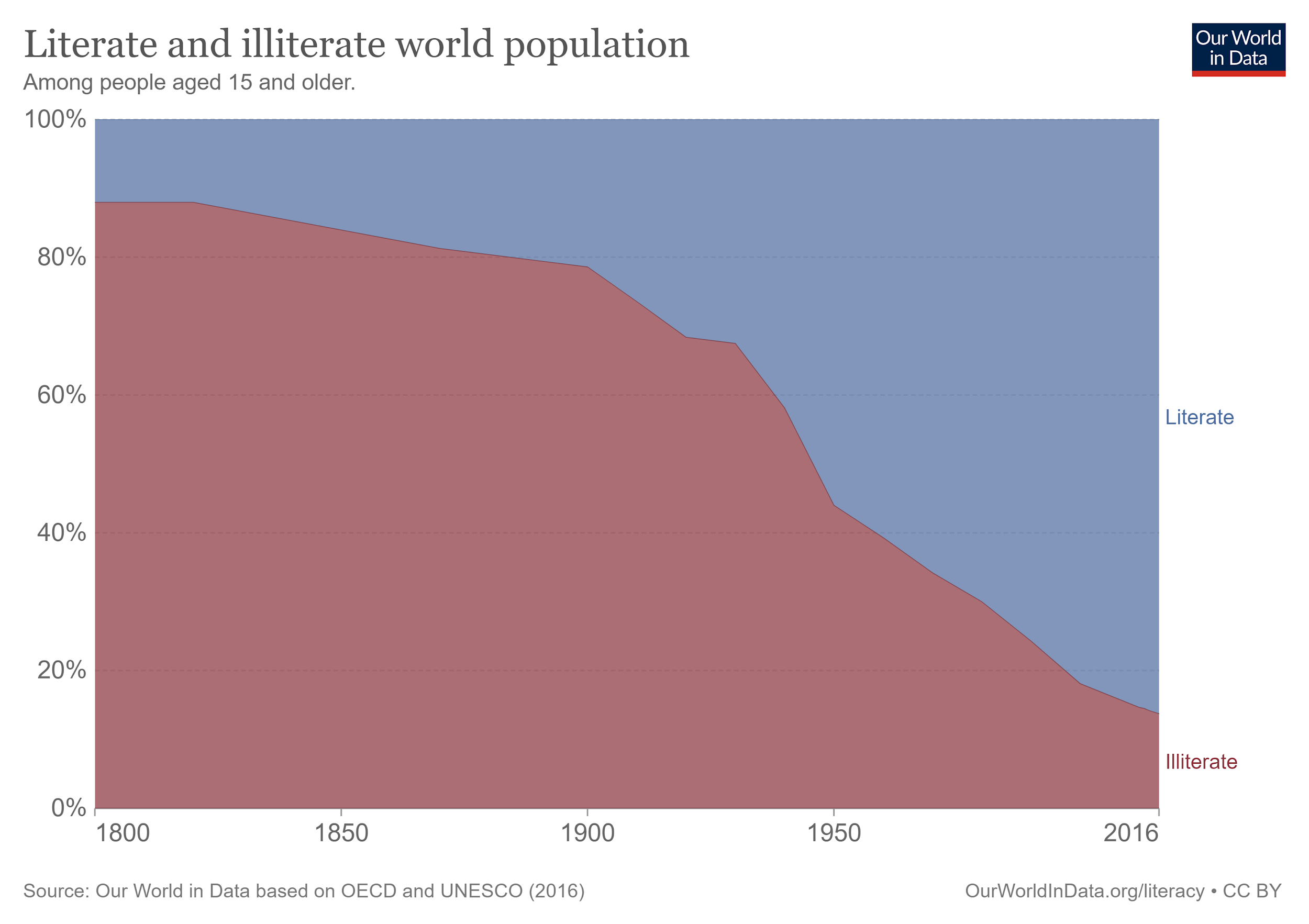
Thus, the author demonstrates how humanity grapples with problems pertinent to individuals during a specific era. Upon analyzing this trend, it becomes clear that throughout history, people have consistently overcome various challenges and obstacles (Mensah, 2019). However, despite the difficulties, no one thought about how wrong everything was. The author wants to convey to the listener the importance of maintaining an optimistic mindset.
Correlating Videos with Topics and Concepts from the Class
The topic of the video is relevant and brings a fresh perspective to the study of statistics and critical analysis. It relates to topics covered in class in that the author teaches the audience to think critically and verify multiple facts before concluding. To say something for sure, much information needs to be studied as the state of affairs (Guo et al., 2021). This requires much effort, which is also part of what happens in the classroom.
Analytics of world social and political processes is essential to any person’s life. However, due to different circumstances, early individuals may interpret the changes that have occurred differently (Wallace-Wells, 2019). The popular fallacy that, for example, 2017 was the worst year ever, and that life gets worse over time, is partly due to people’s inability to appreciate the full context of the situation.
Each person is mainly focused on their problems. Therefore, if something changes for the worse in a person’s life, they think the year was terrible (Slaby, 2020). The human brain works according to this principle, which is one of the critical mistakes that prevent people from developing. If people learn to perceive the world as a whole, rather than focusing on themselves, it will be possible to experience many more joyous moments each year. This concept of analyzing ongoing events resonates with the topics of the classes and is a central theme of the video.
Statistical Measures
In his speech, Pinker often cites facts and excerpts from world history to support his words. This allows the audience to capture the speaker’s point more clearly. Throughout the video, the author talks about the problems of humanity using various statistical indicators.
For example, Pinker claims that over the past 25 years, 1.25 billion people have overcome the threshold of poverty (TED, n.d.), demonstrating that positive changes are happening daily worldwide. In this case, he highlights the limitations of human perception and the tendency of news to focus on adverse events rather than positive developments. The speaker also uses such statistical measurements as mean, mode, and median. With the help of such tools, it reveals statistics about humanity that many were unaware of due to the incorrect representation of the news.
Conclusion
In conclusion, it is worth saying that we can agree with the facts presented in the video. They are presented in such a way that the misconceptions that have haunted the human brain throughout its entire existence become clear. However, the video could have included more explanation on each topic or event.
On the positive side, the video leaves a basis for further research in this area, as it raises the critical topic of people’s attitudes toward the time in which they live. It can be argued that no one can present a video better than Steven Pinker because he is an engaging speaker, and his ideas are credible. Thus, it is worth noting that pessimism and the tendency for people to focus only on their problems are a severe mistake.
References
Benneworth, P. (2020). Things are going to get worse before they get better, but get better they will.
Guo, Y., Guo, S., Jin, Z., Kaul, S., Gotz, D., & Cao, N. (2021). Survey on visual analysis of event sequence data. IEEE Transactions on Visualization and Computer Graphics, 28(12), 5091-5112.
Mensah, J. (2019). Sustainable development: Meaning, history, principles, pillars, and implications for human action: Literature review. Cogent social sciences, 5(1), 1653531.
Pinker, S. (n. d.). Is the world getting better or worse? A look at the numbers. TED.
Roser, M. & Ortiz-Ospina, E. (2018). Literacy. Our World in Data.
Slaby, J. (2020). The weight of history: From Heidegger to afro-pessimism. In Phenomenology as performative exercise (pp. 173-195). Brill.
Wallace-Wells, D. (2019). The uninhabitable earth: A story of the future. Penguin UK.