
Introduction
Bread decay is commonly caused by mold, which reduces its shelf life and quality, making it difficult for both consumers and the food processing sector. Therefore, we need to be aware of how moisture moves around a mold colony if we are to understand why bread goes terribly. In most cases, other researchers have focused on identifying factors that influence growth and spoilage, such as temperature, moisture content, and even components used in making the substrate (Jansen et al., 2020). These inquiries have shown that they are linked to moisture availability, which can lead to mold proliferation.
Some missing pieces prevent us from fully comprehending moisture dynamics within mold colonies, as well as their direct effects on spoilage rates in loaves of bread. This study seeks to close this knowledge gap by examining various aspects of water behavior upon contact with moldy bread pieces (Kopecký et al., 2023). The concern shall be on investigating various patterns that may arise due to uneven distribution of moisture between these two points, followed by the growth of molds.
The main aim of conducting such an investigation is not only to understand how moisture moves in a mold but also to find ways to prolong the storage life of bakery goods based on this information. The purpose of the work is to clarify all aspects of humidity changes associated with microbial activity during contamination of various parts of food products. This will benefit the topic by developing preventive measures against mold and improving food safety standards.
Methods & Materials
Bread Sample Processing
White loaves of bread that are sold in shops have been bought from a local bakery. A clean knife was used to slice the bread into 2 cm-thick even pieces. Then, each piece was infected with a standardized spore suspension of molds obtained from pure cultures of Penicillium spp. All the slices that got infected were put separately. For the calculations, the Moisture Loss Calculation formula was used to determine the percentage of moisture loss in bread slices.
Procedure
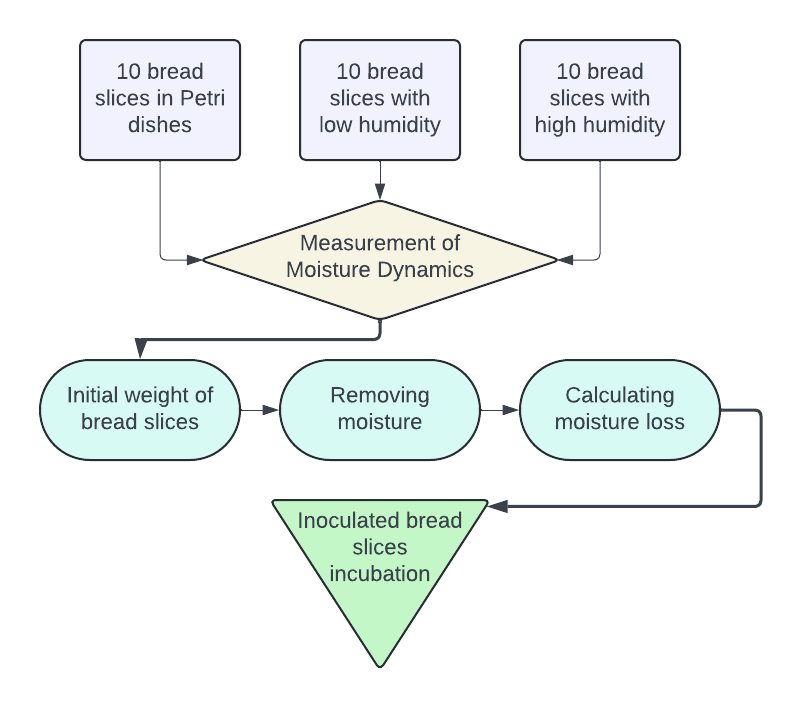
The study had three sets: the control group, the low-moisture group, and the high-moisture group. There were 10 replicates per treatment group (i.e., 10×3=30 bread slices) used in this trial (See Figure 1). Moisture levels in the low- and high-moisture groups were adjusted using desiccators containing saturated salt solutions (LiCl for low moisture and NaCl for high moisture) to achieve specific relative humidity values.
Moisture Measurement
A gravimetric method was used to determine the amount of moisture held within these slices. Firstly, an electronic balance was used to record the initial weight of each slice. Furthermore, they were kept in an oven at 70°C for a day to remove their water content completely. Once completely dried, another weighing was conducted to determine the extent of moisture loss.
Monitoring Mold Growth
To allow mold development, all molded pieces were observed at a temperature not exceeding 25°C for 7 days. Every day during this time frame, each sample underwent a visual check, and digital images were taken showing exactly where the mold started growing and when it stopped spreading on that particular sample.
Results
Low Moisture
The outcome revealed different moisture dynamics and mold growth among the experimental sets. In the control group, bread pieces maintained relatively constant moisture content throughout the test, with slight changes between individual slices. Conversely, bread pieces in the low-moisture group showed markedly lower moisture content than the control, indicating successful manipulation of humidity levels.
High Moisture
On the other hand, the high-moisture group had a significantly higher percentage increase in weight, implying greater moisture exposure given the desiccators used. As for fungi proliferation, no visible signs were observed throughout the observation period within the control batch, whereas both low-moisture and high-moisture batches experienced fast colonization by molds, with spores becoming apparent on bread surfaces within a few days from the start of incubation (Kon & Caner, 2022; Wu et al., 2020; Shi et al., 2022). These results give an idea about how water moves around during experiments involving loaves.
Discussion
The results have shown that moisture levels greatly influence bread mold. The rapid growth of molds in low- and high-humidity groups aligns with findings from previous studies, which noted that the availability of water is a critical factor in the development of fungi. These findings are supported by observations that, under high-dampness conditions, many spores germinated into mycelium, resulting in widespread colonization of bread slices (Alonso-González et al., 2021; Pacher et al., 2022).
Moisture dynamics remain significant considerations when assessing mold proliferation rates vis-à-vis spoilage control measures and preservation duration of loaves. The freshness maintenance period for bakery items can be extended while reducing contamination levels if only transportation or storage humidity variations are kept in check, as per our findings (Ackerman et al., 2021; Kitaw et al., 2022; Zhu et al., 2024). This discovery supports prior research that recommends methods to control moisture to prevent microbial deterioration in foods. Bakery industries should, therefore, implement interventions targeting specific areas where ventilation systems regulate the amount or type of packaging materials.
References
Ackerman, A., Wenndt, A., & Boyles, R. (2021). The sorghum grain mold disease complex: Pathogens, host responses, and the bioactive metabolites at play. Frontiers in Plant Science, 12, 1-23.
Alonso-González, M., Felix, M., Guerrero, A., & Romero, A. (2021). Effects of mould temperature on rice bran-based bioplastics obtained by injection moulding. Polymers, 13(3), 1-12.
Jansen, K. M. B., Zhang, M. F., Ernst, L. J., Vu, D. K., & Weiss, L. (2020). Effect of temperature and humidity on moisture diffusion in an epoxy moulding compound material. Microelectronics Reliability, 107, 1-6.
Kitaw, G., Faji, M., & Terefe, G. (2022). Nutritional and fungal load dynamics of fresh brewers’ grain stored under aerobic conditions. AMB Express, 12(1), 1-7.
Kon, O., & Caner, İ. (2022). The effect of external wall insulation on mold and moisture on the buildings. Buildings, 12(5), 1-21.
Kopecký, P., Staněk, K., Ryparová, P., Richter, J., & Tywoniak, J. (2023). Toward a logistic model of dynamic mold growth on wood. Wood Science and Technology, 57(3), 759-780.
Pacher, N., Burtscher, J., Johler, S., Etter, D., Bender, D., Fieseler, L., & Domig, K. J. (2022). Ropiness in bread—a re-emerging spoilage phenomenon. Foods, 11(19), 1-16.
Shi, M., Cheng, Y., Wang, F., Ji, X., Liu, Y., & Yan, Y. (2022). Rheological properties of wheat flour modified by plasma-activated water and heat moisture treatment and in vitro digestibility of steamed bread. Frontiers in Nutrition, 9, 1-8.
Wu, H., & Wong, J. W. C. (2020). The role of oxidative stress in the growth of the indoor mold Cladosporium cladosporioides under water dynamics. Indoor Air, 30(1), 117-125.
Zhu, J., Huang, T., Chen, X., & Tian, D. (2024). Effect of vanillin-conjugated chitosan-stabilized emulsions on dough and bread characteristics. Current Research in Food Science, 8, 1-8.