
Abstract
Background
Healthcare organizations are essential to the growth and functioning of any society. In the global context, healthcare organizations are regarded as slow to adopt quality management programs compared with other industries, such as the manufacturing sector, which are quicker to adopt quality initiatives. The provision of safe, high-quality healthcare remains a key issue for patients. Likewise, healthcare organizations emphasize delivering safe, high-quality care to patients (O’Dowd, 2021).
There is a substantial risk of losing a patient, especially if healthcare fails to embrace the importance of safe, high-quality service provision and places little emphasis on patient satisfaction (Swathi, Barkur, and Somu, 2023). Creating a healthcare organization with superior service and incorporation of safety results in increased patient satisfaction. Currently, the community has become more cognizant of the nature of service delivery by healthcare organizations.
Quality management and safety cover every aspect of healthcare organizations. Hidayah (2022) reports the impacts of quality management on the performance of healthcare organizations. The author established a positive connection between quality management, safety, and the overall performance of healthcare organizations. The issue of inadequate quality management and safety in healthcare organizations is a major concern, hence the need for a detailed synthesis on the subject.
Justification
There are growing concerns about patient safety and healthcare quality, despite the increasing spending in the sector. Regarding patient safety, issues such as medication errors remain a key concern in medicine. Wondmieneh et al. (2020) show that the U.S. has substantial cases of medication errors that contribute to the death of patients, with those occurring during the administration of drugs becoming common. The situation is similar to other regions globally, such as Africa, Asia, and the Pacific, where patient safety remains a major concern. Therefore, these numerous safety concerns necessitate integrating quality management and implementing safety measures to improve the performance of healthcare organizations.
Aim of the Research
The research aims to provide a detailed synthesis of the contribution of quality management and safety in healthcare organizations with an emphasis on leadership, safety, and implementation frameworks. Through examining the current systems and methods used in developed healthcare, the study presents the legal and political framework needed to implement such in the hospital workplace. The study seeks to evaluate existing quality management systems in hospital spaces while integrating local, global, and professional bodies that influence various frameworks such as NICE guidelines, the Care Quality Commission, and professional practice rules.
The research also seeks to investigate the systems and requirements for managing staff and patient complaints and analyze evidence-based approaches to the leadership of quality, safety, and risk management in the hospital. The research will also explore the governance procedures utilized in health, quality, and safety management procedures in hospitals. In addition, the research aims to assess the professional and legal accountability linked to major safety, health, and quality management.
Research Objective
- To explore the critical role of quality management and safety in healthcare organizations, investigate the impact on patient care and performance in the hospital workplace.
Research Questions
- How does implementing quality management and safety procedures impact patient outcomes in healthcare organizations?
- What safety protocols and quality management systems can be integrated into healthcare organizations to guarantee overall hospital workplace performance and patient safety and satisfaction?
- How do organizational leadership and culture foster improvement in quality management and safety in healthcare organizations?
Feasibility
The challenges experienced in healthcare organizations can be addressed by reengineering them to institutionalize quality management and emphasize patient safety at all levels. Through quality management, robust systems are deployed not only to guide healthcare staff in doing the right things and avoiding mistakes such as medication errors, but also to enhance service delivery. Moreover, it helps to address systemic weaknesses that contribute to relapse in healthcare organizations.
Literature Review
There is a growing need to implement quality management and safety initiatives in healthcare organizations. Such intended systems will support and enhance the effectiveness of healthcare management and reduce the overall costs associated with improper management. Quality management will also help reduce risk and improve patient safety (O’Dowd, 2021). It also helps improve the performance of many healthcare organizations, enabling them to meet current and future needs effectively.
Theoretical Framework Underpinning the Project
The paper will adopt theories of change management to guide the research objective and evaluate the contribution of quality management and safety. Change in healthcare organizations is unavoidable. Every day, new and positive developments emerge in the healthcare industry to improve care delivery and enhance patient outcomes. Change in healthcare can take the form of advanced equipment, treatment procedures, and medications that aim to improve patient care and management.
The theoretical framework consists of two opposing models of change. Theory E is anchored in the premise of economic values and top-down management as the driving factors for organizational success (Badham & Santiago, 2023). The change from this perspective is pragmatic and entails economic incentives, process streamlining, staff layoffs, and overall restructuring.
In contrast, the opposing model, theory O, is based on organizational capabilities and viewed from a bottom-up perspective. The objective is to create and sustain human capabilities and culture by establishing organizational and individual learning. High value is emphasized on staff dedication and institutionalizing a learning-oriented culture in the organization (Kuno, 2022). Therefore, incentives and consultants are significant in driving change, since the organization mainly depends on its staff members to develop and shape solutions and interventions.
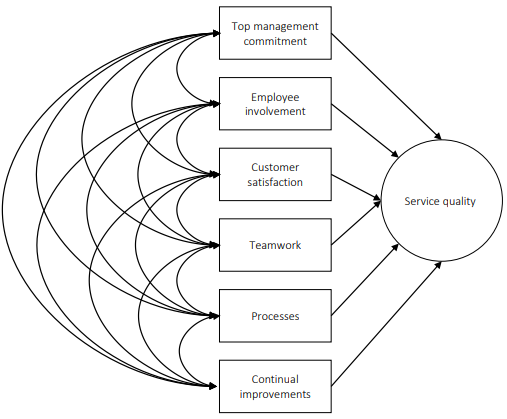
The research is also anchored in the total quality management (TQM) model to investigate the research objectives. TQM is centered on quality, where every member of the organization centers on long-term excellence in customer satisfaction and the overall benefit of the organization (Daqar & Constantinovits, 2020). The main views of TQM encompass continuous improvement, management’s commitment to achieving customer satisfaction, customer focus, and employee empowerment.
TQM entails the culture, attitudes, and organization of any company that seeks to provide consumers with products or services that meet their needs. Daqar and Constantinovits (2020) state that this culture requires a specific level of quality to be applied across all phases of operations. In healthcare organizations, TQM holds all clinicians and administrators accountable for the quality of service in the health facility (Daqar & Constantinovits, 2020). Systems within total quality management prevent clinical and administrative problems, enhance patient satisfaction, and increase organizational processes.
As a global management model, TQM encompasses various concepts. Alanazi (2020) shows that TQM includes error prevention, employee participation, teamwork, customer focus, continuous quality improvement, and leadership systemization. The ideas can be configured and transferred to any business or organization.
The findings of Alanazi align with those of Daqar and Constantinovits (2020), who describe quality as the primary tool for measuring TQM. Incessant improvement is regarded as its major model, while staff contribution is considered its approach. In the context of healthcare organizations, TQM can be gauged with little effort or deep knowledge of the healthcare sector.
In the hospital workplace, quality management can be measured using the Six Sigma model. Alasmari et al. (2021) highlight the significance of the Six Sigma model for gauging quality in hospitals, as it is highly accurate. The Six Sigma model was created to drive continuous quality improvement and to fully optimize organizational processes and activities to maintain operational excellence (Mahgoub & Ahmed, 2020). However, TQM services are more likely to adopt tools and techniques to confirm whether an existing process in the hospital workplace is functioning as expected.
Patient safety remains a core objective in all healthcare organizations. The World Health Organization (2023) defines patient safety as the absence of avoidable injury to patients and the reduction of the risk of preventable harm associated with healthcare to the tolerable minimum. Patient safety entails a framework of planned activities that establishes the culture, procedures, processes, technologies, and behaviors within healthcare organizations to sustainably and consistently reduce risks (Shenoy, 2021). Most errors that cause harm result from systemic failures that lead healthcare staff to make mistakes. Therefore, understanding the underlying triggers of errors in healthcare organizations helps ensure safety. Figure 1 presents the conceptual framework adopted in the study.
Methods and Research Design
Epistemology
The role of quality management and safety, which is critical in healthcare organizations, will be explored systematically within the constructivist/interpretivist paradigm to provide a holistic perspective. The holistic view will contribute to a greater understanding of the case at hand. From a holistic perspective, the concepts and knowledge of quality management and safety are viewed through the lens of complex systems within healthcare organizations. The interpretivist paradigm helps the investigator to explore the subjective beliefs, perceptions, and experiences of healthcare stakeholders, patients, and professionals (Alanazi, 2021). Moreover, the interpretivist perspective facilitates the exploration of diverse perspectives on the topic, yielding a holistic understanding of quality management and safety in healthcare organizations.
Methods
Protocol
The protocol outlines the guidelines the study will follow in investigating the research question. The protocol for this study outlines the study objectives, the procedure for data collection to inform the research, data analysis, data interpretation, and data translation to understand quality management and safety aspects in healthcare organizations. The protocol was considered to ensure full compliance with existing regulatory authorities and standards throughout the study.
Information Sources
The study will use both primary and secondary data to obtain in-depth information on the study topic. For secondary data, the study will conduct a systematic literature review to identify credible sources that complement the primary data. In this study, the systematic literature review (SLR) comprises six steps: defining the problem, conducting scoping research, outlining the search strategy, establishing eligibility criteria, extracting data, analyzing data, and disseminating findings (Alanazi, 2021). The SLR helps to obtain diverse sources for a detailed evaluation.
Search Strategy, Eligibility Criteria, and Variables
The search strategy will begin with identification, screening, exclusion, and inclusion methods. The secondary materials for the study will be identified and retrieved from databases such as Google Scholar, PubMed, and the Journal of Healthcare Management, using Boolean operators such as “AND” and “OR”. Duplicate records will be expunged, and the remaining materials will be examined to determine whether they provide full access.
Sources that only offer abstracts, are not in English, and are not relevant to the study topic will be excluded from the study. The selection will be eligible only if it is published in peer-reviewed journals or reputable websites and addresses topics related to safety and quality management in healthcare organizations. Discrepancies noted in study selection will be consulted with other materials to confirm the veracity. The variables entail quality improvement initiatives, TQM principles, patient safety guidelines, and patient care outcomes.
Assessing Bias, Methods of Screening, and Theoretical Explanations
To evaluate bias, the quality of research papers will be assessed using tools such as the Cochrane risk of bias tool. The tools encompass five areas of bias and illustrate the main changes when matched to the risk of bias (Ma et al., 2020). The possible sources of bias include publication bias and selective reporting, which will be addressed during data analysis and interpretation. In addition, the study will be based on the identified theoretical framework of change management theories and the total quality management model. These models will help to contextualize the study outcomes and offer theoretical explanations for the research phenomenon of quality management and safety in healthcare organizations.
Analysis Strategy
The data extraction process for this research will involve collecting primary data from various sources to provide a deep understanding of the research topic. Qualitative data will be obtained through interviews with sector stakeholders, such as healthcare professionals, administrators, and patients, to gain a first-hand understanding of the research. Quantitative data will be extracted from hospital workplace databases, electronic health records, and quality assurance reports, including incidence reports and patient care outcomes, and descriptive statistics will be used to analyze and present the results. The data will be synthesized using a logical framework anchored in both deductive and inductive reasoning.
Quality Assessment
The research will assess the quantitative studies using the Cochrane RoB tool on aspects such as incomplete reporting. Moreover, the Critical Appraisal Skills Program (CASP) will be used to assess qualitative data on the themes of data collection, research design, and analysis (Ma et al., 2020). Moreover, measures of consistency will be evaluated to establish uniformity within interventions and outcomes. In addition, the Cochrane RoB tool will continue to be used to assess the risk of bias in areas such as publication bias, geographical bias, and other biases.
Ethical Consideration
While conducting the research, the investigator will remain aware of the ethical implications that arise. The researcher will ensure anonymity for the study interviewee by ensuring that the information gathered does not include any personal details, such as name, email, or address (Nii Laryeafio & Ogbewe, 2023). Ensuring anonymity during data collection allows interviewees to provide information that ensures the dependability of findings. The research will also integrate confidentiality and privacy during information gathering from relevant stakeholders. No third party will gain access to the raw data unless the interviewee provides express authority to do so (Mirza, Mirza, and Bellalem, 2023).
The study will ensure voluntary participation and will not require or coerce anyone to participate. Compelling participants might infer that they are unwilling to share information. If participants are forced to participate in the research, they might provide false information. Moreover, the investigator will respect the rights of every interviewee at every stage of data collection and will allow participants to opt out if they are not comfortable sharing the required information or change their minds about their participation.
Reference List
Alanazi, B. M. (2021) An assessment of quality management systems and practices in general hospitals in the Kingdom of Saudi Arabia (KSA): towards initiating a holistic framework. Doctoral dissertation, Manchester Metropolitan University.
Alasmari, S. et al. (2021) ‘Sustainability of quality improvement initiatives within the Saudi Ministry of Health hospitals: an institutional overview’, Saudi Journal of Health Systems Research, 1(1), pp. 3-10.
Badham, R. J. and Santiago, B. M. (2023) Ironies of organizational change: introduction to change management and organizational theory. Cheltenham: Edward Elgar Publishing.
Daqar, M.A. and Constantinovits, M. (2020) ‘The role of total quality management in enhancing the quality of private healthcare services,’ Problems and Perspectives in Management, 18(2), pp. 64-78.
Hidayah, N. (2022) ‘The impact of integrated quality management-based health services on general hospital quality’, Frontiers in Public Health, 10(1), pp. 1-5.
Kuno, S. (2022) Elgar encyclopedia of public management. Cheltenham: Edward Elgar Publishing.
Ma, L. L. et al. (2020) ‘Methodological quality (risk of bias) assessment tools for primary and secondary medical studies: what are they and which is better?’, Military Medical Research, 7(1), pp. 1-11.
Mahgoub, W. A. and Ahmed, N. S. (2020) ‘The impact of total quality management (TQM) on efficiency of health services in Hamad Medical Corporation – Qatar’, Canadian Journal of Nursing Informatics, 15(3), pp. 1-21.
Mirza, H., Mirza, C. and Bellalem, F. (2023) ‘Ethical considerations in qualitative research: summary guidelines for novice social science researchers’, Social Studies and Research Journal, 11(1), pp. 441-449.
Nii Laryeafio, M. and Ogbewe, O. C. (2023) ‘Ethical consideration dilemma: systematic review of ethics in qualitative data collection through interviews’, Journal of Ethics in Entrepreneurship and Technology, 3(2), pp. 94-110.
O’Dowd, E. (2021) Unlocking the potential for quality improvement of healthcare complaints made about general practice in Ireland. Doctoral dissertation, University of Galway.
Shenoy, A. (2021) ‘Patient safety from the perspective of quality management frameworks: a review’, Patient Safety in Surgery, 15(1), p. 12.
Swathi, K. S, Barkur, G., and Somu, G. (2023) ‘Assessment of healthcare service quality effect on patient satisfaction and care outcomes: a case study in India’, Cogent Business & Management, 10(3), pp. 1-25.
Wondmieneh, A. et al. (2020) ‘Medication administration errors and contributing factors among nurses: a cross-sectional study in tertiary hospitals, Addis Ababa, Ethiopia’, BMC Nursing, 19(1), pp. 1-9.
World Health Organization. (2023) Patient safety.