
Risk Identification Methods
The process of recognizing and evaluating potential threats to a company to ascertain their impact is known as risk identification. Companies face various hazards, some of which may be exclusive to their industry (8 Risk Identification Methods to Discover Your Business Risks, 2022). A monetary risk may be shared between a software development firm and a construction firm if they keep their gear to accommodate modern methods (Abdel-Basset et al., 2019). Nonetheless, they may be subject to dangers unique to their field, such as intellectual property threats or occupational hazards.
The management of a firm can improve its understanding of the challenges it is up against and the steps it has to take to overcome those challenges by identifying risks. In addition, it can help give a clear image of the dangers associated with obtaining finance from banks or investors, which is a nice added plus (Leo et al., 2019). Businesses can be helped to identify potential risks through techniques such as brainstorming, conducting interviews with key stakeholders, and using the nominal group technique.
Brainstorming
Brainstorming is when a group of people gets together to discuss an issue and develop ideas for fixing it. This is the kind of meeting where the team may look ahead to the project’s future, examine the facts, and make educated guesses (Zhu et al., 2020). Risks can be identified, analyzed, and mitigated through brainstorming to gather input from those interacting directly with customers (Rocher et al., 2019). Based on their ground-level business knowledge, team members can provide unique insights into the company’s risks.
The process of brainstorming is an effective method because it fosters the development of critical thinking skills and encourages participation from all participants. Holding a monthly brainstorming session to identify the team’s biggest risks in the project is one technique to improve communication and reduce tension between management and employees (Wanner, 2019). This can also be done to foster better working relationships between the two groups.
Stakeholders Interviews
Those with a vested interest in the project or business are called “stakeholders,” Talking to them might provide insight into the threats they see facing the endeavour. Those with a vested interest in a company have often already put in substantial effort, money, or both (Kerstetter, 2021). They have a unique view of risk since they are investors rather than workers or managers (El-Baz & Ruel, 2021). Understanding the worries of the investors and how to handle them might be facilitated by adopting this frame of view.
Nominal Group Technique (NGT)
The NGT is an alternative brainstorming technique that takes a deeper dive into the topic. Each group member writes their thoughts on the problem without consulting anyone else. A team leader then has everyone share their opinions, which are recorded on a chart or whiteboard after eliminating duplicates (Queiroz et al., 2020). The team reviews each item to ensure everyone is on the same page before attempting to assign priorities (Nominal group technique – NGT, 2022). Due to this, the top three topics can be investigated in greater depth, with the team offering analysis and potential solutions (see Figure 1). This indicates that the NGT method is a more thorough alternative to brainstorming, and it relies on open communication and cooperation among team members to succeed.
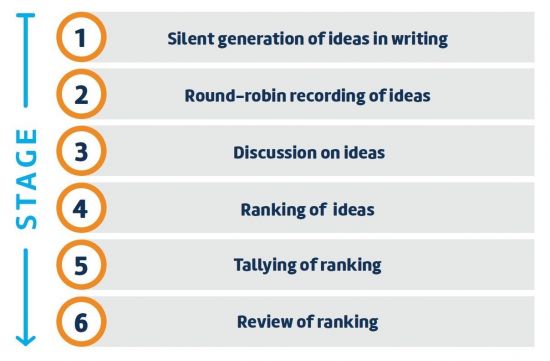
Identifying potential risks in a firm is beneficial since it outlines potential monetary, logistical, and social hurdles. In addition, identifying potential threats and developing countermeasures can assist businesses in increasing their profits and developing higher-quality services and products (Sjödin et al., 2020). Techniques like brainstorming, interviews with key stakeholders, and the nominal group technique are examples of risk assessment methods that managers and owners of businesses should be able to identify and mitigate.
Robust Risk Framework in Coca-Cola HBC
A robust risk framework is the best practice in designing and implementing a risk identification process. Risks resulting from or affecting the business activities are often identified, reviewed, and escalated (where required) using a top-down and bottom-up structure (Lamine et al., 2020). The Board must oversee the group’s risk management and internal control mechanisms and ensure they function properly (see Appendix 1) (Agustia et al., 2020).
Further, the Board sets and monitors the company’s risk appetite to ensure that the major threats to the business are mitigated to advance the company’s strategic goals and objectives (Voronova, 2022). It is the Audit & Risk Committee’s responsibility to ensure that these procedures are carried out properly, but the full Board is kept abreast of the results and any major issues that have arisen.
Every business unit at Coca-Cola usually meets monthly with senior leadership to discuss and analyze risks. The Group Business Resilience Team has a central risk register where the outcomes of these meetings are recorded and periodically evaluated (Zscheischler et al., 2022). To aid the process and ensure that management teams are examining and assessing a wide enough variety of risks, including developing risks, the Group Chief Risk Officer (CRO) attends these monthly meetings (Risk Management, n.d.). Its Group Business Resilience Team collects and analyses risks (Norrman & Wieland, 2020). The Chief Risk Officer discusses important operational risks and actions, trends, and emerging risks with the Regional Directors, their teams, and the Chief Operating Officer biannually.
I recommend that Coca-Cola take two actions to enhance its strong risk management practice. The first action is updating strategic risks and regularly identifying and evaluating developing risks. This can be done by the CRO conducting quarterly risk reviews with Group function heads (Rykhtikova, 2019). As a result, the strategic risks will be seen from a cross-functional viewpoint (Kim et al., 2021).
Finally, they need to analyze and manage strategic risks that might not have an immediate operational impact but might have a longer-term effect on our company (Ferreira de Araújo Lima et al., 2021). These developing concerns include consumer and economic trends, sustainability and climate change, human rights, and modern slavery (Beuttler et al., 2019). These two steps guarantee that Coca-Cola includes risks that might impact its business in the short and long term.
Reference List
8 risk identification methods to discover your business risks (2022) indeed. Web.
Abdel-Basset, M. et al. (2019) ‘Retracted: a framework for risk assessment, management and evaluation: economic tool for quantifying risks in supply chain,’ Future Generation Computer Systems, 90, pp. 489–502. Web.
Agustia, D., Muhammad, N.P. and Permatasari, Y. (2020) ‘Earnings management, business strategy, and bankruptcy risk: evidence from Indonesia,’ Heliyon, 6(2). Web.
Beuttler, C., Charles, L. and Wurzbacher, J. (2019) ‘The role of direct air capture in mitigation of anthropogenic greenhouse gas emissions,’ Frontiers in Climate, 1. Web.
Ferreira de Araújo Lima, P., Marcelino-Sadaba, S. and Verbano, C. (2021) ‘Successful implementation of project risk management in small and medium enterprises: a cross-case analysis,’ International Journal of Managing Projects in Business, 14(4), pp. 1023–1045. Web.
Kerstetter, K. (2021) Risk-management-stakeholders, Diligent Corporation. Web.
Kim, J., Kim, J. and Wang, Y. (2021) ‘Uncertainty risks and strategic reaction of restaurant firms amid covid-19: Evidence from China,’ International Journal of Hospitality Management, 92, p. 102752. Web.
Lamine, E. et al. (2020) ‘BPRIM: an integrated framework for business process management and risk management,’ Computers in Industry, 117, p. 103199. Web.
Leo, M., Sharma, S. and Maddulety, K. (2019) ‘Machine learning in banking risk management: a literature review,’ Risks, 7(1), p. 29. Web.
Nominal Group (2021) Better Together. Better Together. Web.
Nominal group technique – NGT (2022) Quality Gurus. Web.
Norrman, A. and Wieland, A. (2020) ‘The development of Supply Chain Risk Management over time: revisiting Ericsson,’ International Journal of Physical Distribution & Logistics Management, 50(6), pp. 641–666. Web.
Queiroz, M.M. et al. (2020) ‘Impacts of epidemic outbreaks on supply chains: mapping a research agenda amid the COVID-19 pandemic through a structured literature review,’ Annals of Operations Research, 319(1), pp. 1159–1196. Web.
Risk management (no date) Coca-Cola HBC Group Website. Web.
Risk manager skills: Definition and examples | indeed.com (2023). Web.
Rocher, L., Hendrickx, J.M. and de Montjoye, Y.-A. (2019) ‘Estimating the success of re-identifications in incomplete datasets using generative models,’ Nature Communications, 10(1). Web.
Rykhtikova, N. (2019) “Methodical and practical aspects of the analysis of the state and development of risk management systems for international corporations,” Proceedings of the International Scientific-Practical Conference “Business Cooperation as a Resource of Sustainable Economic Development and Investment Attraction” (ISPCBC 2019) [Preprint]. Web.
Sjödin, D. et al. (2020) “An agile co-creation process for digital servitization: A micro-service Innovation Approach,” Journal of Business Research, 112, pp. 478–491. Web.
Tan Pham, N., Tučková, Z. and Phu Thi Phan, Q. (2019) ‘Sectoral analysis of the effectiveness of bank risk capital in the Visegrad Group countries,’ Journal of Business Economics and Management, 20(3), pp. 446–465. Web.
Voronova, O. (2022) ‘Improvement of warehouse logistics based on the introduction of Lean Manufacturing Principles,’ Transportation Research Procedia, 63, pp. 919–928. Web.
Wanner, R. (2019) Identify risks successfully with brainstorming, microtool. Web.
Zhu, Q., Golrizgashti, S. and Sarkis, J. (2020) ‘Product deletion and supply chain repercussions: Risk management using FMEA,’ Benchmarking: An International Journal, 28(2), pp. 409–437. Web.
Zscheischler, J. et al. (2022) ‘Perceived risks and vulnerabilities of employing digitalization and digital data in agriculture – socially robust orientations from a transdisciplinary process,’ Journal of Cleaner Production, 358, p. 132034. Web.
Appendix 1: The Key Features of Coca-Cola HBC Enterprise-Wide Risk Management System
- Group declarations regarding the strategic goal, morals, and values
- Business ideas and objectives that are extremely clear
- Structured risk management guidelines
- A risk universe that is well-defined and in line with the company’s strategic growth pillars:
- Use the business’s exclusive 24/7 Portfolio
- Gain market advantage
- Drive growth through Investment and Competitiveness
- Develop its People’s Potential, and
- Get its operating license.
- Including risk management in project management and new product development in the business planning processes.
- A systematic approach to identifying and assessing essential risks that could prevent the attainment of company goals.
- They are implementing and monitoring management procedures to reduce significant risks to a manageable level.
- They are implementing measures to ingrain risk management into the corporate culture.
- Continuous assessment of the external and internal environments of the organization for elements that could alter our risk profile.
- Emerging risk identification, assessment, and monitoring.
- As part of its third-party management procedures, the company does thorough due diligence on compliance issues related to mergers, acquisitions, joint ventures, partnerships, and other investments. It does this by looking at the policies and procedures and relevant monitoring and enforcement activities the target entity has in place, both now and in the past. This includes any laws that deal with:
- Preventing corruption and bribing
- Export restrictions and sanctions
- Money-laundering prevention
- Due diligence in the supply chain
- Human rights, including prohibitions on child labour, modern slavery, and human trafficking.
- It must regularly evaluate its captive insurance company’s cost and coverage alternatives and the type and amount of external insurance it buys.