
Executive Summary
The objective is to establish a digital campaign for Samsung to increase brand awareness and, ultimately, positively affect sales. To achieve the goal, examining the internal and external environments, as well as the factors that can hinder or contribute to campaign success, is essential. The analysis based on the SWOT framework highlights that Samsung benefits from its effective branding, product diversification, its presence in emerging markets, and technological advancements. At the same time, expensive marketing, quality control issues, high competition, and strict regulations adversely affect the internal and external environments.
Additionally, the PESTLE examination highlights the benefits of a favorable economic situation, a strong presence in countries, advanced technological capabilities, and environmental agendas. Porter’s 5 Forces suggests intense rivalry, especially with Apple, is the main element hindering competitiveness. As a result, Samsung should consider these factors when marketing to its consumer base, which consists of young, ambitious individuals ready to invest in high-quality technology. The digital campaign aims to generate attention by outlining the goals, objectives, and strategies to facilitate brand recognition and sales.
Introduction
Samsung is a major tech giant that manufactures and retails a wide range of products, including smartphones, laptops, TVs, and stoves. However, it is essential to acknowledge that competition has become more rigged over the last few years, as the overall tech segment has advanced and more organizations can offer goods of similar quality. An example is Apple, the leading company in smartphone sales, and Samsung’s competitor in the market. Establishing a digital campaign to increase brand awareness, consumer loyalty, and sales is vital.
In this paper, Samsung’s external and internal environments will be examined, with a focus on the positive aspects to be maximized and the negative aspects to be minimized. Moreover, a consumer assessment will be conducted to identify the target demographic. As a result, Samsung will address the existing barriers, such as high competition, and create an image that will attract new consumers and inspire those already investing in the brand.
Situational Analysis
A situation analysis provides insight into the factors that can impact a company’s opportunities in its internal and external environments. To perform Samsung’s analysis, several tools and measures can be applied. The SWOT framework will help identify business factors that currently affect or will affect the organization, directly or indirectly. The PESTLE analysis will similarly help assess factors correlating with marketing opportunities. Furthermore, Porter’s forces will be employed to highlight competitiveness.
SWOT Analysis
A SWOT analysis of Samsung can identify its strengths, weaknesses, opportunities, and threats within its internal and external environments. The internal environment benefits from the brand’s recognition, the company’s innovative approaches, financial success and stability, and the variety of products Samsung offers (Table 1). On the other hand, Samsung faces high marketing costs and negative aspects of relying on smartphone sales. Furthermore, quality control issues have minimized trust and consumer loyalty. Simultaneously, the organization is in a favorable external environment, driven by the growth of the tech sector and emerging markets. Nonetheless, the high competition, ever-changing consumer demands, and strict regulations hinder potential success.
Table 1: SWOT Analysis
PESTLE Analysis
Political Factors
Political stability plays an integral role in the success of an organization. Samsung has faced political pressure in Africa and Latin America. In addition, South Korea’s tense relations with North Korea have hurt Samsung’s home market (Shamout and Elayan, 2020). However, China and India offer the company a favorable business environment, allowing it to capitalize on emerging markets
Economic Factors
The global economic environment has been favorable for Samsung. The company has continued to grow despite the global economic slowdown and has benefited from low-interest rates and increasing consumer confidence (Shamout and Elayan, 2020). Samsung has reduced costs by taking advantage of economies of scale and utilizing new technologies to increase efficiency.
Social Factors
Social factors include group-specific customs, traditions, and practices. Social status influences product demand and work ethic. Even after expanding to many countries, Samsung still customizes its products for local customers. Its large-screen smartphones and tablets have met consumer demand, and the Galaxy series is popular in major markets.
Technology Factors
The technological environment surrounding Samsung has rapidly changed in recent years, as the company has invested heavily in research and development. The company has benefited from technological advances like the Internet of Things, artificial intelligence, and 5G.
Legal Factors
The legal environment surrounding Samsung has changed in recent years, as the company has faced legal challenges from various governments and international organizations. The organization has been involved in various patent disputes, antitrust lawsuits, and labor disputes.
Environmental Factors
The company has been investing in energy-efficient products and renewable energy sources, such as solar and wind power. In addition, the company has been taking steps to reduce its carbon footprint and improve its environmental performance.
Competitive Analysis
A digital campaign to increase brand awareness should be considered from the competitors’ perspective. Namely, marketing can minimize rivals if the brand efficiently targets consumers and creates content correlating with customer loyalty. Competitive analysis will be addressed from an analytical perspective by employing Porter’s 5 Forces tool. As a result, Samsung will be assessed from the perspective of existing threats correlating with market competition as well as buyers, suppliers, and entrants’ threats and powers.
Porter’s 5-Forces
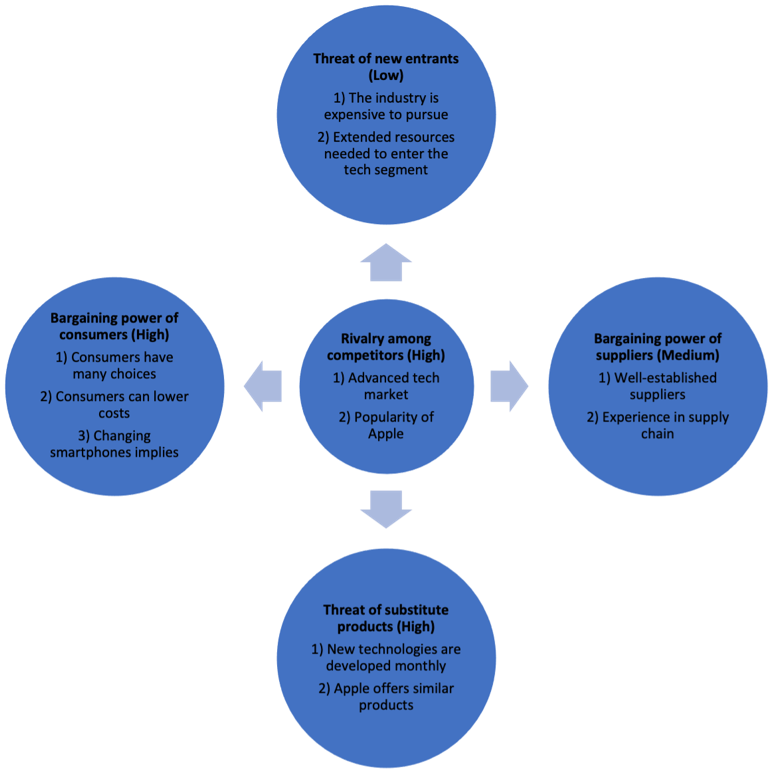
Figure 1 highlights the factors that correlate with the company’s competitive environment. The electronics industry is highly competitive, and market entry barriers are relatively high, especially with Samsung’s well-established reputation, strong brand loyalty, and huge research and development capabilities. Thus, the threat of new entrants is low, mainly due to the extensive resources needed to establish a new tech company.
Additionally, the bargaining power of suppliers is on a medium level as Samsung has built strong relationships with its suppliers over the years, allowing it to negotiate favorable terms and prices (Shamout and Elayan, 2020). The buyers, however, have high power since they are relatively price sensitive and have a wide range of choices when purchasing electronics. Similarly, the threat of substitutes is high because Samsung faces intense competition from other established players in the electronics industry, such as Apple, LG, and Sony.
Consumer Profiles
The campaign will target consumer personnel profiles—young professionals and business owners who use Samsung products. It will highlight the benefits of Samsung products to this consumer base and how they can help them professionally. It will combine digital channels like social media, ads, and emails to reach our target audience. The campaign will demonstrate the features of Samsung products and their value compared to other products on the market. It will offer discounts and special offers to attract customers to purchase Samsung products.
Digital Campaign
The digital campaign will be the primary focus to maximize engagement in content related to Samsung as a brand and its products. For it to be effective, an algorithm will be implemented to ensure the target audience is reached. Namely, the videos will be posted on channels and platforms preferred by the consumer demographic.
The articles will be uploaded on relevant websites, and social media posts will include content the target consumer will relate to. As a result, the generated content will be more successful in generating profit (Olson et al., 2021). Thus, the reach will be expanded, and more individuals will be interested in the brand.
Purpose
The purpose of the campaign is to generate interest by increasing brand awareness. The digital campaign implies that the information will be distributed across multiple channels, such as social media, email, and other online platforms (Chaffey and Ellis-Chadwick, 2019). As a result, facilitating interest correlates with attracting new consumers and motivating existing customers to continue investing in Samsung goods. The main objective is to increase sales, which is one of the primary aims of most digital campaigns.
In the case of Samsung, the company is already recognized due to its market experience and diversified products. However, a more specific purpose is to convince Apple users to switch to Samsung and influence consumers to purchase a more diverse range of goods. In this case, owners of Samsung smartphones would recognize the benefits of also purchasing Samsung laptops, TVs, and accessories for their PCs.
Digital Marketing Goals, Objectives, Strategy, and Tactics
As mentioned previously, the campaign’s primary goal is to increase profit. This, however, can be achieved by setting smaller objectives, such as increasing brand loyalty and interest in new releases. One of the strategies is to create channels of communication between Samsung and its consumers, which can be achieved through social media presence. The tactic of receiving helpful feedback while simultaneously generating interest can assist in reaching a higher engagement and increased sales, brand loyalty, and more consumers choosing Samsung over competitors.
Increasing brand awareness, while necessary, is a secondary aim because Samsung is already well-known, as the organization has been in the industry longer than its rivals. However, customers may not choose to invest in smartphones as they are perceived as less advanced than Apple’s. The digital campaign can address this factor by increasing knowledge of the tech elements of the products, as well as the benefits regarding cost and user-friendly features.
Reference List
Chaffey, D. and Ellis-Chadwick, F. (2019) Digital marketing: strategy, implementation, and practice. 7th ed. Harlow, England: Pearson.
Shamout, M.D. and Elayan, M.B. (2020) ‘A comparative analysis of strategic planning practices in Gulf Cooperation Council Region: A case study of Huawei and Samsung companies’, Journal of Talent Development and Excellence, 12(1), pp.4891-4910.
Olson, E.M. et al. (2021) ‘Business strategy and the management of digital marketing‘, Business Horizons, 64(2), pp.285-293.