
Servant vs. Traditional Leadership
The primary goal of servant leaders sets them apart from other leadership styles. Traditional forms of leadership emphasize the leader’s position of authority, whereas servant leadership (SL) emphasizes the needs of followers. Although other leadership approaches emphasize getting things done, servant leaders prioritize their team members’ needs and development.
Under authoritarian leadership, for instance, the leader exercises unchecked authority over their followers and takes all crucial decisions behind closed doors. On the other hand, SL encourages participation from all team members and uses their ideas and suggestions to guide decision-making (Lewis, 2019). The manner of delegation differs: in conventional leadership, the goal is to lighten the leader’s burden, while in servant leadership, it is to give team members more responsibility and help them grow professionally.
Foundations and Philosophy of Servant Leadership
The very nature of leadership is fundamentally different in servant leadership compared to other models. Its primary motivation is to serve others rather than lead them. Unlike many of the other models, SL emphasizes a desire to serve first, followed by a deliberate effort and decision to serve in a leadership capacity (Stollberger et al., 2019). This contrasts with the more common starting point of a desire to lead and create changes within an organization.
Even though Greenleaf never settled on a single term for SL, he did provide a lengthy explanation that elaborated on the concept and its philosophy. Greenleaf concluded that a great leader must be willing to serve first and foremost based on his reading of Hesse’s book and his work as a management consultant. To put it another way, servant leaders prioritize their people’s needs. To what extent those who are served mature and become their own servants remains the central issue.
In Greenleaf’s opinion, the SL idea is relevant to more than only the leaders of organizations and institutions as a whole. Greenleaf encouraged businesses to prioritize the needs of their consumers and the public. Unlike other forms of leadership, servant leadership is an all-encompassing ideology with broad implications for the broader community (Langhof & Güldenberg, 2020).
The Paradox and Practice of Servant Leadership
The SL paradox is the combination of the two terms “servant” and “leadership”—the challenge of being both a servant and a leader. Upon examining the model, one will notice a contradiction: being a good servant leader requires more than a selfless attitude (Langhof & Güldenberg, 2020). To inspire others to follow in their leadership footsteps, they must possess a unique set of traits and abilities.
The servant leader, therefore, must work on being the best possible servant to foster an atmosphere where people are really served. The paradox is that it requires the leader to prioritize others’ needs over their own while still taking charge. The idea of putting others’ needs before one’s own may seem at odds with self-interest; yet, making such an effort may be a powerful means of gaining others’ confidence and loyalty.
A servant leader, for instance, might prioritize the growth of their team members over meeting immediate objectives. However, the team’s and the company’s long-term success may depend on this investment in their collective growth. Another kind of leader is the servant leader, who, in addition to the benefits already mentioned, also models accountability for team mistakes and encourages credit sharing for triumphs.
Even if a servant leader’s motivation should be a desire to serve, the graphic shows that this is just the beginning. As a result of being led by a servant leader, followers should feel motivated to emulate their example. It is represented in the continuous, unending loop that never breaks in the SL Infographic (Fig. 1).
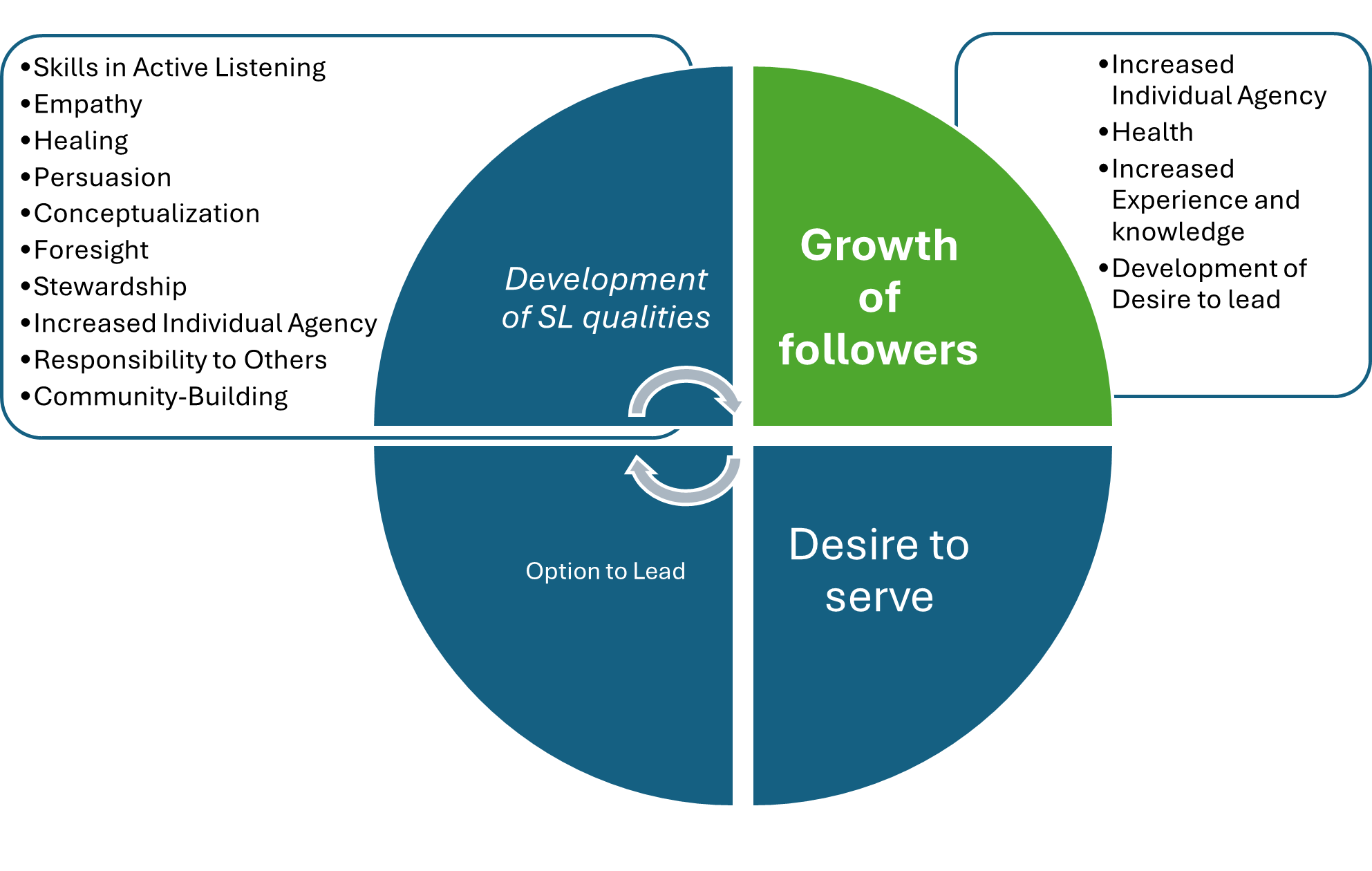
While each part of the process is of equal value, only the font-size variances reflect the relative significance of the components. To become a leader, one must, as a larger font size indicates, take charge and develop their followers or employees. Others develop as a result of servant leadership, as demonstrated in italicized font. Since a person may be influential even if they do not hold a formal leadership position, I placed the option to lead in the smallest font size.
References
Langhof, J. G., & Güldenberg, S. (2020). Servant leadership: A systematic literature review—Toward a model of antecedents and outcomes. German Journal of Human Resource Management, 34(1), 32-68.
Lewis, D. E. (2019). Old Testament view of Robert Greenleaf’s Servant Leadership Theory. J. Bibl. Perspect. Leadersh, 9, 304-318.
Stollberger, J., Las Heras, M., Rofcanin, Y., & Bosch, M. J. (2019). Serving followers and family? A trickle-down model of how servant leadership shapes employee work performance. Journal of Vocational Behavior, 112, 158-171.