
Introduction
William Shakespeare is primarily recognized as one of the most renowned personalities in English literature, with his plays and sonnets widely regarded as among the finest works of literature ever written in the English language. However, scholars and fans have long debated who wrote Shakespeare’s plays. The authorship controversy relates to the debate over the legitimacy of Shakespeare’s work, and it is one of the most enduring and fascinating literary puzzles.
The controversy about authorship stems from the fact that little is known about Shakespeare’s life, and his education and experiences are insufficient to explain the depth and complexity of his works. Some critics claim that the plays were written by someone else or that Shakespeare was actually a pseudonym for a group of anonymous authors. This dispute has far-reaching implications beyond the realms of literature and drama.
Shakespeare’s plays molded English culture and history and continue to influence our understanding of the world. As a result, the question of Shakespeare’s authorship is more than just an academic curiosity; it has important implications for our understanding of early modern England’s literary and cultural heritage. The authorship of Shakespeare’s works, specifically whether Shakespeare wrote his own plays, is a crucial area of inquiry that can shed light on the interpretation and appreciation of his literary legacy, while also revealing important insights into the historical and cultural context of early modern England.
Literature Review
For centuries, historians, critics, and aficionados have argued about who wrote Shakespeare’s plays. The traditional theory, also known as the Stratfordian theory, suggests that William Shakespeare wrote all the works attributed to him. The main argument evidences this theory: during his lifetime, several works were published under his name, first of all, two poems in 1593 and 1594, plays, some of which were published more than once, and sonnets (Leigh et al. 1). A large body of historical, literary, and linguistic data also backs up the argument. For instance, contemporary testimonies and artifacts refer to William Shakespeare as both a writer and a performer, as seen in the First Folio (Leigh et al. 1).
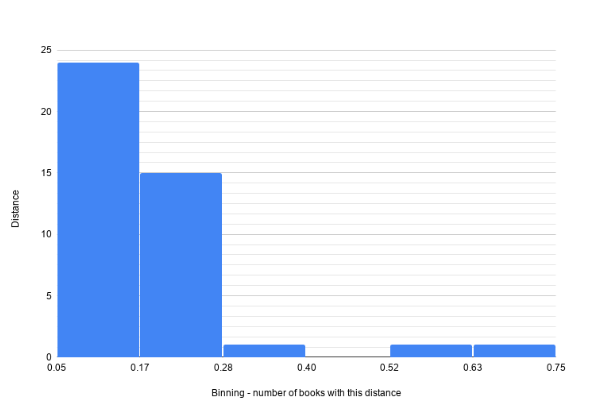
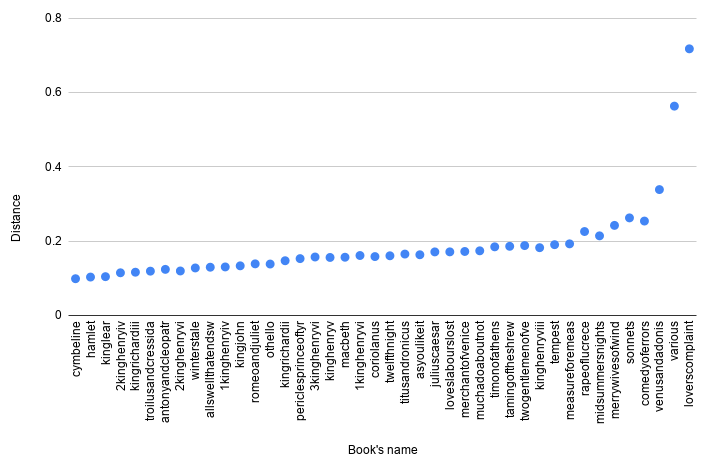
The theory’s strength lies in the enormous quantity of historical, literary, and linguistic evidence that supports the mainstream hypothesis. For centuries, most academicians and literary experts have acknowledged Shakespeare’s authorship. However, the weakest point is that it is believed that Shakespeare never attended the University. Still, his works demonstrate encyclopedic knowledge of history, physics, astrology, and other subjects (Leigh et al. 7). There are also specific gaps in the historical record concerning Shakespeare’s life and career (Figures 1 and 2).
Controversial theories are associated with individuals such as Henry Neville, Francis Bacon, Edward de Vere, and Christopher Marlowe, all of whom are believed to be potential authorship candidates. However, the most popular theory is often called the “Oxfordian theory”, which states that Edward de Vere, the 17th Earl of Oxford, wrote Shakespeare’s works. This argument posits that de Vere was a well-educated nobleman with the knowledge and experience necessary to create the plays and sonnets (Leigh et al. 4). Shapiro also examined alternative theories, which were primarily based on the notion that a man from humble beginnings could not have authored such magnificent works. Thus, he states that Shakespeare’s plays were written by various people, including Francis Bacon, Christopher Marlowe, and Edward de Vere.
The strongest point of the theory is that there are several connections between de Vere’s life and the ideas and characters in Shakespeare’s plays. Furthermore, several literary specialists have noticed parallels between de Vere’s work and Shakespeare’s.
Nevertheless, the Oxfordian view largely relies on circumstantial evidence and necessitates considerable conjecture. No concrete historical or literary evidence links de Vere to Shakespeare’s works. According to the Oxfordian school of thought, there are significant parallels between de Vere’s life and the concepts and characters in Shakespeare’s plays. Several literary experts have also discovered links between de Vere’s work and Shakespeare’s.
It is necessary to examine both the historical and cultural context in which Shakespeare wrote, as well as the nature of the evidence that has survived from this period, when assessing the strengths and weaknesses of each argument. For example, Vickers assesses the evidence for each theory, including personal, historical, and linguistic data. He also investigates the methods used to identify authorship, such as stylometric and paleographic studies. While these methodologies have limits, Vickers believes that when combined with other types of evidence, they can give valuable insights into the authorship question (18).
Similarly, Jackson acknowledges certain inconsistencies and anomalies in the plays, but maintains that they are inherent to any writer working over a lengthy period. He also criticizes alternative authorship ideas, claiming that they are frequently founded on shaky evidence and fail to account for the entirety of Shakespeare’s work (Jackson). While some reasons for considering alternative candidates may be valid, Posener (2017) points out that they often rely on speculation and supposition rather than actual evidence. In contrast, the evidence supporting Shakespeare’s authorship is more substantial and drawn from various sources.
Historical Evidence
Historical evidence plays a crucial part in the controversy over Shakespearean authorship. Due to the substantial historical evidence linking him to these works, supporters of the conventional view of Shakespearean authorship argue that William Shakespeare was the actual author of the plays and sonnets attributed to him. Some academics, however, argue that the historical circumstances in which Shakespeare’s plays were written, as well as the social, political, and cultural aspects that may have influenced their development and interpretation, suggest that the conventional perspective is flawed.
Analyzing the historical context in which Shakespeare’s plays were written, it is evident that Shakespeare lived and worked in England during a period of immense social, political, and cultural upheaval. According to Jackson, it is argued that the traditional view of Shakespearean authorship is based on a flawed assumption that “great writers must have had great lives” (153). However, the Elizabethan Age led to the development of the middle class, the expansion of trade and business, and the creation of new forms of entertainment, such as the theater.
Examining biographical material and records about Shakespeare’s life is also essential in the authorship issue. While much historical evidence links Shakespeare to the plays and sonnets attributed to him, some academics argue that the historical record of his life and work is incomplete. For example, there are no surviving manuscripts in Shakespeare’s handwriting, and no clear record of his education or apprenticeship as a writer remains.
In the argument over authorship, it is also crucial to discuss the sociopolitical and cultural aspects that may have impacted the production and interpretation of Shakespeare’s work. Some experts suggest that the plays and sonnets attributed to Shakespeare may have resulted from a collaborative effort by multiple writers and actors. Furthermore, some academics suggest that cultural and political circumstances, such as the Victorian era’s focus on morality and propriety, have impacted how Shakespeare’s work is interpreted.
Literary Techniques
Another element considered in the controversy over Shakespearean authorship is the literary approaches utilized by William Shakespeare in his plays and sonnets. Traditionalists say that Shakespeare’s complex characters, deep storylines, and rich language demonstrate his remarkable writing competence. Some academics, however, have questioned whether a single person could have created such a massive corpus of work of such high quality.
Considering the literary approaches and issues in Shakespeare’s plays is necessary for evaluating the authorship debate. Many of Shakespeare’s plays deal with themes such as love, power, and vengeance, and they include complex characters motivated by a range of emotions and desires. Some historians feel that these themes and characters are evidence of Shakespeare’s exceptional writing talent, while others argue that they are the product of collaboration among several authors.
Using classical materials and theatrical tropes in Shakespeare’s works is also significant in determining authorship. Various classical sources inspired Shakespeare’s works, including ancient Greek and Roman plays and mythology. He also employed a variety of theatrical tropes to produce complex and entertaining plays, such as soliloquies, asides, and dramatic irony. Some academics argue that Shakespeare’s use of these tactics and sources demonstrates his exceptional writing competence. In contrast, others think they resulted from collaboration between numerous authors.
Finally, the historical context in which Shakespeare wrote and his background are essential factors in determining authorship. Shakespeare was born and raised in a working-class family, and there is no evidence that he had more than a rudimentary education. Some academics feel that his upbringing would have made it difficult for him to create such complex and profound works independently. In contrast, others believe it gave him a unique worldview, allowing him to develop such captivating characters and themes.
Linguistic Patterns
Scholars have resorted to language patterns and stylistic traits in Shakespeare’s works in recent years to provide insight into the authorship controversy. Linguistic analysis evaluates language usage patterns, such as word choice, syntax, and grammar, to uncover consistent patterns that may indicate a particular author’s work. For instance, Blake’s (2006) book is based on a considerable examination of Shakespeare’s works and uses linguistic analysis to detect and classify the author’s non-standard English. It mainly contains various non-standard terms and phrases, such as colloquialisms, slang, dialect, archaic language, and frequent idioms and expressions used in Elizabethan English.
One of the strengths of linguistic analysis is impartiality. It employs a scientific approach to authorship evaluation, which may help overcome subjective biases inherent in other techniques. In this sense, Hays uses language analysis and thematic contradictions to argue that Shakespeare did not contribute meaningfully to the play (56). According to Hays, the space’s historical and political backdrop and the known participants’ writing styles better explain the manuscript’s development (Hays 56). Linguistic analysis can also detect tiny distinctions in the style that are not visible to the human eye, aiding in the difference between authentic Shakespeare works and those claimed to be by him but authored by someone else.
Linguistic analysis, however, has limits. It may be difficult, for example, to discern between the author’s explicit style decisions and unconscious language usage patterns that are not unique to a given writer. Furthermore, rather than being unique to Shakespeare, the linguistic patterns observed in his works may have been affected by the usage of standard language and traditions of the period. Despite these constraints, language research has yielded intriguing insights into the authorship controversy. Leahy (2019) suggests that the authorship debate can be approached by approaching “inguistic patterns” and stylistic features of Shakespeare’s plays. The study discovered that Shakespearean stylistic traits differed considerably from those of other writers’ plays, lending credence to the traditional notion of Shakespearean authorship.
Conclusion
In conclusion, the controversy over Shakespearean authorship remains contentious, with several hypotheses and reasons supporting various assertions. The historical evidence emphasizes the difficulties in establishing who wrote Shakespeare’s works since the little information known about his life and the historical setting in which he lived can lead to opposing conclusions. The literary and linguistic study makes a persuasive case for Shakespeare’s authorship, emphasizing his distinctive style and noting the probable impact of other writers and sources.
The ramifications of this discussion for the future are enormous because our understanding of Shakespeare’s works and their place in literary and cultural history is inextricably linked to the issue of authorship. Further research should look at the possibility of merging historical, literary, and linguistic studies to acquire a better grasp of the authorship question. Furthermore, regardless of established ideas or traditions, this argument emphasizes challenging our preconceptions and critically scrutinizing the evidence. As our understanding of history and culture evolves, it is critical to approach these discussions with an open mind, welcoming new ideas and viewpoints and engaging in constructive discourse and debate.
Works Cited
Blake, N. F. Shakespeare’s Non-Standard English: A Dictionary of His Informal Language. Thoemmes Continuum, 2006.
Hays, Michael L. “Shakespeare’s Hand Unknown in ‘Sir Thomas More’: Thompson, Dawson, and the Futility of the Paleographic Argument.” Shakespeare Quarterly, vol. 67, no. 2, 2016, pp. 180–203. JSTOR. Web.
Jackson, MacDonald P. “Shakespeare, Single Authorship, and the Progress of Knowledge.” Shakespeare Quarterly, vol. 68, no. 2, 2017, pp.149-66.
Leahy, William. “Shakespearean Authorship: A Practical Guide”. Literature Compass, vol. 16, no. 4, 2019. Web.
Leigh, R. John, et al. “A Scientific Approach to the Shakespeare Authorship Question.” SAGE Open, 2019, pp. 1-13. Web.
Mokryn, O. and Shoshan, H. B. “Domain-based Latent Personal Analysis and its use for impersonation detection in social media.” 2020. Web.
Posener Michael. “The Shakespeare Authorship Question: A Crackpot’s View.” Maclean’s, vol. 130, no. 35, 2016, pp. 32-33.
Shapiro, James S. Contested Will Who Wrote Shakespeare? Faber and Faber, 2011.
Vickers, Brian. “Shakespeare and Authorship Studies in the Twenty-First Century.” Shakespeare Quarterly, vol. 62, no. 1, 2011, pp. 106–142. Web.