
Significance of Maize Industry in South Arican Agricultural Sector
Background
Most primary grains are produced in South Africa’s market-driven, highly diverse agricultural sector. Around 10% of South Africa’s $12.0 billion in total export revenue in 2021 came from the agriculture industry (International Trade Administration, 2023). One of the most significant agricultural sectors in South Africa is the grain sector, which includes the growing of barley, maize, oats, and wheat (International Trade Administration, 2023). This sector accounts for more than 30% of the country’s total gross agricultural output (International Trade Administration, 2023).
Market Share
The market share of the maize industry is substantial, with the majority of South Africa’s maize crop being produced by more than 9,000 commercial maize farmers. At the same time, the remainder comes from thousands of small-scale farmers (Agbugba et al., 2020). Since maize is the primary staple crop in South Africa, it has the potential to significantly improve the lives of small-scale farmers and enhance food security (Agbugba et al., 2020). Therefore, since maize is a staple food, it continues to maintain its role in the market.
Competition
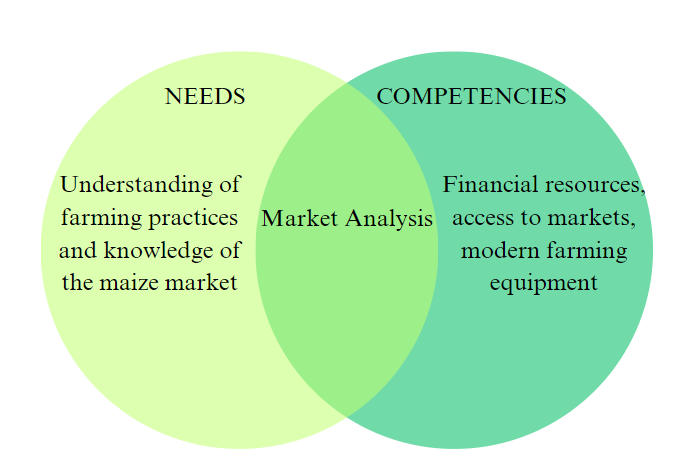
However, the market’s characteristic is that it is quite monopolistic. There are several participants in South Africa’s significantly competitive maize market. Pioneer Foods, RCL Foods, Tiger Brands, and Premier Foods are the biggest businesses in the sector (Reuters, 2022). The companies above have a considerable market share, with Pioneer Foods, the nation’s largest producer of maize, having a 20% market share (Reuters, 2022). Still, due to its importance to the agricultural business and the national economy, the South African maize industry was chosen as the subject of this paper. The sector can expand and advance if farming practices and knowledge of the maize market are improved with the help of financial resources, as seen in Figure 1.
Value Chain and Current Model in Market
Stakeholders
The value chain in the maize industry includes several stakeholders. Overall, the stakeholders include “farmers, researchers, input suppliers, farmworkers, unions, farm advisors, processors, retailers, consumers, policymakers, silo owners, and financiers” (International Trade Administration, 2023, para.24). Each stakeholder plays a vital role in the business idea through their contributions. As seen in Table 1, many issues can be involved, ranging from political to governmental concerns. However, with each stakeholder, it is possible to ensure food security and employment opportunities, while also managing supply and demand efficiently.
The current model in the South African environment market is to ensure a successful transition from farming to consumers (Ala-Kokko et al., 2021). Initially, farmers sell their maize harvest to processors who, in turn, sell the goods to retailers, finally reaching consumers. Therefore, policymakers and financiers play a crucial role in the process, facilitating support and market growth.
Business Idea and Role of Value Chain
The business idea is to create an online platform that facilitates faster and more effective connections between suppliers and processors. This idea aims to create a simplified business environment that enables suppliers to reach new markets and contribute to their own success. Our role in this process is to offer profitability to maize industry suppliers and connect all stakeholders to promote a sustainable environment. Providing such a platform enables the industry to grow and develop, ultimately benefiting the economy.
Table 1. PESTLEG Analysis
References
Agbugba, I. K., Christian, M., & Obi, A. (2020). Economic analysis of smallholder maize farmers: implications for public extension services in Eastern Cape. South African Journal of Agricultural Extension, 48(2), 50-63. Web.
Ala-Kokko, K., Nalley, L. L., Shew, A. M., Tack, J. B., Chaminuka, P., Matlock, M. D., & D’Haese, M. (2021). Economic and ecosystem impacts of GM maize in South Africa. Global Food Security, 29, 1-11. Web.
International Trade Administration. (2023). Agricultural sector. Web.
Reuters. (2022). South Africa’s Premier Group intends to list on Johannesburg exchange. Web.