
Executive Summary
Conscious consumption is an undeniable tendency and necessity of the twenty-first century, which presents an opportunity to introduce unique visions. This business plan represents one such idea: the creation of the St. Brand service, which provides a $100 monthly subscription service in exchange for receiving up to four fashionable and comfortable items per month. The primary advantage of rental services is that they can reduce the stress level of users trapped in hedonistic adaptations. The company’s strategy is to gradually expand the range of products while maintaining its high quality. Sharing trends and customers’ desire to look unique are the primary stimulators of commercial service possibilities.
The leading requirements that St. Brand will satisfy are practicality, economic efficiency, and the possibility of ordering from home. PERT methodology, Agile tools, poker planning, and SMART goals will be used to implement the business project successfully. Market analysis shows low concentration, opening grand opportunities for loyal customers. The market leader strategy will be enforced to achieve the goals, emphasizing the service’s uniqueness and innovation. The report contains precise information concerning the service’s strategic planning and implementation specifics, confirming the idea’s relevance and viability.
Strategic Direction
One of a brand’s most significant tasks is to connect with its target audience. Shrivastava et al. (2021) state that a company must formulate certain missions, principles, and values that construct the strategic direction to gain customer trust. The St. Brand’s principal mission is to help clients feel more confident while providing unique and individual clothes. The precisely chosen look influences the internal state and self-perception of buyers, who are the company’s principal value. Based on this, the brand’s strategy is to improve the quality and expand the range of products to meet customers’ desires.
The company is an intersection of style, uniqueness, and quality materials, seeking to attract and retain the most valuable people. The company’s vision can be formulated as follows: “Every customer request is an opportunity for creative solutions.” Nevertheless, it is noteworthy that St. Brand strives to develop in harmony with society, building its work on the principles of transparency and creating timeless and comfortable clothes, adding more comfort to the lives of those who wear them. The company aims to become the number one brand in the world of casual but unique images for everyday life.
Definition of Service
Steady production and customers’ desire to share rather than own have caused rental services to grow in popularity. At the same time, car rental remains the most popular service, leaving other types of goods behind. Despite this, a significant part of human expenses is occupied by clothes. That is why the idea arose to create a new service, St. Brand, offering a $100 subscription in exchange for getting up to four images each month for an unlimited time. Moreover, the service will provide personalized support and the opportunity to own unique casual wear created by the designer.
The canvas below provides a more detailed definition of the service and the basic components of the project. St.Brand is a unique service based on sustainability principles, offering a refund of 10 percent of the purchase on the card when returning goods. The company’s vision is to reduce one’s expenses with one click: a monthly subscription that allows one to get multiple stylist-picked handmade outfits within a few minutes.
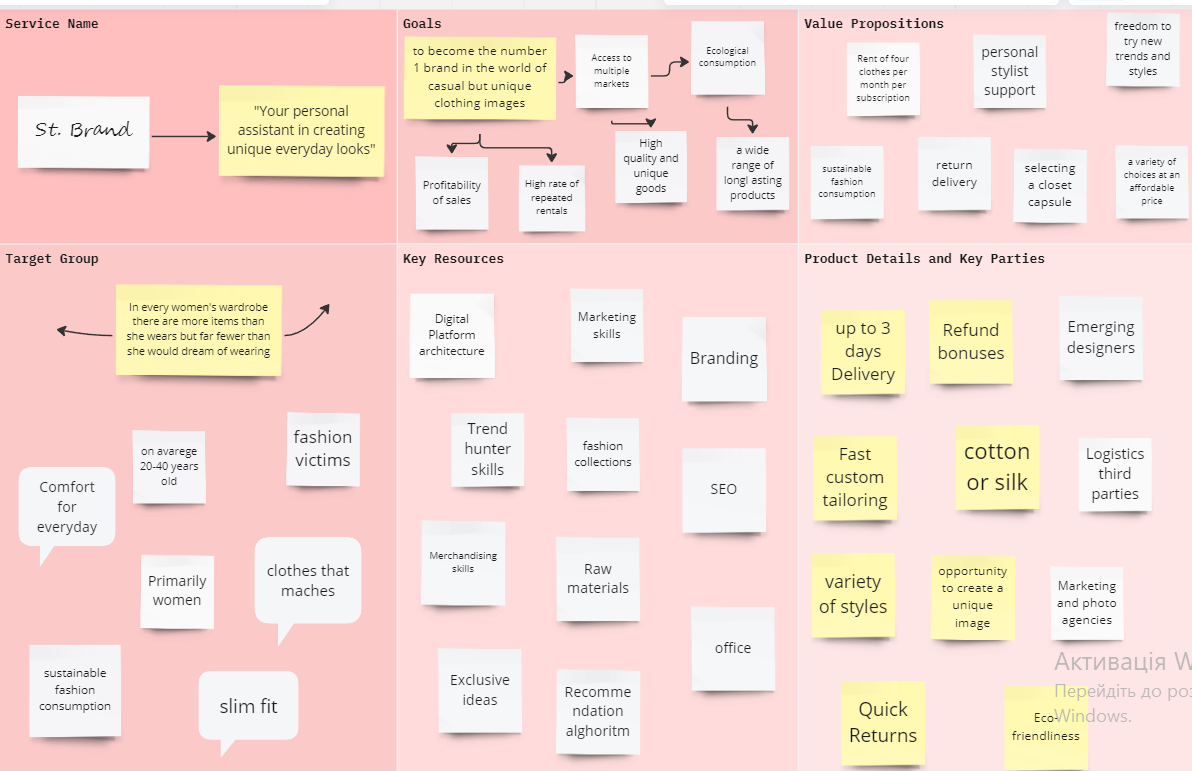
Commercial Opportunities
The commercial opportunity for the business is promising due to the growth in demand for the service. People consume 400% more clothes than 20 years ago, and 150 billion closet items are produced annually (Online clothing rental market, 2023). It is enough for everyone to buy one or two new clothing items every month. The Online clothing rental market (2023) predicts that by 2030, the consumption of clothing and footwear will increase from 62 to 102 million tons, which is harmful to the environment. At the same time, this opens up opportunities for the commercial growth of the rental store, which is a more environmentally friendly consumption option.
Moreover, the increase in demand is related to the prices of quality branded items that are unaffordable for most residents. Increasing the number of conscious buyers will, in turn, increase the company’s profitability, with the possibility of expanding services such as support for a stylist and the selection of a closet capsule. Sharing, environmental legislation, and the proper use of marketing are the foundation for the company’s development, allowing it to expand its loyal customer base and financial resources with the ability to enter new markets.
Project Concept Evaluation and Planning
The concept evaluation will be divided into an evaluation of the idea and the service itself. A manager will define the composition of the assessed processes at the stage of concept initiation, interacting with the project team and key stakeholders. For a more precise evaluation, an individual evaluation with the involvement of an expert and a collective evaluation in the form of a council with the participation of all employees responsible for different areas and processes will be applied.
Assessment of task fulfillment time will be reproduced according to the PERT methodology, focusing on the real terms of similar tasks in other projects. Agile methods and tools will be used to determine the number of short-term tasks. Planning will be implemented using a poker planning approach, one of the most popular and sought-after estimation techniques (Shrivastava et al., 2021). In this way, project participants can determine the importance of tasks and their sequencing.
Customer Needs
The primary age of subscribers to the rental service is 20-40 because older people have the necessary closet space. The niche with the rental of evening and wedding dresses is quite filled, while at the same time, there is a huge need for everyday looks. At the same time, statistics show people’s lack of funds and opportunities to purchase new outfits, which emphasizes the need to create optimal prices for service use. Furthermore, according to surveys on the change of habits of people after the pandemic, 60 percent of individuals noted the transition to online shopping (Online clothing rental market, 2023). Thus, practicality, economy, and the ability to order from home should be highlighted among the main requirements.
Market Report
The COVID-19 pandemic had a serious negative impact on the textile and apparel industry. Hossain (2020) notes that at the same time, indoor consumers were forced to buy most items online. The Online clothing rental market is segmented based on end users, predominating women, dress code (formal, casual, dressy, and traditional), and geography (North America, Europe, Asia Pacific, South America, the Middle East, and East Africa).
Online purchases permit acquiring a more expansive scope of buyers, stabilizing the demand, and are likely to have a favorable influence in the next five years (Hossain, 2020). The online clothing rental market (2023) has projected market growth at a compound annual rate of 8.89% during the forecast period (2022-2027). Market engagement is downward, and parties are expected to deliver outcomes that welcome local developer brands and design exceptional products.
Market Entry Plan
The entrance strategy will be based on transparency, and customers will be aware of the cost of all production phases. In contrast to the secure information of competitors, the brand will provide a detailed description of the prices of materials and the possible profits that should interest customers. Moreover, the market leader’s strategy will be used, emphasizing the innovation of the service, allowing it to obtain stylish and unique images created by the designer (Hossain, 2020). To successfully implement this approach, the company will focus initially on the national market, being ready to increase production capacity quickly and modify the product based on the experience gained during its mass distribution. To hold the market leader position, the company will upgrade its products to meet the requirements of different target audiences.
Competitor Analysis
The online apparel rental market is moderately fragmented, and a mix of established retailers and startups fragments the competitive landscape. While established traders seek a more expedient manner to manage their stock through rentals, startups desire to develop their corporation by delivering multi-brand outcome varieties (Bettels and Wiedmann, 2019). Nuuly, Armoire, Le Tote, Bee, and Gwynnie are among the foremost competitors.
The analysis of competitors allows us to conclude that their emphasis is on clothing sales for formal events. At the same time, casual looks are practically unavailable in the assortment. Among the strengths are affordable prices with adequate quality, service, and high customer loyalty. However, there are disadvantages, including exclusively physical stores, the absence of a developed marketing campaign, and the absence of individual approaches.
Sustained Competitive Analysis
A few decades ago, clothing shopping events were significant and well-planned. Berman (2019) emphasizes that many brands can produce up to 24 collections yearly, while people worldwide do not wear even half of their closets. St. Brand’s primary advantage is the promotion of sustainable consumption and ecology. The company will offer an exceptional service that provides a one-time subscription to clothing for $100 a month, with unlimited access to four pieces of designer clothing.
Individual approach to clients, unique images, stylist consultation, and the opportunity to create a capsule are the advantages that will allow the company to quickly occupy a leading position on the market. The rental niche is overcrowded with stores selling evening wear, while the casual, comfortable, and stylish clothes sector is not yet filled. With all the advantages they provide, active advertising of sustainable consumption and service is a strong competitive advantage.
Financial Projections
Setting up a business will require spending on various needs, including an office. Even though the business is planned online, there is a need for a warehouse that will require approximately $500 per month. Plans to run targeted advertising on social networking sites to reach the right number of people with an expenditure of about $500 per month. A no less important element of the expenses is spent directly on creating an online site, including its web design, which is about $4,000.
Moreover, materials and tools for creating fashionable images must be constantly updated, initially costing about $4,000. There are also salary expenditures, particularly for the work of the designer, stylist, and team. A subscription costs approximately a hundred dollars, depending on the additional services chosen. Despite the high cost of this type of activity, it offers a fast payback. Each unit is planned to allow for a potential gross margin of +50%.
Project Management
The project management process will start with an organizational meeting and a feasibility study. The benefits, costs, and risk factors associated with the expected project results will be outlined. The overall process of project management will be accomplished with the Kanban system, which helps visualize the project’s path from the idea to the delivery of the final service. Kanban methodology will be used to perform immediate tasks, limit their number, and distribute tasks evenly among employees.
Brydges et al. (2021) argue that this management approach will reduce costs, track processes, and delays. Electronic cards will be utilized in the management process to provide more data about the task. Moving the card through the columns of the software will provide transparency and make it easier to track the progress of the project (Berman, 2019). Instead of spending months developing the perfect solution, new functionality can be released weekly or monthly.
Project and Time Planning
Smart goals technology will be used to execute tasks quickly. SMART is a criterion for setting specific, measurable, achievable, time-bound goals (Berman, 2019). Moreover, PERT technology will be used to chart all processes. Project time planning will start with defining the project’s start and end dates, followed by checking the dates of the other key events. The creation of the project schedule will also be realized through several technologies.
To distribute time, tasks will be organized in a work allocation structure, a diagram visualizing the tasks and their subtasks. Each task will be examined for its dependency on another phase to establish order and avoid delays. The duration of the steps will be estimated using data from industry standards and the average time of similar tasks in similar projects.
Reference List
Brydges, T., Heinze, L., Retamal, M., and Henninger, C. E. (2021) ‘Platforms and the pandemic: A case study of fashion rental platforms during COVID‐19’, The Geographical Journal, 187(1), pp. 57-63.
Berman, B. (2019). ‘Flatlined: Combatting the death of retail stores’, Business Horizons, 62(1), pp. 75-82.
Bettels, J., and Wiedmann, K. P. (2019). ‘Brand logo symmetry and product design: The spillover effects on consumer inferences’, Journal of Business Research, 97(6), pp. 1-9.
Hossain, M. (2020). ‘Sharing economy: A comprehensive literature review’, International Journal of Hospitality Management, 87(2), pp. 102-470.
Online clothing rental market: Growth and forecasts (2023) Web.
Shrivastava, A., Jain, G., Kamble, S. S., and Belhadi, A. (2021) ‘Sustainability through online renting clothing: Circular fashion fueled by Instagram micro-celebrities’, Journal of Cleaner Production, 278, p.12.