
Introduction
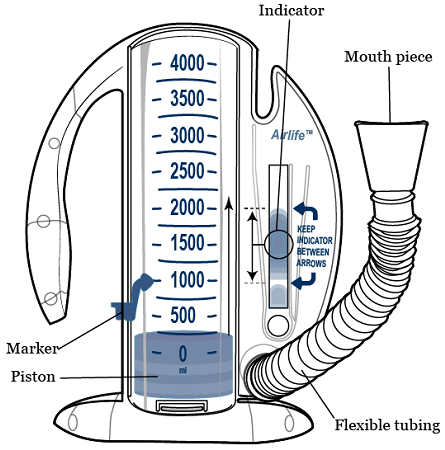
The incentive spirometer helps patients breathe deeply, avoid lung tissue collapse, and improve overall respiratory recovery, thereby enhancing lung health. The target audience for these instructions is patients who have never used an incentive spirometer and have limited prior familiarity with the device (Eltorai et al., 2019). A prospective registered nurse should learn about the three components of the incentive spirometer and be shown the proper method in this step-by-step tutorial. Patients are urged to perform the exercises as directed by healthcare specialists, approximately ten times every one to two hours, as they recognize the need for consistency and proper use.
A future healthcare practitioner should be prepared to apply this practical information to help patients breathe more easily (Cleveland Clinic, 2022). By learning about the nuances of incentive spirometer usage, the nurse can advance their medical knowledge and help individuals in their care achieve better healthcare outcomes. Therefore, these step-by-step instructions aim to help users enhance their lung function and respiratory recovery through consistent practice.
Audience, Skill Level, and Location Overview
Patients unfamiliar with an incentive spirometer and those with little prior experience using the tool are the intended audience for these instructions. The incentive spirometer can be used effectively by anyone, regardless of their medical expertise, as no special skills are required. Consistency is essential for achieving the best outcomes, and using the spirometer only requires a few minutes, several times a day, approximately ten times every 1 to 2 hours (Franklin & Anjum, 2023). As long as a person can sit straight and breathe easily without obstacles, they may use the incentive spirometer comfortably wherever they are—at home, a hospital, or anywhere else.
Materials and Tools Required
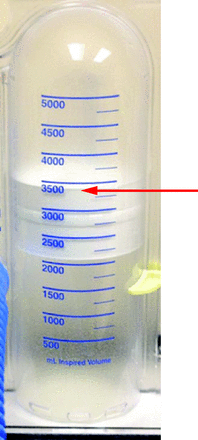
- Incentive spirometer device, as seen in Figures 1 and 4.
- Clean, well-ventilated area.
- Nonsterile gloves (Memorial Sloan Kettering Cancer Center, 2023).
- Comfortable seating (chair or bed).
- Pillow or rolled-up towel (if recovering from chest or abdominal surgery).
Steps
- To perform hand hygiene by washing hands with soap and water.
- To Prepare the Device:
- To ensure the incentive spirometer is pristine and hygienic before removing it from the container. To connect the flexible tubing to the outlet on the right side of the base and attach the mouthpiece to the opposite end of the tubing, as shown in Figure 1.
- To Sit Upright:
- To sit comfortably and upright on the edge of one’s bed or a chair (Cleveland Clinic, 2022).
- To Exhale Slowly:
- Before using the spirometer, one should exhale slowly and completely through the mouth to empty the lungs.
- Mouthpiece Placement:
- To put the mouthpiece in one’s mouth and firmly seal it with one’s lips, and verify that one’s tongue is not obstructing the mouthpiece.
- Slow and Deep Inhalation
- To breathe in (inhale) slowly and deeply through one’s mouth, aiming to fill one’s lungs with as much air as possible.
- To Watch the Indicator:
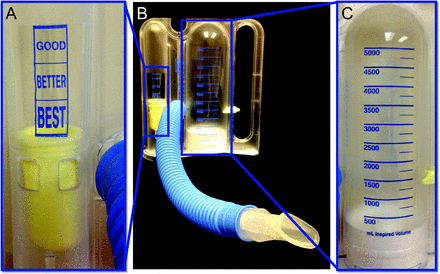
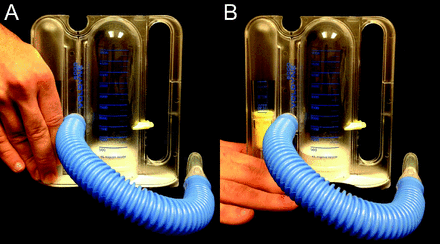
- As one inhales, one should observe the piston on the incentive spirometer rise slowly. One must ensure the coaching indicator on the right side remains between the arrows, indicating a steady breathing pace, as shown in Figures 2 and 4.
- To Hold One’s Breath:
- Once the piston reaches its highest point, one should hold their breath for at least 5 seconds to maximize lung expansion (Cleveland Clinic, 2022).
- Slow Exhalation:
- To exhale slowly and fully through one’s mouth, allowing the piston to fall back to the bottom of the spirometer.
- To Rest and Repeat:
- To rest for a few seconds before repeating steps 3 to 8 at least ten times per hour while awake.
- To Cough (If Needed):
- After completing the breathing exercises, one should cough a few times to help clear any remaining mucus in one’s lungs. One has to support one’s incision site with a pillow or rolled-up towel if necessary.
Warnings
- To stop doing the exercises immediately and take a break if one feels dizzy or lightheaded.
- To call a doctor if one experiences discomfort, trouble breathing, or a bloody cough.
- Not to use the incentive spirometer around others if one has an active respiratory infection, which may spread through the air.
- To take pain medication, since it is more challenging to take a deep breath when one is in pain.
- To keep the incentive spirometer within reach so one remembers to use it as directed.
- To use the incentive spirometer at home to help keep one’s lungs clear while one recovers.
Conclusion
Following these detailed instructions may help a nurse learn how to operate the incentive spirometer correctly, thereby improving lung function and facilitating a more effortless respiratory recovery. While awake, perform the exercises at least ten times a minute. If an individual experiences any problems, they should consult a doctor. One has to take care of oneself first as one embarks on one’s path to improved respiratory health. Regular use of the incentive spirometer will increase lung capacity, strengthen respiratory muscles, and guard against lung infections. Commit to developing a healthy respiratory system, follow these guidelines, and benefit from enhanced lung function and general well-being in the future.
References
Cleveland Clinic. (2022). Incentive spirometer. Web.
Eltorai, A. E., Martin, T. J., Patel, S. A., Tran, M., Eltorai, A. S., Daniels, A. H., & Baird, G. L. (2019). Visual obstruction of flow indicator increases inspiratory volumes in incentive spirometry. Respiratory Care, 64(5), 590–594. Web.
Franklin, E., & Anjum, F. (2023). Incentive Spirometer and Inspiratory Muscle Training. National Center for Biotechnology Information. Web.
Memorial Sloan Kettering Cancer Center. (2023). How to use your incentive spirometer. Web.