Executive Summary
Toll is an Australia-based logistics company owned by Japan Post. The company’s strategy is to provide expensive and qualitative services to large businesses while pursuing the ESG agenda. Toll’s business model relies on accumulating shipping fees as its main source of income.
Toll’s approach to competition includes implementing new technologies, such as intelligent automation, blockchain, and robotics, to improve its performance. Financially, the company reports improvement, but the overall strategy may lead to the loss of customers in the future. Instead of pursuing innovations, it is advisable to divert resources to improving basic operations, thus retaining the customer base and ensuring competitiveness within the existing technological context.
Introduction
As post-COVID-19 demand for quick deliveries increases, logistics companies are receiving more attention. Toll Group is an unusual business that originates in Australia but is owned by a Japanese company. This combination provides Toll with access to diverse markets and resources necessary for ensuring logistical services. This report aims to analyze how effective Toll is at servicing customers and achieving its ambitions.
Summary of the Organization’s Strategy
To properly understand Toll’s current strategy, it is essential to ascertain its origins. Toll Group is an old company, and its brand name can be traced back to the late nineteenth century. Although Toll was a successful international logistics company headquartered in Australia, it became even larger when it was purchased by Japan Post in 2015.
However, the overall sentiment of stakeholders and customers inclined management to believe that drastic organizational change was needed. In particular, two problems were ascertained: loss of customer focus and operational excellence (Mostert & Kern, 2021). A new strategy was meant to correct these drawbacks and ensure a better reputation.
Toll Group’s strategy can be described as an initiative to provide quality logistics services to the world’s most reputable and significant companies. It is evident in Toll’s motto: “We move the businesses that move the world” (About – Toll Group, n.d., para 1). The emphasis on the most powerful companies is important because it highlights Toll’s approach to choosing customers. The first value of the company is that “we put our customers at the center of everything” (Mostert & Kern, 2021). As a result, Toll is oriented towards large businesses that can pay high fees for the company’s services and cooperate with it consistently.
The second aspect of Toll’s strategy is to emphasize the unity of Toll’s employees at all levels. The company’s second value is that “we work together to succeed and strive to contribute beyond our responsibilities” (Mostert & Kern, 2021, p. 290). The emphasis on teamwork was especially evident in how management handled the pandemic’s first wave. Executives of all levels announced their decisions to cut their wages, ranging from the CEO, who had a 40% pay cut, to lower-ranking officials opting for a 10% pay cut (Wiggins & Sullivan, 2020). Toll continued to showcase its commitment to fostering employees by organizing training courses for them and prioritizing workplace safety.
Business Model
Toll’s business model revolves around transportation and logistical services. It delivers parcels, goods, and commodities in various ways, including ocean, air, and multi-modal freight forwarding (Toll Sustainability Report, 2022). The company’s main source of income is shipping rates. This implies that Toll benefits from the price of shipping increase across the industry, which has been evident since the start of the pandemic.
As long as the industry average rates remain high, Toll is profitable and can invest in its future. At the same time, the company provides other services, such as warehousing and even rescue missions performed by the Toll Helicopter team (Toll Sustainability Report, 2022). The downside of this model is that by limiting its target audience to powerful businesses, Toll ignores a substantial proportion of the customer base who prefer less discriminating competitors.
Approach to Competition Strategy
Being a logistics company, Toll Group has to operate in a highly competitive environment, which requires it to use technological innovations as leverage points to boost its advantage. One of the prevalent trends in the industry is the adoption of advanced robotics in warehouse centers that reduce human participation and increase efficiency (Merkert & Hoberg, 2022). Toll Group has also publicly announced its use of autonomous mobile robots in distribution centers, which are cheaper than traditional automation systems (The Rise of Robotics, n.d.). The benefit provided by robots is evident – unlike human workers, they are less likely to make mistakes, have no fatigue, and can work day and night.
Another trend followed by Toll Group is the implementation of machine learning techniques and artificial intelligence. The practical value of these innovations is wide, ranging from real-time optimization of truck routes to using the Internet of Things smart sensor technology in warehouses (Merkert & Hoberg, 2022). Both of these directions are pursued by Toll Group, which is evident in its announcements regarding the adoption of intelligent automation (Crozier, 2021). Meanwhile, it was specifically emphasized that the development of the Internet of Things is one of the objectives of the company’s innovation center (Toll Group launches, 2022). These technologies are meant to increase the efficiency of Toll’s operations, thus giving it a competitive advantage over companies that do not have access to such technologies.
Finally, Toll favors blockchain technology, which is another rapidly developing field. The primary reason companies in the logistics industry show interest in blockchain is its capacity to improve authentication and verification (Merkert & Hoberg, 2022). Toll is no exception, as it has announced plans to use blockchain to “provide end-to-end visibility on supply chains” (Toll Group launches, 2022, para. 6). Distributed ledger technology is important for logistics because it can substantially accelerate supply chains. Not only does it allow businesses to make quick transactions, but it also ensures financial transparency, thus eliminating many trust issues. Combined with investments in robotics and intelligent automation, blockchain technology highlights Toll’s view of technological innovations as leverage points against the competition.
Another important part of Toll’s approach to competition is the use of the ESG agenda. A large proportion of Toll’s public announcements is its commitment to safety, environment, and personnel well-being. There has been a spike in interest in ESG business practices in recent years. Although following them may not be profitable in the short term, companies still derive financial value from publicly proclaiming their commitment to the ESG agenda.
One of the reasons why businesses do it lies in the possibility of attracting the attention of institutional investors who favor sustainability initiatives. Logistic companies are especially scrutinized as their business operations involve movement practices that directly damage the environment, such as using gasoline-powered vehicles to move goods (Kim et al., 2021). Therefore, highlighting one’s commitment to ESG may determine whether a logistics business receives the investments.
Toll Group is also notable for its emphasis on sustainability and ESG agenda. This is evident in the Toll sustainability report (2022), which reviews the company’s efforts to reduce the impact on the environment and social consequences. The company explicitly recognizes its negative environmental impact by pointing out that the “fleet is the largest contributor to Toll’s emissions” (Toll Sustainability Report, 2022, p. 4).
Toll has committed to investing in environmentally friendly power, such as electrified fleet and hydrogen fuel. Meanwhile, another contribution to environmental degradation stems from Toll’s buildings’ carbon emissions, which it also seeks to transform by switching to renewable energy. The concern for the environment is an important marketing point of Toll’s representation.
Another dimension of the ESG agenda pursued by Toll Group is the well-being of its employees. Obsession with safety is a recurring theme in Toll’s sustainability report. It comprises compliance with the legal requirements of different countries, providing training, and ensuring safe working conditions.
Yet, physical well-being is not the only area of focus for Toll, as mental health is also accentuated as an important component of Toll’s employees’ work (Toll Sustainability Report, 2022). The company ensures it with standards of hygiene, manager-to-subordinate communication, and an overall humane attitude towards workers. Although such a public image incentivizes greater labor interest towards Toll, the real goal is receiving ESG investing. The more outside financial influx the company can ensure, the better it will respond to competition.
Performance Measurement
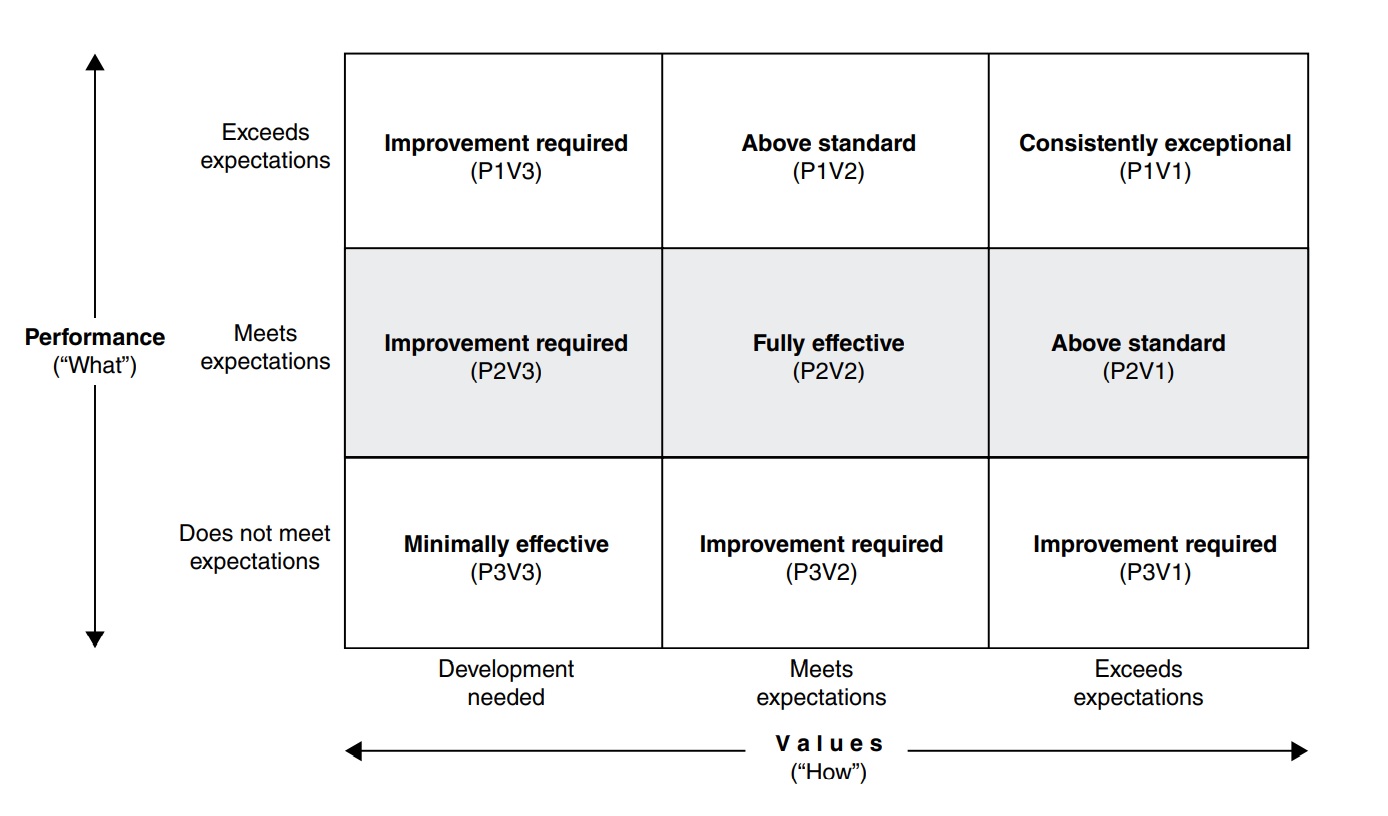
Toll’s performance measurement revolves around ascertaining how successful employees are at accomplishing objectives and respecting corporate values. The entire framework is depicted in Image 1 in Appendix A. Each employee is measured based on how committed they are to values and how effective they are in performance (Mostert & Kern, 2021).
In total, there are three layers of assessment – development needed, meets expectations, and exceeds expectations. It should also be noted that neither indicator is preferable, as both are equally important in ascertaining employees’ work. From this perspective, it is entirely possible for an employee to excel at performance, but the lack of commitment to values can render them inadequate for the company.
The subsequent implication is that the success of the company should also be evaluated using a dual metric. In general, the most commonly used metric is the financial performance of a business. The more a company manages to grow and earn without increasing debt, the more perspective such a company becomes. In the case of Toll Group, there is an indication that the company performs well financially – it reported $7.6 billion in revenue in 2022, while a significant proportion of its earnings went into business growth (Toll Group delivers, 2022). However, financial performance alone does not describe the commitment of the company to its strategic values.
The most evident metric for evaluating commitment to values would be the presence of accounts regarding Toll’s social achievements. A strike organized by the United Workers Union is an example of such an account. After the protests, the company agreed to a 3% wage increase, the creation of new jobs, and providing better training opportunities (Mcllroy, 2021). On the one hand, the company’s concessions signify Toll’s readiness to accept compromises and is a positive sign. On the other hand, the fact that such a strike happened in the first place highlights inconsistency in Toll’s practices with its strategy, which proclaimed the comprehensive protection of employees.
Balanced Scorecard
Financial Perspective
Financially, the company has experienced a positive period, having successfully overcome pandemic-related difficulties. 2022 was marked by the company’s announcement that it has accumulated “revenue of $7.6 billion, and Earnings Before Income Tax (EBIT) of $341 million, a significant increase over the prior year” (Toll Group delivers, 2022, para. 2). Compared with 2020, when management had to publicly cut its pay, Toll has significantly improved finance wise.
Customer Perspective
There are two important aspects to customer perception – how fast the business can perform its functions and how customers themselves view the business. Toll’s improving financial performance as well as receiving Award for Best Corporate & Service Provider Partnership suggest that customers are satisfied enough to continue using the company’s services (Toll sustainability report, 2022). Combined with the company’s intent to pursue the ESG agenda, Toll appears attractive to its customers.
Internal Processes Perspective
Toll’s approach to providing logistics services is comprehensive, including a wide variety of suppliers as well as subcontractors. Toll’s logistics relies on an extensive network of warehouses, planes, trucks, and ships, which allows the company to transport deliveries worldwide (Toll Sustainability Report, 2022). At the same time, it engages subcontractors for non-logistical services, such as IT, HR, and safety. As a result, the supply chain is wide enough to cover the needs of many customers in different regions.
Learning and Growth Perspective
Toll constantly seeks ways to innovate and improve its performance. At the end of 2022, Toll set aside almost $200 million for future investment opportunities, while $100 million was invested directly in new technologies and infrastructure (Toll Group delivers, 2022). Meanwhile, employees are frequently offered employer-sponsored training programs (Toll Sustainability Report, 2022). The result is sustainable learning and growing businesses that seek to capitalize on talent and new technology.
Summary of Recommendations
The major recommendation is to divert resources from innovations to customer service. The rhetoric of Toll Group’s management indicates its obsession with technological improvement while the quality of logistics suffers. The reason why Toll reports improving financial performance lies in higher shipping rates.
Toll has articulated that high rates may become a new norm. The company’s strategy to implement as many technological innovations as possible to justify its costs will likely be offset if those innovations are not successful. A more sensible strategy would be to focus on numerous small improvements, such as increasing delivery time, instead of betting on a number of prospective technologies, which are still in the early phases of development.
Conclusion
Overall, Toll has proven itself capable of deriving profit during a turbulent period, but its innovation-driven strategy may be highly risky. High shipping rates enabled by the pandemic-related recession have allowed the company to increase its revenue and invest in intelligent automation, blockchain, robotics, and other technologies. However, in order to properly manage competition, Toll also needs the quality and speed of its basic operations, which are key to retaining customers. Unless Toll recognizes the importance of customer service in the current technological context, the excessive pursuit of potential innovations may lead to its downfall.
References
About – Toll Group. (n.d.). Web.
Crozier, R. (2021). Toll Group adopts ‘two-speed’ approach to IT delivery. iTnews. Web.
Kim, J., Kim, M., Im, S., & Choi, D. (2021). Competitiveness of E commerce firms through ESG logistics. Sustainability, 13(20), 1-15. Web.
Mcllroy, J. (2021). Toll warehouse workers end strike over wages, job security. Green Left. Web.
Merkert, R. & Hoberg, K. (2022). Global logistics and supply chain strategies for the 2020s: vital skills for the next generation. Springer International Publishing.
Mostert, R., & Kern, J. (2021). Organizational culture change: Process to sustainably improve performance. In J. Kern & M. Sullivan (Eds.), The digital transformation of logistics: Demystifying impacts of the fourth industrial revolution (pp. 277-298). Wiley.
The rise of robotics. (n.d.). Web.
Toll Group delivers strong performance in financial year 2022. (2022). Web.
Toll sustainability report. (2022). Web.
Wiggins, J., & Sullivan, R. (2020). Toll Group CEO takes 40pc pay cut. The Australian Financial Review. Web.
Appendix