
Introduction
The Israeli-Palestinian conflict is one of the ongoing and problematic issues impacting the region and its stability. The opposition emerged in the second half of the 20th century and remains confusing because of the opposing views on it. Both Israel and Palestine have their own views on the reasons that triggered the war and the factors that should be considered to make an agreement and achieve peace. The differences in cultures, religions, ideologies, claims over the territory, and uncertain legal status of states make the conflict more sophisticated. The enhanced understanding of all parties’ views and arguments is key to a better understanding and the provision of a practical resolution.
The History of the Conflict
Israel declared Jerusalem its capital in 1950 and moved its state institutions there. After its victory in the Six-Day War in 1967, Israel also seized the eastern part of the city. The UN considers this occupation a violation of international law (Manusama 121). World leaders, including the “friends” of Israel, have long avoided recognizing Jerusalem as the Israeli capital (Lutz 153). Firstly, it threatened an escalation in the region. Secondly, it would have nullified the plan for a peace settlement based on the “two states for two peoples” formula – the parallel coexistence of Israel and Palestine. At the same time, the beginning of it was historical.
The anti-Israeli demonstrations coincided with “Exile Day,” annually celebrated by the Palestinian Arabs on May 15, the day after the historic founding of the State of Israel. Despite the quarantine restrictions, hundreds and thousands of people took to the streets in various cities (Jamal 365). In France, rallies were held in Marseilles, Lyon, and Paris. At the demand of Gérald Darmanin, head of the Interior Ministry, the march in the capital of the Fifth Republic was banned (Jamal 365).
However, this ban only heated up the crowd, which the police had to disperse with water cannons and tear gas. The same measures were taken against protesters in Athens. Moreover, in London, demonstrators clashed with Scotland Yard officers near the Israeli diplomatic mission, with flaming firecrackers flying at them (Ukashi). Nine police officers were injured, and thirteen protesters went into custody under the new health regulations law.
The West Bank is now under de jure Palestinian control, but de facto, it is under Israeli control. There are Israeli soldiers there all the time with the right to restrict the movement of Palestinians. Furthermore, the Israeli authorities, just as in the Golan Heights, are building Jewish settlements there, effectively displacing the Arab population from that land (Waxman 31). The Palestinians are outraged, but Israel says that this is how it protects itself from the Palestinian terrorist threat. Gaza Strip plays a critical part in this episode and conflict.
The Gaza Strip is controlled by the Palestinian militant group Hamas (not the Palestinian National Authority). Since its founding in 1987, it has waged an unrelenting war against Israel, with the sole aim of achieving absolute Palestinian domination of present-day Israel (Waxman 32). Of course, Hamas does not recognize the legitimacy of Israel’s existence. Jerusalem is located on the border between Israel and the West Bank, and both Judaism and Islam have their sanctuaries here, in close proximity to each other (Waxman 33). Therefore, both Israel and Palestine want complete control over it, and the international community’s attempts to divide power fairly are not working. At the same time, the war had to be stopped, and both sides wanted it.
After that war, Israel asserted its authority over the West Bank and the Gaza Strip, from which the shelling began on May 10, 2021, territories that are predominantly inhabited by the Palestinian population (Waxman 155). These are the two territorial components that should constitute the independent state of Palestine, a partially recognized state entity that is in the process of being established.
In addition, during the Six-Day War, Israel occupied the Golan Heights and the Sinai Peninsula (Jamal 365). The latter, however, had to be returned to Egypt, and the dispute over the Golan Heights is still ongoing between Israel and Syria. Under Donald Trump, the U.S. recognized Israel’s authority over the territory, and the Israeli government, in turn, named one of the settlements there after the 45th president of America.
The Israeli Perspective on the Issue
Speaking about the issue, it is vital to mention that, as with any conflict, this one has different interests, which have a right to exist. Speaking of the confrontation between Palestine and Israel, it is also possible to find features that speak in favor of one or the other side. Thus, Israel insists that the contested territories can be considered the indigenous land of the Israelis (Asseburg 100). Picture 1 below depicts the territory which has been contested over the years:
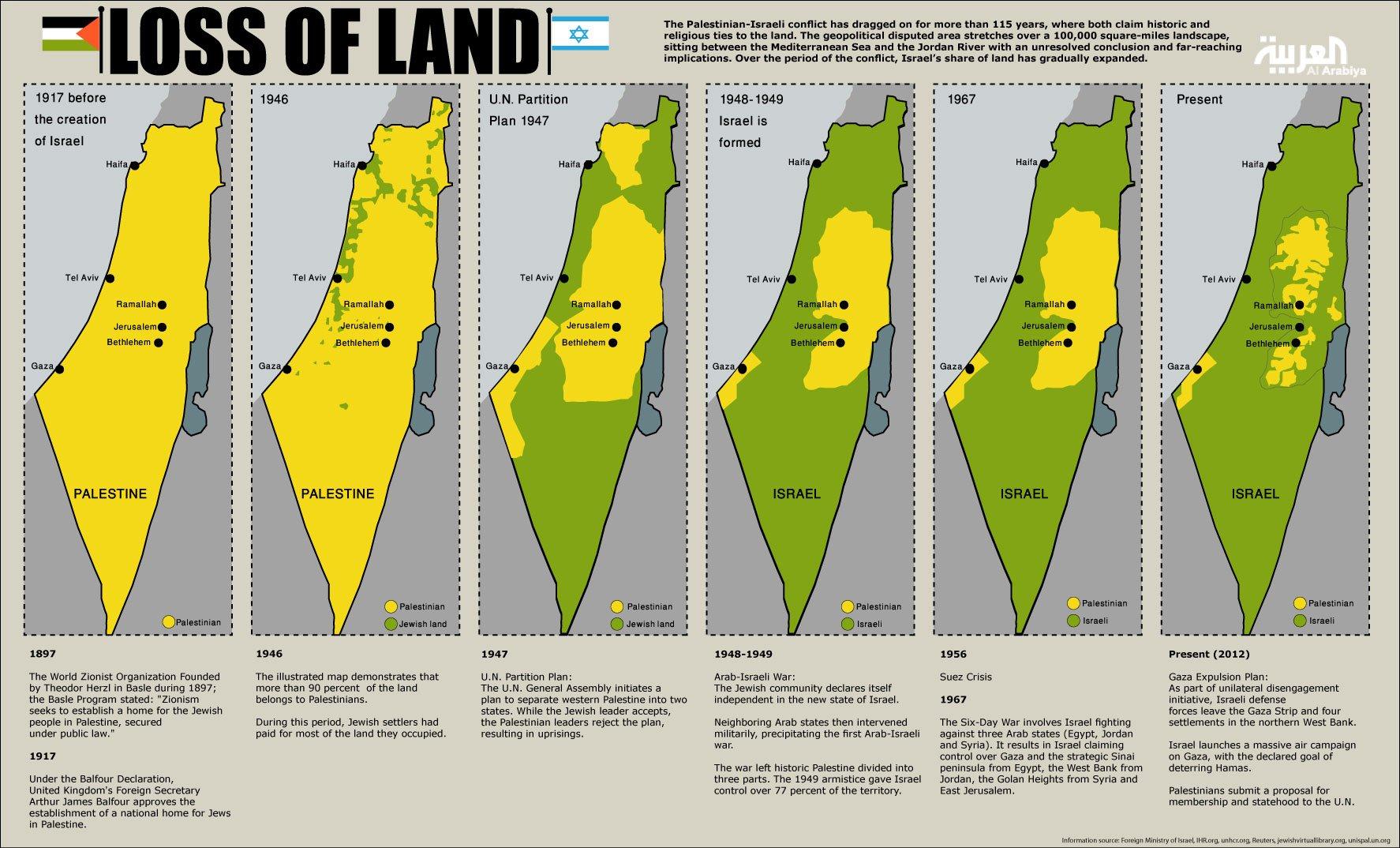
It shows that Israel successfully spread its influence on the problematic region. The state’s official position states that it has the right to struggle for the territory because of its history, while Israel’s citizens can be viewed as successors of peoples who lived here and had the right to control the territory (Jamal 370). At the same time, official Israel considers Palestinians natives from the other land who have no rights to control the territory (Ahmed).
Moreover, official Israel sees a potential threat if the warring party takes the disputed territory (Ahmed). In such a way, the Israeli position regarding the question implies several essential assumptions. First, the state views the territory as part of its historical heritage, meaning it is ready to struggle for it. Second, Palestinian control over the sector will pose a direct threat to the nation. Finally, Israel wants to de-occupy the area and end military conflicts here. However, the problem is complicated by the fact that the current Israeli position regarding the problem contradicts the Palestinian one, meaning that any negotiations have a high chance of failing.
Moreover, the territory is also significant for Israel from cultural and religious perspectives. Following the main ideas of Judaism and ancient beliefs, the region has several critical objects of worship that should be controlled by the Israeli government because they are viewed as part of the historical and cultural heritage (Waxman 8). For this reason, the country insists on settling the Jewish people in the new territory to ensure they have access to their old homes and important religious objects (Ahmed). For this reason, the state is not ready to give up and negotiate its positions regarding the future of the area. Thus, it can be concluded that the main arguments of the Israeli side are the unequal division of territory, the controversial views on the origin of the enemy, and the possibility of placing an enemy army on the territory of one’s own state.
The Palestinian Perspective on the Issue
Analyzing the conflict from the Palestinian perspective, it is also possible to accept the fairness of their claims. The Palestinian side does not recognize the Israeli claims over the historical right to control the land as they cannot be proved (Ukashi). Moreover, they doubt the legitimacy of Israel as the state was formed only in the second half of the 20th century as the answer to the genocide and the attempt to protect Jewish people globally (Ukashi).
However, this decision was made regardless of the interests of the local population and the territorial claims of states existing in the area (Lutz 153). As a result, Palestine views this decision as the basis for the development of the military conflict. The representatives of Palestine believe that they are indigenous people who emerged on the territory of their condition, while Israel claims the opposite (Ahmed, 2021). In such a way, there is a lack of understanding between parties and an impossibility of aligning effective communication and interaction.
Another critical factor affecting the Palestinian perspective on the problem is its relations with Israel and global status. The UN views Palestine as a state partially occupied by Israel (Ukashi). It impacts Palestine’s position at the global level and its interaction with Israel (Asseburg 100). The officials insist on de-occupying the territory and providing Palestine with complete control over its lands as determined by the UN Assembly (Asseburg 101).
However, Israel’s unreadiness and unwillingness to follow the rulings and negotiate worsened the situation. For this reason, Palestine views the issue as the principal question that should be resolved by negotiations and Israel’s withdrawal from the region, which it holds illegally (Ahmed). This vision of the issue complicates the situation and requires the engagement of third parties as mediators to ensure the conflict is resolved.
The conflict is also complicated by the region’s great cultural and religious importance. Palestinian people are mostly Muslims, and they have their holy places in the region (Ahmed). This means that the state wants constant access to the territory because of its increased significance for the Arab world (Waxman 16). For this reason, Palestine proposes to make these lands accessible and end the opposition by resolving these issues. At the same time, it does not support the appertaining policy by which they are pursued, providing counterarguments to the right of ownership of their land and the mutual possibility of introducing foreign troops into the disputed territory.
Conclusion
Altogether, the Israeli-Palestinian conflict is one of the most complex issues in the modern world. The radical differences in cultures, ideologies, religions, and problematic legal statuses of the lands, along with the claims for territories, make the conflict more complex and sophisticated. Both sides offer their own arguments justifying their actions and decisions.
Israel views the territory as part of its cultural heritage, meaning that its citizens can be viewed as successors with the right to control the area. Moreover, the lands have significant cultural value for the state. Palestine introduces similar arguments, insisting on its right to control the area, its cultural importance, and the lack of Israel’s rights to control the territory. As a result, the conflict remains unresolved, and additional negotiations are required.
Works Cited
Ahmed, Abubakar. “Sirael-Palestine Conflict: The World’s Most Intractable Conflict.” SSRN Electronic Journal, vol. 1, no. 1, 2021. Web.
Asseburg, M. “The One-State Reality in Israel/Palestine: A Challenge for Europe and Other Parties Interested in Constructive Conflict Transformation.” Pathways to Peace and Security, no. 2, 2021, pp. 96–109. Web.
Jamal, Amal. “Conflict Theory, Temporality, and Transformative Temporariness: Lessons from Israel and Palestine.” Constellations, vol. 23, no. 3. 2017, pp. 365–377. Web.
Lutz, Fiedler. “Israel in Revolution—Matzpen, the Palestine Conflict, and the Hebrew Nation.” Israel Studies, vol. 22, no. 3, 2017, p. 153. Web.
Manusama, Kenneth. “‘Lawfare’ in the Conflict between Israel and Palestine?” Amsterdam Law Forum, vol. 5, no. 1, 2017, p. 121. Web.
“Maps: Loss of Land.” Palestine Portal, 2017. Web.
Ukashi, Ran. “Zionism, Imperialism, and Indigeneity in Israel/Palestine: A Critical Analysis.” Peace and Conflict Studies, vol. 25, no. 1, 2018. Web.
Waxman, Dov. The Israeli-Palestinian Conflict: What Everyone Needs to Know. Oxford University Press, 2019.