
Introduction
Corporate culture impacts the enterprise’s efficiency, fostering employee cohesion, enhancing productivity, and contributing to the development of labor discipline, motivation, and employee interaction. Elements of the organization’s culture are formed from its inception and throughout its existence. It strengthens internal ties between employees and structural units, enhances employee motivation, and provides more effective coordination than a formal control and planning system.
Wells Fargo is included in the list of systemically important banks; therefore, the stability of the entire financial system depends on it. The Wells Fargo cross-selling scandal highlights how corporate culture played a central role in creating the situation. During the Wells Fargo fake account scandal, several negative aspects of corporate culture were identified that contributed to the emergence and development of this scandal, the primary one being the company’s rules regarding employees.
There are significant concerns about the company’s ethics and governance following the Wells Fargo fake account incident. Employees at Wells Fargo are alleged to have opened millions of fictitious bank accounts without obtaining permission from consumers, which had a detrimental impact on both the company’s reputation and its own. This affair illustrates unethical behavior and poor leadership in the banking industry.
To achieve high selling rates, pressure was placed on staff to create fake accounts, one of the critical issues identified throughout the study. This suggests that improper management procedures and inadequate oversight of the business are in place. The Wells Fargo Bank case demonstrates the importance of corporate culture, and implementing a plan to change it is critical for the company, as the scandal has negatively affected its reputation.
General Analysis of the Wells Fargo Bank Organization
Wells Fargo & Company is a banking holding that specializes in providing financial, insurance, and other services in the United States of America, Canada, and Puerto Rico. The basis of activity is Wells Fargo Bank, which accounts for 89% of the assets (Lilly et al., 2021). Wells Fargo acquired the banking holding company Wachovia, which enabled it to become the leader in the U.S. mortgage lending market.
Scope of operations Wells Fargo creates four main areas, the first of which is Consumer Banking & Lending. As of the end of 2020, Wells Fargo’s retail arm had 65 million individual customers and 3 million small businesses (Lilly et al., 2021). At the same time, the number of people actively using digital channels to obtain banking services reached 32.9 million (Lilly et al., 2021). It is engaged in opening and maintaining current client savings accounts, as well as issuing debit and credit cards, consumer, mortgage, and car loans.
The next element is Wealth & Investment Management, which provides wealth management, investment, and retirement insurance products to wealthy clients in the United States. Additionally, this division offers fiduciary and trust services to institutional clients. Corporate and Investment Banking is the third element, which serves large corporations, real estate funds, financial institutions, and governments. Services include account management, lending, assistance with stock and bond placement, and financial advice.
The last element is Commercial Banking, which provides complete financial services to medium-sized companies. Wells Fargo’s business model in 2020 was heavily influenced by the consumer banking segment, which accounted for nearly half of the company’s revenue. The bank generates almost all its revenue in the United States, where its assets are located.
Wells Fargo’s structure is hierarchical and features several elements that promote accountability and transparency. At the top of the company’s hierarchy is the Board of Directors, which is elected by and accountable to the shareholders. Further down the line is the Chief Executive Officer (CEO), the highest-ranking officer at Wells Fargo, who is responsible for the overall direction and management of the company (Shichor & Heeren, 2020). A senior management team assists the CEO, comprising crucial executives who oversee central business units.
Wells Fargo also has several business units, each responsible for specific areas of activity. These divisions include retail banking, wholesale banking, wealth and investment management, consumer finance, and corporate and investment banking. Since Wells Fargo has a large regional structure, it effectively manages operations in various regions (Tayan, 2019). This structure comprises regional presidents who oversee and coordinate business activities within their respective regions. Wells Fargo also operates an extensive network of branches and local offices throughout the United States and abroad.
Wells Fargo’s Corporate Culture During the Scandal
Some unfavorable features of organizational culture that aided in the inception and growth of the Wells Fargo phony account scandal have been identified. The business culture at Wells Fargo placed much emphasis on exceeding ambitious sales targets. Employees were pressured, leading to inappropriate activity like creating fictitious accounts.
Overcoming sales goals took precedence over morality and protecting customers. Internal management and procedures at Wells Fargo have been unable to stop the establishment of bogus accounts. The incident surrounding bogus accounts may indicate a toxic workplace where employees feel pressured to meet ambitious sales targets, even if it means compromising their moral obligations.
The Wells Fargo fake account affair has raised several ethical concerns surrounding managerial decision-making. Management choices that led to the establishment of fake accounts did not adhere to ethical standards and ideals (Shichor & Heeren, 2020). This includes breaching the law, taking advantage of clients, and engaging in unlawful activity (Tayan, 2019). These judgments demonstrate the lack of ethical standards and ideals that the corporation and its management were expected to uphold. How accountable and transparent Wells Fargo’s management was in its activities is a crucial ethical consideration.
Implementation Plan for a New Corporate Culture
Since the company has suffered reputational losses, it is essential to rehabilitate its image in the eyes of the public, as adjusting the culture of a corporation necessitates consideration of image aspects. Conducting a regional advertising campaign to shape a positive brand image among customers is vital. It is also necessary to develop a quality after-sales service system by introducing new technologies and a more convenient product design and applications (Graham et al., 2022). To change the prevailing negative opinion about the company in society, disseminate information about the bank’s mission and strategic goals, taking into account the interests of society, the bank’s business reputation, and its top management.
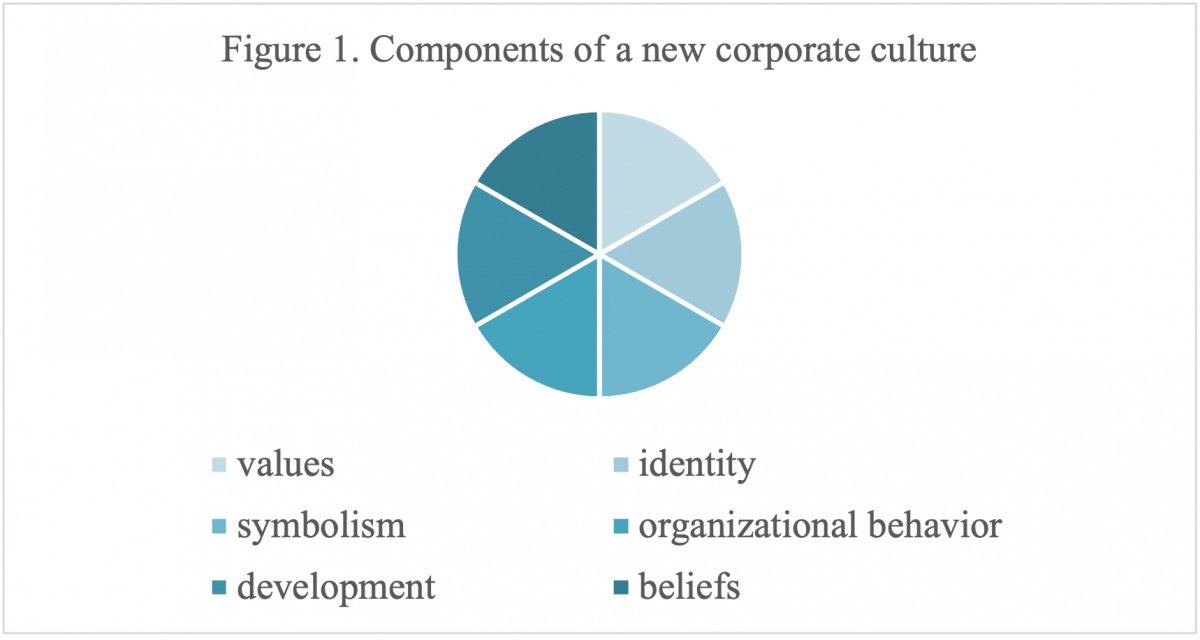
The main reason for the Wells Fargo Cross-Selling Scandal is the pressure that employees experienced from management, indicating a weak corporate culture that needs to be changed. As shown in Figure 1, the primary areas of focus in forming corporate culture include values, identity, symbolism, organizational behavior, development, and beliefs. The fundamental values in Wells Fargo’s new corporate culture are professionalism, discipline, mutual assistance, and personal growth (Teo & Kimes, 2019). Forming a sense of unity with the company means that most employees identify with the organization, which will be a positive result of developing a corporate culture.
Adopting a common symbolism for the awareness of unity should be emblems, logos, and corporate identity. For the new corporate culture, it is also essential to update the standards of conduct, which should be the norms of ethics and morality, the revised relationship with clients, and the subordination of top management (Graham et al., 2022). To increase employee loyalty, management recognizes the value of their personality and establishes partnerships with them.
Creating a new corporate culture can face several challenges, making the process difficult and requiring extra effort. Potential sources of resistance may be existing employees who may be accustomed to the old corporate culture and be reluctant to accept change. They may experience fear, insecurity, or disagreement with new values, norms, and behavioral expectations. If clear goals and a vision for a new corporate culture are not defined, this can lead to confusion and uncertainty among employees. Employees’ lack of active involvement in creating a new corporate culture and insufficient communication between management and staff can lead to dissatisfaction, misunderstanding, and rejection of change.
A new corporate culture will be introduced through several steps, the first of which is the involvement of management and employees. The company’s management should serve as models of behavior, support new values, and welcome change. Further, it is necessary to ensure open and effective communication among all employees about new values, norms, and expectations (Graham et al., 2022). Regular training sessions and feedback will help employees understand and embrace the new culture.
Actions to sustain the cultural change are no less important than introducing a new culture. It is necessary to analyze the company’s existing systems and processes and align them with new values and expectations. This may include changes in employee evaluation, remuneration, communication systems, and other management aspects. Another step to ensure the sustainability of the cultural change is to support and reward employees who successfully embrace and implement the new corporate culture (Nguyen et al., 2019). Management must assess the effectiveness of the new culture, gather feedback from employees, and respond to necessary changes and improvements.
For Wells Fargo Bank, introducing a new corporate culture will bring many benefits, among which the main one is the improvement of teamwork because it stimulates the exchange of ideas and increases trust between colleagues. It will also make it easier for companies to find qualified employees and reduce the loss of existing ones. The organization’s culture is directly reflected in the customer experience because it implies a high level of service, which can increase loyalty and attract new customers.
Conclusion
In conclusion, the Wells Fargo fake account issue should significantly shift the organization’s corporate culture. Following the incidents, the business recognized the need to regain the trust of its clients and embraced the challenge of modifying its ethical standards and management strategies. An essential component of a new business culture should be ethics.
Wells Fargo must change its emphasis from a narrow one on sales to better ideas like compliance, openness, and consideration for customers’ interests. The business must recognize the value of staff training and development and prioritize ethics and compliance training. The objective is for staff members to understand ethical standards and norms and be able to put them to use in their work. The new corporate culture at Wells Fargo should be dedicated to regaining consumer trust, fostering an ethical and responsible workplace, and upholding high standards throughout all aspects of the company’s activities.
References
Graham, J. R., Grennan, J., Harvey, C. R., & Rajgopal, S. (2022). Corporate culture: Evidence from the field. Journal of Financial Economics, 146(2), 552–593. Web.
Lilly, J., Durr, D., Grogan, A., & Super, J. F. (2021). Wells Fargo: Administrative evil and the pressure to conform. Business Horizons, 64(5), 587–597. Web.
Nguyen, D. D., Nguyen, L., & Sila, V. (2019). Does corporate culture affect bank risk-taking? evidence from loan-level data. British Journal of Management, 30(1), 106–133. Web.
Shichor, D., & Heeren, J. W. (2020). Reflecting on corporate crime and control: The Wells Fargo Banking Saga. Journal of White Collar and Corporate Crime, 2(2), 97–108. Web.
Tayan, B. (2019). The Wells Fargo cross-selling scandal. The Harvard Law School Forum on Corporate Governance. Web.
Teo, T., & Kimes, S. (2019). Wells Fargo Bank: The Fake Accounts Scandal. Web.