
Introduction
Ageing is an inevitable progressive or sequential change in a person’s life, manifested by deterioration of physical and mental capability. Older adults’ inability to perform daily life activities requires adequate social support through planning and allocation of resources. The exponential population growth in the UK is coupled with demographic shifts, with an increasing number of people over sixty-five.
As the number of older adults increases in a country, it poses a significant challenge to various sectors of the economy, such as pension schemes and resources to take care of their healthcare issues. Further, policies are needed to ensure adequate resource allocation and that older adults can experience a higher quality of life. The statistical investigation is necessary to determine the challenges affecting older adults and to help the government and other policymakers devise ways of improving the quality of life.
The disengagement theory of ageing states that as people age, they disengage from others in society and hence become prone to mental and psychological disorders due to loneliness. Older adults retire from active employment and minimize social interactions with others, hence suffering social isolation (Skarbek, 2020). It is further imperative to note that as physical activities reduce, the elderly are prone to suffer chronic illness and require adequate healthcare coverage for treatment and maintenance of good health (Kemperman et al., 2019).
Unfortunately, some older adults lack the finances to pay their medical bills in the long run. Therefore, the government needs to understand the growth rate of the elderly population and devise means to ensure their protection (McMaughan et al., 2020). This statistical investigation analyzes the rate of growth of the elderly population and the challenges they face to help form equitable policies that allocate resources equally to all people in need.
Research Objective
The primary and overarching aim of the research is to investigate the growth rate of the aging population in the UK and understand the challenges they face. Once the growth rate is determined and the challenges are known, it will be easier to develop solutions. Two main research questions will be used to direct the research. The research questions include:
- What is the growth rate of the elderly population in the UK?
- What are the main challenges facing the elderly population in the UK?
Methodology
The statistical investigation will leverage primary and secondary research to collect data for analysis. The first research question on the growth rate will be conducted using secondary research. Data from the Office for National Statistics in the UK will be used to determine the growth rate of the ageing population (Harrison et al., 2020). Once the growth rate is determined, primary research will be conducted through interviews to determine the main challenges that affect the selected population.
Secondary Research
Data from the national statistics office shows that the elderly population has increased. The number of people older than 65 has increased steadily since 2000. As of 2019, the estimated number of people aged was about 12.1 million, approximately 18% (Sharma et al., 2019). The national statistics estimate that by 2043, the elderly population will be almost 20.4 million, approximately 25% of the UK population (Robb et al., 2020). The data collected from the statistics office is shown in Table 1 below.
Table 1. Number of the elderly population in the UK
(Source: The State of Ageing 2022, 2022)
Primary Research
The qualitative research design used to determine the challenges faced by the ageing population in the UK was interviews. The participants were selected from their natural environment and nursing homes to determine the issues affecting them in the country. Ethical considerations were considered to ensure that the ageing population was considered. A sample of 30 participants was randomly picked and interviewed on the main challenges affecting them as they moved on with their lives. The responses were recorded in Table 2 below as the main challenges affecting the ageing population.
Table 2. Main challenges affecting the elderly in the UK
Calculations and Graphs
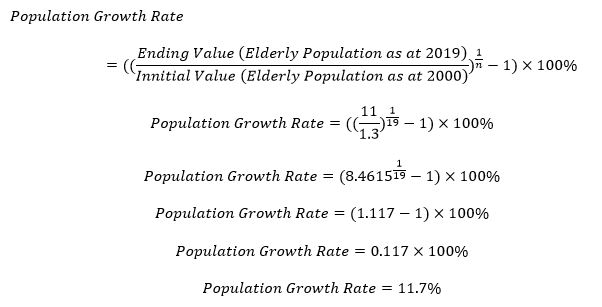
The data obtained from the secondary and primary research is interpreted for effective decision-making using calculations and visualization in the form of graphs. The growth rate of the elderly population is calculated to offer the trajectory for the government to plan for it (The State of Ageing 2022, 2022). The equation below calculates the growth rate and how it can be extrapolated to determine the number of elderly in the upcoming years for adequate planning.
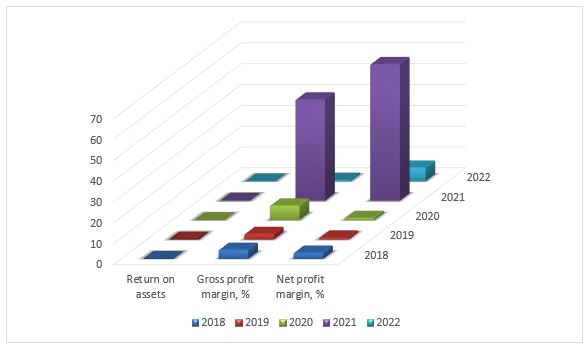
The graph below further shows a visual representation of how the elderly population has grown from 2000 to 2019. There is steady growth in the elderly population, and extrapolating it means that there will be many people above the age of 65 in the coming years.
Pie chart for the qualitative data
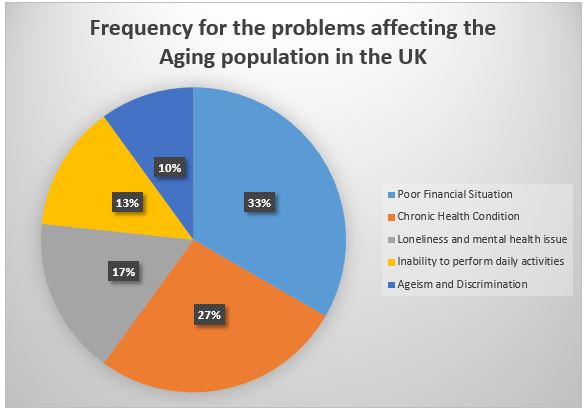
The challenges facing the elderly population were determined by the use of interviews, where the participants were allowed to share their experiences and have a chance to offer suggestions on what needed to be done. The factors that made their lives miserable were analyzed, and the frequency table was used to determine the most severe problem affecting older adults. The pie chart below shows the problems affecting the elderly, from the most rampant to the least challenging problem.
Data Analysis
Data analysis is essential as it helps extract knowledge from the research and helps with decision-making. The secondary data answered the first research question, while the primary data answered the second one. The line graph shows an exponential growth in the population of people above 65 years old, meaning that the dependence ratio on the government increases as older adults require adequate planning to ensure they lead a positive life.
The calculation shows that the growth rate for the elderly population is 11.7%, which means that it will continue to grow over the years. Careers and policymakers must be prepared to build the capacity to care for the elderly population. The secondary data is therefore helpful in ensuring adequate planning to give the elderly comfortable lives.
The primary research shows five key challenges affecting older adults in the UK, and financial challenges are the main issues affecting the elderly. Therefore, the government and employers should enhance savings plans and pension schemes to ensure older adults have adequate funds after retirement to lead positive lives. Chronic health conditions constitute the second most crucial factor affecting the ageing population, meaning the government should plan for healthcare insurance. Loneliness and the inability to perform daily activities show that support systems must continuously be enhanced. Ageism and discrimination are critical issues affecting older people, and essential policy changes are needed to increase equality.
Conclusion
The statistical investigation has shown exponential growth in the elderly population and multifaceted problems affecting older adults after retirement in the UK. Data drawn between 2000 and 2019 showed that the ageing population is rising steadily, and adequate plans must be made to offer a higher quality of life among older people. The UK government should leverage the statistical investigation to set up resources and facilities for the ageing population. The primary research revealed that financial constraints, chronic diseases, and loneliness account for enormous challenges affecting the elderly.
Further, ageism and discrimination are the least prevalent issues affecting the selected population. Since the government is responsible for ensuring that people lead better lives, they are expected to use the research outcomes to overcome the challenges by planning and allocating resources. If the relevant authorities acknowledge the findings of this research and develop strategies to overcome the challenges, older people are likely to lead a positive life. Generally, the statistics show that the aging population in the UK is growing exponentially and is suffering numerous challenges that require urgent intervention from the government to guarantee them a higher quality of life.
Reference List
Harrison, A.J., McErlain-Naylor, S.A., Bradshaw, E.J., Dai, B., Nunome, H., Hughes, G.T., Kong, P.W., Vanwanseele, B., Vilas-Boas, J.P. and Fong, D.T., (2020) ‘Recommendations for statistical analysis involving null hypothesis significance testing’. Sports Biomechanics, 19(5), pp.561-568. Web.
Kemperman, A., van den Berg, P., Weijs-Perrée, M. and Uijtdewillegen, K., (2019) ‘Loneliness of older adults: Social network and the living environment’. International Journal of Environmental Research and Public Health, 16(3), p.406. Web.
McMaughan, D.J., Oloruntoba, O. and Smith, M.L. (2020) ‘Socioeconomic status and access to healthcare: interrelated drivers for healthy aging’. Frontiers in Public Health, 8(1), p.231. Web.
Robb, C.E., De Jager, C.A., Ahmadi-Abhari, S., Giannakopoulou, P., Udeh-Momoh, C., McKeand, J., Price, G., Car, J., Majeed, A., Ward, H. and Middleton, L., (2020) ‘Associations of social isolation with anxiety and depression during the early COVID-19 pandemic: a survey of older adults in London, UK’. Frontiers in Psychiatry, 11, pp. 191-220. Web.
Sharma, A., Smith, H.J., Yao, P. and Mair, W.B. (2019) ‘Causal roles of mitochondrial dynamics in longevity and healthy aging’. EMBO Reports 20(12), pp. 48-95. Web.
Skarbek, D., (2020) ‘Qualitative research methods for institutional analysis’. Journal of Institutional Economics, 16(4), pp.409-422. Web.
Summary: The State of Ageing 2022 (2022) Centre for Ageing Better. Web.