
Introduction
The benefits of globalization are insurmountable in consideration of the global economy. Industrial output across numerous countries has risen to an unprecedented level. However, these developments led to the emergence of climate change. The rising temperature issue is overtaking the discussion of global politics due to the urgent need for change.
Discussion
The estimations by Grossman (2018) project a future in which 74% of the global population will experience the negative effects of heat waves while half of the world may be exposed to deadly consequences. This development is expected to be inevitable if no drastic changes are introduced by 2100, when climate-related deaths sharply rise, and coastal floods will change European terrain. It is possible to mitigate certain aspects of global warming by enforcing regulations and policies that restrict greenhouse gas emissions and promoting social awareness to adopt sustainable lifestyles. However, the global population is divided into camps: those who feign ignorance at the ongoing disaster and those who promote change.
Potential Impacts of Global Warming
The major concern in enforcing global warming policies is the social disagreement that human activity is the primary cause of climate change. This disagreement persists even though it has been long-established that using fossil fuels and clearing forests increases the presence of carbon dioxide in the atmosphere. The National Wildlife Federation has been closely monitoring climate change and global warming for many years. They are researching changing weather, ocean acidification, rising sea levels, and global temperature. These changes in these planetary aspects put global fauna at peril. In addition, wetlands are vanishing, the proliferation of rare species becomes practically impossible, and the spread of diseases is increasing.
The majority of people on Earth are susceptible to infectious diseases that are pathological. The life cycles of these diseases are sensitive to environmental conditions (Booth, 2018). This means that future regional transmission patterns of numerous illnesses are anticipated to be altered by climate change (Booth, 2018). At the same time, it is possible to anticipate the spread of inherently localized neglected tropical diseases outside of the common areas (Booth, 2018). The research by Pacheco et al. (2021) stated that climate changes disturb the distribution of pollen allergies and infectious disease vectors. Similarly, society has to anticipate the damages from increasing heat waves, which can induce short-term fatalities for those with previously established heart or breathing problems.
Strategies to Mitigate Global Warming
However, many people aim to rectify the global perception of the issue. In academic circles, numerous people like Witoolkollachit et al. (2020) called for global action via numerous research articles. In the article of Witoolkollachit et al. (2020), the author was concerned about the effects of globalization on the worsening climate situation. The author recognized the need to moderate increasing international trade, which may otherwise promote chemical contamination and the severe greenhouse effect.
Some explore possible solutions in various aspects of nature, such as the study of Yong et al. (2022). According to the authors, climate change and environmental decline have sparked the development of a blue carbon economic model. This model proposes processing energy and food from marine ecosystems using carbon sequestration, storage, and harvesting techniques. The authors argue that it is possible to replace fossil fuels via this method. The authors highly value the potential of seaweed as a blue carbon sink and a sustainable, renewable energy source. They underlie the possibility of solving major climate change problems via seaweed expansion.
Recent Global Events Influencing Climate Action
Nevertheless, there is a clear need to unify the global cause of combating climate change. People’s awareness should be increased, and severe changes to current lifestyles are inevitable to preserve humanity. However, recent events demonstrate that politics tackle the issue by feigning ignorance or searching for a scapegoat. For example, African nations press developed countries to support the climate transition on their continent (Kabukuru, 2022).
Donald Trump has litigated numerous policies aimed at controlling climate change (Borunda, 2018). According to the Climate Change Performance Index 2022, global performance in mitigating the phenomenon across 60 countries and the EU is insufficient even though some nations are progressing well (Navarre, 2022) (See Figure 1). Therefore, the organization overseeing the ranking left the first three ranks vacant. These events instill doubt in the efforts made by the global community.
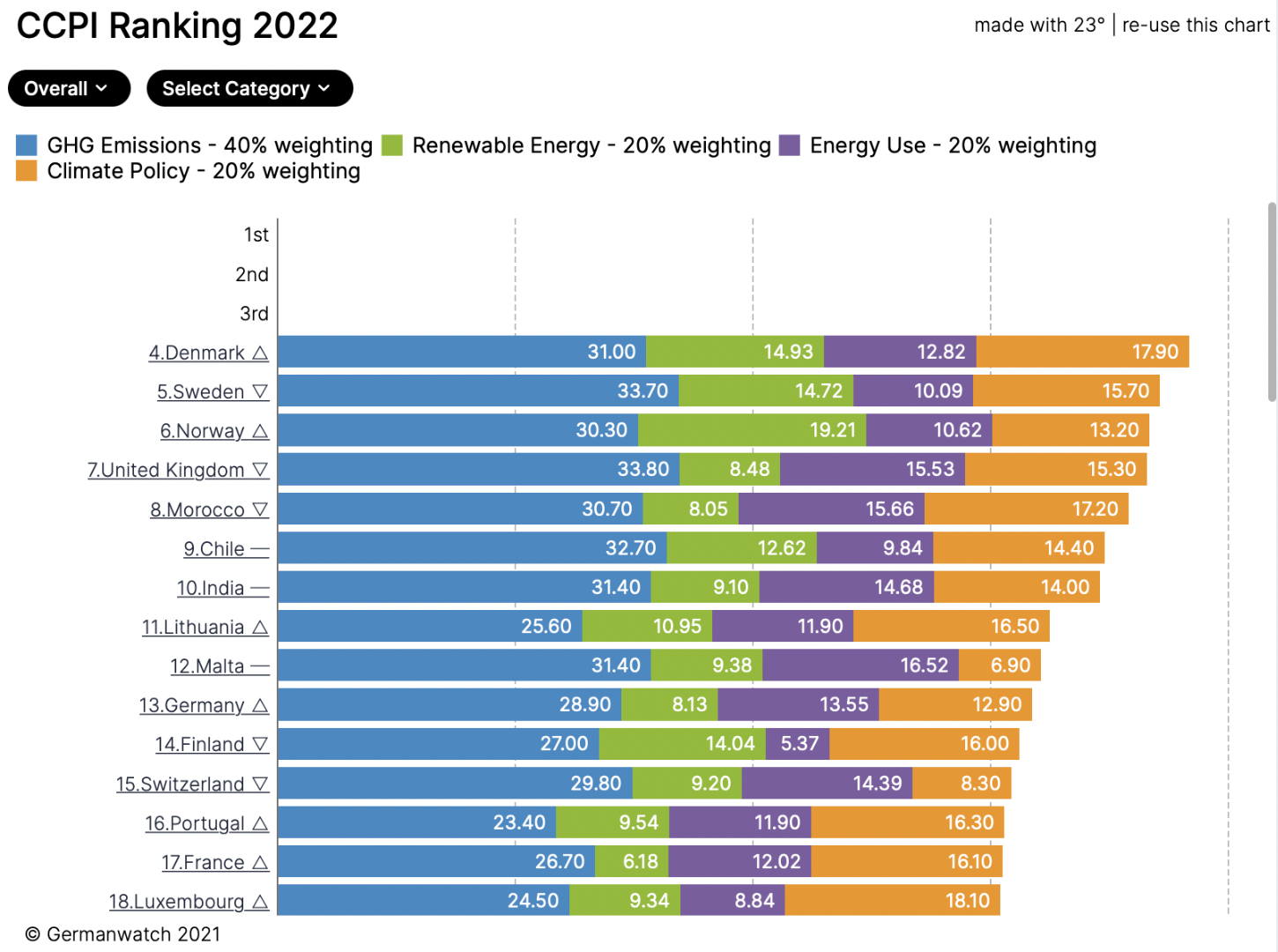
In the United States, the Democrats and Republicans disagreed on global warming. Republicans have refused to accept it, while Democrats have expressed anxiety over it. During the Trump presidency, progress on climate change mitigation was slow. In 2017, his skepticism took many decisions that slowed down or diminished the importance of climate action (Borunda, 2018). The government abandoned the Paris Agreement, loosened rules for climate polluters, and approved the Keystone XL project (Borunda, 2018). The momentum of numerous climate-related initiatives starting to reshape the country was diminished, raising the difficulty for further development. Surprisingly, numerous people supported Trump’s ideas, which call for a dire need for education and unification of society.
By educating people and putting faith in science, society may help to resolve these issues. Many individuals are unaware of the facts and unwilling to embrace the science that is available to them. By giving the general population the best knowledge possible to fully understand how they can contribute to preserving the planet, science and technology can help disprove the hypothesis. Fast decarbonization and aiding communities in adjusting to the effects of climate change require science-based solutions. In order to make progress toward gross zero greenhouse gas emissions and improved climate change resilience, numerous policies were established globally.
One of the primary goals for preserving the environment is to control temperature increase to a level below 2 degrees Celsius. According to the Intergovernmental Panel on Climate Change (IPCC), by 2050, carbon dioxide (CO2) and other greenhouse gas emissions must have decreased by half in contrast to 1990 figures to reach the temperature goal (EEA, 2020). Simultaneously, developed nations will need to decrease emissions by between 80 and 95 percent; advanced emerging nations with high emissions, such as China, India, and Brazil, will need to restrain their emission rise (EEA, 2020). There is a clear political urgency for global interference in policy regulation to meet these requirements.
The Role of Society in Addressing Global Warming
However, the personal responsibility of individual households and citizens is similarly important. Human lifestyle is one of the major causes of the rise in the atmospheric concentration of greenhouse gases. A significant adjustment in behavior across various activities is necessary to combat climate change. These activities involve controlling transportation, purchases, leisure, energy, and water consumption. These actions frequently repeat in static environments and are habitual for many. It is easily predictable that the change would be difficult to introduce despite the urgency.
Therefore, different techniques to encourage a sustainable lifestyle should be introduced. For example, the distinguishment of positive self-image is related to the contribution to environmental sustainability. Consuming environmentally friendly items might help one feel more morally upright about themselves, especially if they helped with their creation (Habib et al., 2021). When customers buy sustainable goods, reading about the experiences of others who have repurchased them might make them feel special and distinctive, which is good for their self-concept (Habib et al., 2021).
Customers are more inclined to try to maintain their surroundings when they feel ownership over public assets like parks and lakes (Habib et al., 2021). Consuming environmentally friendly goods that are regarded as good can also have beneficial spillover effects, whereby one donation or other act of prosociality is prompted by the purchase (Habib et al., 2021). This social approach could act as a primary motivator for individual change.
Conclusion
In conclusion, it is undeniable that climate change is an ongoing and human-influenced phenomenon. The negative effects of the phenomenon are extensive and multi-dimensional. The effect of global warming on healthcare, terrain, wildlife, and humanity is drastic and could be observed within the current century if no change is introduced. The political response to climate change during the Trump presidency led to stagnation in developing new strategies due to the litigation of existing policies. Therefore, enforcing education and awareness of the scope of global warming is necessary for social unification in response to the change.
Governmental interventions are clearly needed to reduce industrial emissions and individual contributions to rising CO2 levels. People could be encouraged to indulge in sustainable lifestyles while raising the prestige and virtuous perception of going green. This could act as a more definitive change in contrast to simple education. Nevertheless, the research developments related to the solution of the issue remain relevant, and more funding should be allocated to establish the viability of new ideas, such as carbon sequestration via seaweed.
Reference List
Booth, M. (2018) ‘Climate change and the neglected tropical diseases.’ Advances in Parasitology, pp.39–126. Web.
Borunda, A., (2021) ‘The most consequential impact of Trump’s climate policies? Wasted time.’ Environment. Web.
Germanwatch (2021). CCPI Ranking 2022. Climate Change Performance Index. Web.
European Environment Agency (EEA). (2020) Climate change policies. Web.
Grossman, R., M. (2018) ‘Climate change and the individual.’ The American Journal of Comparative Law, 66(suppl_1), pp.345–378. Web.
Habib, R. et al. (2021) ‘Shifting consumer behavior to address climate change.’ Current Opinion in Psychology, 42, pp.108–113. Web.
Kabukuru, W. (2022) ‘Africa calls on rich nations to help continent’s climate transition.’ Time. Web.
Navarre, B. (2022) ‘The 10 countries leading the way in climate policy.’ U.S. News & World Report. Web.
Pacheco, S.E., et al. (2021) ‘Climate change and global issues in allergy and immunology.’ Journal of Allergy and Clinical Immunology, 148(6), pp.1366-1377. Web.
Witoolkollachit, P., Bhuasiri, W., Kiattisin, S. and Mayakul, T. (2020) ‘Digital-driven the sustainable social development strategies via an enterprise architecture: the case in digital Thailand‘, Advances in Natural and Applied Sciences, 14(2), 1+, Web.
Yong, W. T. L., Thien, V. Y., Rupert, R., & Rodrigues, K. F. (2022) ‘Seaweed: a potential climate change solution.’ Renewable and Sustainable Energy Reviews, 159, 112222. Web.