
Executive Summary
This report aims to provide a strategy for launching a brand-new product from Canon plc and recommendations for implementing the plan to achieve objectives. Canon plc faces formidable challenges from its global rivals, particularly in Japan, where it has lost market dominance. Therefore, the company’s profit margin has been shrinking over the years and faces the risk of losing market share. Consequently, it has decided to release a new, innovative product, Canon EOS R100, to help it increase its profit margin and maintain its market position in the U.K. and worldwide. This report is divided into four primary sections.
The first section provides an overview of the company and its product. Furthermore, it will establish a market analysis to help understand consumer behaviors and their response to the new product. To this end, Canon plc will conduct a PESTEL analysis, a trend analysis, and a SWOT analysis of the factors influencing the creation of new products in the U.K.
In the second section, the report will examine the product’s marketing objectives in conjunction with specific details on audience segmentation, positioning, and targeting. The fourth section will provide a marketing mix analysis and recommendations for establishing the new product. Finally, Section Four will provide a detailed implementation procedure for the marketing plan, ensuring its effectiveness in fulfilling the company’s objectives.
The Company and Situational Analysis
Company and Product Overview
Company Overview
Canon PLC is one of the world’s leading digital companies, with its headquarters in Japan. The company was established in 1937 to inspire its customers through investing in world-class digital technology. Currently, Canon plc has more than 182000 employees in their marketing and production sites across Japan, the Americas, Europe, Asia, and Oceania (Canon, 2022, para. 2). Besides, Canon reported over $30.55 billion in revenue in its fiscal year 2021(Laricchia, 2022, para. 1).
The company manufactures a diverse range of consumer, business, and industrial products, including printers, copy machines, business machines, and optical devices (Canon Europe, 2022, para. 1). Moreover, the consumer unit specializes in digital single-lens reflex cameras, interchangeable-lens compact digital cameras, camcorders, single- and multiple-inject printers, scanners, and broad-beam scanning devices.
Canon’s global market leadership influenced my decision to choose this company in many regions. For over nine years, Canon has been voted “most trusted” in 13 of 16 European countries and ranked first in the United Kingdom (Canon New Zealand, 2018). However, it faces formidable competition from Kodak and Nikon in the United States, Nikon in Japan and Asia, and Samsung and Sony in Europe, following a 7.1% decline in the gross profit margin in the U.K. for Canon U.K. in 2009. A new product needed to be established to check on the pricing. Therefore, Canon’s declining operating profit and the prospect of further market share losses prompted the company to develop a product that could serve as the cornerstone of a successful reentry into the market.
Product Overview
The Canon EOS R100 is a novel type of camera that offers people the best service at a low price. As Jukic (2022) indicates, the camera’s sensor is 24.2MP APS-C, a higher sensor specification than conventional DSLR cameras. Moreover, it features a higher shooting mechanical capacity of 12 fps, paired with a digital X-Processor. The camera also boasts a higher video recording capability, capturing 4K 30p videos through its dual Pixel AF II system and 1.04 million-dot Vari-angle Touchscreen technology.
Market Situation Analysis
The United Kingdom has the second-largest economy in Europe and led the G7 in GDP growth in 2021 despite its relatively small size (The International Trade Administration, 2022). A study conducted in 2021 reveals that the United Kingdom is a significant international trading power, boasting the world’s fifth-largest economy and a population of approximately 67 million. The U.K. market has grown and become increasingly critical for new investors, despite recent challenges such as high inflation stemming from rising fuel prices, the country’s exit from the European Union, and the Covid-19 pandemic. However, with such a vast market, marketers may be unable to launch a new product like the EOS R100 camera without understanding its dynamics (The International Trade Administration, 2022). Therefore, Canon Plc will undertake internal and external market analyses based on PESTEL and SWOT analyses.
External Market Environmental Analysis-PESTEL Analysis
Political Factors
These are the politically driven factors that can impact the operation of an organization in a particular country. The U.K. has a robust set of democratic factors that support a stable government transition. Effective microeconomic policies characterize the country, and its government has established good working relationships with emerging economies (Shaw, 2020). However, the recent exit of the U.K. from the E.U. has created considerable uncertainty in its economic platforms. Therefore, Canon would be better positioned to establish EOS R100 cameras in the U.K. market if it understood these dynamics.
Economic Factors
These factors include economic growth, inflation, unemployment, and commodity prices. Additionally, the U.K. has the largest market in Europe, thanks to its large population and a single European market with free trade. Since the United Kingdom has a good relationship with emerging economies of Asia and Africa, it has well-established distribution channels (Shaw, 2020). Although the U.K. experiences conducive market conditions, inflation resulting from rising fuel prices has led to the significant depreciation of its currency over recent years. The state has also led to budget deficits at some point.
Socioeconomic Factors
Socioeconomic factors refer to the issues that affect people’s lifestyles and their ability to make a living. The U.K. is a first-world country with most of its citizens featuring high living standards. Most cities in the U.K. are metropolitan, with inhabitants from all corners of the world. Therefore, it experiences cultural diversity, thus creating a rich market for visual products like the EOS R100.
Additionally, the country attracts highly educated individuals from around the world, contributing to its pool of knowledgeable individuals who can readily adopt innovations. As the Guardian (2018) indicates, youths in the U.K. spend a lot on fancy products. With such characteristics, the market is a significant destination for Canon’s EOS R100 camera. However, the company may be forced to engage more in educating the U.K. population, especially the aging population, which forms the base of the U.K.’s population pyramid.
Technological Factors
Technological variables include information production methods and communication tools. These factors impact a company’s day-to-day operations, product sales, interactions with, and intelligence on, its customers, suppliers, and competitors.
The United Kingdom is one of the most innovative countries in the world. This country is home to a few of the world’s finest research and development institutions (Chaffey & Ellis-Chadwick, 2016). Its scientists and engineers work tirelessly to advance their disciplines. Their economic climate will benefit startup businesses (Shaw, 2020).
The economy benefits from every discovery and technological advancement. These days, it is making more significant strides in technology. British technological universities thrive despite competition from universities in the United States, India, Korea, and Japan. Therefore, Canon Plc will enjoy efficient technical advancements in the U.K. market, as it is also a form of innovation and an addition to what was already there.
Legal Factors
When laws and regulations are subject to revision, they can impact the entire economy, specific industries, and companies. The Employment Act 1996 applies to all companies operating in the United Kingdom and requires their compliance. This legislation ensures they receive their legally mandated minimum pay, paid holidays, and maternity/paternity leave. The Equality Act of 2010 protects all individuals against discrimination based on race, color, gender, or other characteristics (Shaw, 2020). The U.K.’s exit from the European Union has also impacted how businesses operate in the country.
Environmental Factors
Every industrialized country faces significant environmental problems, as economic growth is often impossible without industrialization. With it, come pollution and other environmental woes. However, government agencies, businesses, and non-profits have initiated various programs and disseminated information to encourage recycling, reduce plastic waste, and promote environmentally friendly goods and services (Shaw, 2020). Natural disasters, such as extreme weather, exacerbate the country’s environmental woes. Even still, thousands upon thousands of tourists worldwide descend upon Britain every summer. Estimates put the annual value of her tourism business at $137 billion.
Internal and External Environmental Analysis-SWOT Analysis
Canon’s SWOT analysis examines the brand in terms of its weaknesses, threats, opportunities, and strengths. Weaknesses and strengths fall in the internal factors category, whereas threats and opportunities are external factors in the SWOT Analysis of Canon. In I.T. and Technology, Canon is among the leading brands (Global data, 2022). Compared to its competitors, Canon can benchmark its performance and business using a SWOT Analysis, a proven management framework.
Strengths
- Name recognized worldwide.
- Brand leader in many products.
- Fame and a commanding position in the market (Shank and Lyberger, 2021).
- Global advanced planning’s third patient holder firm for the next century (Fern Fort University, n,d.).
- Multiple products to choose from.
- Robotics and other automated machinery developed in recent decades.
- P.O.-based manufacturing system.
- Contributing to microprocessor-imaging-competent-optics-humanity-environment-project partnerships.
Weakness
- Constant reliance on H.P. to produce laser printers.
- Increased attention to, and emphasis on, customers.
- Increased reliance on distributors.
- Decline in profit margin from 2006 to 2022.
Opportunities
- Emerging markets like China and other Asian countries.
- Demand for digital cameras and LCD printers.
- Medical and digital commercial printing.
Threats
- Difference in currencies.
- Competition from Nikon, Sony, and Samsung.
- Competitors low prices.
- Normative requirements from the United Kingdom and the European Union.
- Renewal of contracts between the government and significant suppliers.
New Product/Service Objectives and STP
Marketing Objectives
The SMART product goals for Canon’s EOS R100 camera are:
Increasing Market Share
A superb product is only the first stage in the process. The next step is to determine how to effectively advertise your product, raise awareness, and attract new customers. Here is how to create a SMART objective to do this:
- Specific: Our primary objective is to recruit 1,000 new members by launching a comprehensive digital marketing campaign that incorporates social media, targeted advertisements, and other relevant channels. (Baines, 2019).
- Measurable: We’ll gauge our success in this objective by the number of fresh signups we bring in.
- Achievable: We have a sufficient budget to effectively advertise our product and attract new clients.
- Relevant: We aim to expand and gain more recognition as a company with a novel product.
- Time-bound: We need to complete this task in a month.
Increase Customer Retention
Even if getting additional subscribers is excellent, it won’t be sufficient for business expansion. Find strategies to engage your current consumers and encourage them to buy more of your stuff if you want to position your product for success. Here is an example of a SMART target for increasing user retention:
- Specific: The goal is to increase user retention by 20% by implementing three new features frequently requested by the target demographic (Shank & Lyberger, 2021).
- Measurable: Results will be quantifiable by monitoring metrics like customer attrition, retention, and lifetime value (CLV)
- Achievable: We have the resources on our technical team to see the project through to fruition.
- Relevant: Since our company’s mission is to improve the lives of our target customers, this aim is directly aligned with that mission.
- Time-bound: We anticipate completing this project within one year.
Given its predicted price point, the EOS R100 is a strong contender in the budget market. Canon can expand its low-priced market share with a proactive strategy. Segmentation variables are the factors that marketers think about when developing a strategy for targeting specific groups of consumers (Andaleeb, 2016). When creating market segments, marketers might employ the following four fundamental market segmentation factors:
- A study of the target audience’s geographic location is conducted in the geographic section.
- Psychographics focuses on the habits and character quirks of the intended audience.
- Demographics: Demographic variables are quantifiable aspects of a person that can be categorized into various factors, including gender, age, education, family composition, and socioeconomic status.
- The target market’s consumers’ hopes and wishes constitute the behavioral variable.
- It is possible to employ demographic factors in the case of the Canon EOS R100 (Shank & Lyberger, 2021).
Micromarketing
The recommended way of targeting is micro-marketing. Although niche marketing targets a specific audience, micro-marketing zeroes in on a smaller subset. Micromarketing, often known as one-to-one or targeted marketing, is a form of direct marketing. Products are tailored to the individual requirements of the target market (video bloggers). Micromarketing strategies take into account a consumer’s likes, dislikes, and whims.
There are various methods for micromarketing (Andaleeb, 2016). The company might choose to implement a micro-marketing strategy by, for instance, focusing promotions on its most devoted clientele, matching special offers to disgruntled or lost clients, customizing products to clients with particular needs, targeting residents of a specific town or region, or marketing goods and services to clients with separate job titles or career designations.
Moreover, micromarketing does not imply serving fewer people, even though the word “micro” is small in size. A huge firm can implement micromarketing by dividing its consumer base into smaller groups. Psychological, geographic, or demographic divisions are all possibilities. Nonetheless, to target and market to the right customers more precisely, micromarketing attempts to narrow the size of the market (Andaleeb, 2016). When micromarketing is executed effectively, it incurs minimal marketing expenses for the company and yields excellent results.
Nonetheless, Businesses frequently employ technology to customize content. However, micromarketing is often possible without the use of any technology. You may, for instance, research the issues your close friends and family are facing and create a solution to address them. Following that, you can spread the word about the product to more of your friends; if they discover it helpful, they will spread the word and bring you additional clients.
Segmentation, Targeting, and Positioning
There is a close relationship between target market concentration and product positioning. Product positioning’s primary goal is to create a distinct, trustworthy, and widely recognized perception of a company’s offering among its clients. Products and services can be positioned in various ways, including by user, class, price, attitude, benefit, use or application, or quality. Competitor-based positioning distinguishes one’s offering from the competition by contrasting it with the market’s rivals (Ofek, 2007).
Canon will highlight a critical differentiation between its product and market alternatives to increase product awareness and sales. Something unique about it emerges. The company may learn from its competitors and adopt their methods. Imagine a specific brand commands a substantial portion of the market. In that case, consumers must widely accept its positioning strategy (Yi, 2018). It offers a similar product with similar benefits at the same price to win over some of its current customers.
New Product/Service Marketing Mix
Product
The Canon EOS R 100 is designed to shoot full-HD video and 18-megapixel photos on the same camera. It can be used quickly with Scene Intelligent Auto and features a large, easy-to-use touchscreen compared to other Canon models. It is more capable of supporting a wide range of lenses. This product serves customers what they want and is a perfect solution for shooting dynamic videos and pin-sharp stills.
The Canon EOS R 100 allows you to switch instantly between modes, providing the customer with ultimate flexibility. This product will be a perfect solution for content creators who engage in a wide range of activities. The specs of the EOS R 100 appeared online and point to an APS-C model that will offer an advanced collection of features for content creation and robust photography as well (Jukic, 2022, para.1). The product is available in various colors (grey, pink, black, and white), excellent in style, durable, and reliable. Support is offered online for software and troubleshooting, as well as after-sales services and a comprehensive warranty.
Strategy of Price
This product is being launched to help Canon improve its profit margin, sustain its market in the U.K., and increase its global market share. There has been a significant increase in potential markets for digital cameras, like 51% in Latin America, 20% in Asia, and 25% in Eastern Europe. The splendid features that come with the Canon EOS R 100 contribute to its increasing demand.
Unsurprisingly, Canon has taken the top spot for DSLR cameras, with a dominant 59.8 percent market share (Gray, 2022, para. 3). According to BCN+ R data, Canon controlled the Japanese camera market in 2021. For mirrorless interchangeable lens cameras, Canon has been among the top three, with a 28.2% market share. In the global camera market, Canon takes the lead with a 47.9% share.
Promotional Strategy
This promotional strategy should mainly focus on expanding the business. Promoting will include consumer magazines, newspapers, digital billboards, sponsorship, PR, and TV ads as part of the marketing mix. This promotion aims to sustain the market share and profit margin, while also increasing declining sales. Canon’s website will also be used to advertise and sell its products. Other web promotion sources will be Google, Twitter, YouTube, Facebook, product review blogs, and direct email.
This report recommends that Canon use a push strategy and sponsor this program, as it has been doing for other programs (Rugby World Cup partnership). Canon’s business multi-function devices are powering the women’s Rugby World Cup back office, while our desktop printers are at the gates to give vital information to fans (Canon Australia, 2022, para.2). Furthermore, it should use the personal relationship acquired from the partnership and its brand name to promote this product.
Implementation and Evaluation Plan
The marketing process for the Canon R100 will take significant time before the outcomes of the marketers’ efforts are realized. Therefore, the company must develop a detailed implementation plan to ensure the project’s full functionality. This report has developed an implementation plan, singling out critical elements of the marketing process.
Therefore, each qualified prospect generated by the company’s campaign will be assigned a monetary amount. This is especially helpful when comparing different types of online advertisements, such as those found in Google Ads (formerly AdWords) or social media platforms. With a large pool of high-quality leads, the cost per lead (CPL) can be kept low while remaining profitable.
Moreover, if a lead meets the marketing and sales follow-up criteria, the marketing team hands off the lead to the sales team. As a result, Canon may extract the most productive points in your sales and marketing pipeline if you define a qualified lead for your company, be it a form submission, a user’s behavior on your website, or anything else (Chaffey & Ellis-Chadwick, 2016). Lastly, how well a company retains consumers over time can be gauged by examining the retention rate of its client base. It would help if you prioritized this KPI to improve your company’s image, customer service, and overall customer experience, as acquiring new consumers is more expensive than keeping existing ones.
Marketing Budget
The first item of the implementation plan is the budget covering one year of introducing the product in the market. It will cost Canon Plc a total of $325 023, and the funding runs between January 2023 and December 2023. While coming up with the budget, it was to the company’s knowledge that the costs might run into the evaluation process. After marketing is done and launched, there will be an evaluation against the actual allocation to judge the forecasted marketing budget performance. The table below is the breakdown of all expenses involved in marketing EOS R100 during the first year.
Work Plan
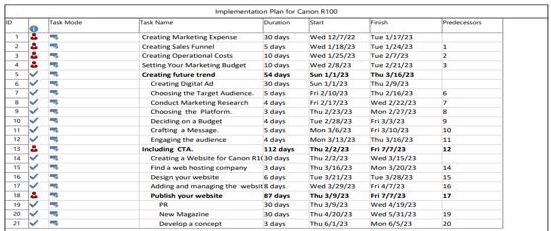
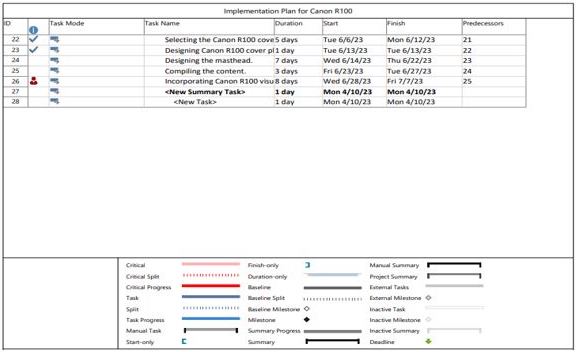
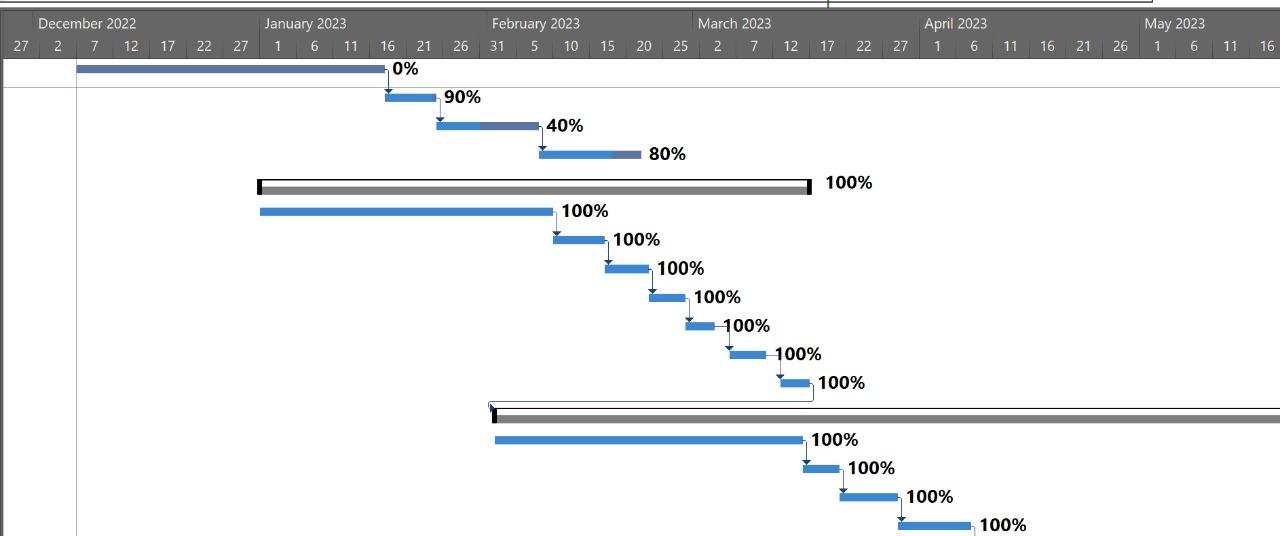
While being the new product like Canon EOS R100 in the market, the company would need to come up with an implementation plan that considers the key performance indicators like Cost per Lead (CPL), Marketing Qualified Leads (MQLs), customer retention, and cost per custom acquisition among others Canon’s marketing initiatives’ efficiency at bringing in new sales leads can be evaluated in terms of their cost per lead (CPL). The figures below show a detailed plan of activities involved in implementing the marketing plan for the product (Fig. 1) and a Gantt chart (Fig. 2) showing the distribution throughout the year.
The Gantt chart provides the dates and a detailed list of tasks to be completed by each department during the first year of the implementation plan’s adoption. It also provides an in-depth strategy for the first year’s execution, outlining when essential activities should be launched before and throughout the proposed time frame. Furthermore, the most important key performance indicators (KPIs) are scheduled in the Gantt chart during planning.
List of References
Andaleeb, S.S. (2016) “Market segmentation, targeting, and positioning,” Strategic Marketing Management in Asia, pp. 179–207. Web.
Baines, P. (2019) Marketing. 5th edition. Oxford, Oxford University Press.
Canon Australia (2022) About Canon, Canon Australia. Web.
Canon Europe (2022) Canon Inc. Background – Canon Press Centre, Canon Europe. Web.
Canon New Zealand (2018) Canon New Zealand appoints New General manager for Consumer Imaging Business. Canon New Zealand. Web.
Chaffey, D. & Ellis-Chadwick, F. (2016) Digital marketing. Sixth edition. Upper Saddle River, Pearson.
Fern Fort University (n,d) Canon SWOT analysis matrix (strengths, weakness, opportunities, threats), Fern Fort University. Web.
Global data (2022) Marketresearch.com, Market Research. GlobalData. Web.
Gray, J. (2022) BCN+R data shows that Canon and Sony controlled the Japanese camera market in 2021, DPReview. Web.
Jukic, S. (2022) Specs for the upcoming Canon EOS R100 have been leaked, Shotkit. Web.
Laricchia, F. (2022) Canon Net Sales 2006-2021, Statista. Web.
OFEK, E. (2008) “Competitive positioning through new product development,” Handbook of New Product Development Management, pp. 49–85. Web.
Shank, M.D. and Lyberger, M.R. (2021) “Segmentation, targeting, and positioning,” Sports Marketing, pp. 267–325. Web.
Shaw, A.A. (2020) Pestle analysis of U.K.: The United Kingdom Pestel Analysis, Marketing Tutor. Web.
The Guardian (2018) Shoes, sweets, and soap: Ons reveals how teens spend their cash, The Guardian. Guardian News and Media. Web.
The International Trade Administration (2022) United Kingdom – Market Overview, International Trade Administration | Trade. Web.
Yi, Z. (2018) “Market segmentation, targeting, and positioning,” Marketing Services and Resources in Information Organizations, pp. 39–48. Web.