
Background
The Structure and Function of the Nervous System
When scholars refer to the central nervous system, they usually mean the human spinal cord and brain. The peripheral nervous system connects the brain and the spinal cord with other organs (Solanelles-Farré & Telley, 2021). The signal originates from the central nervous system, which is responsible for processing all impulses, and then transmits the signal through the nerves (Solanelles-Farré & Telley, 2021).
The CNS is responsible for speech, thinking, movement, and sensory perception of reality, including smell, taste, feeling, hearing, and sight (Solanelles-Farré & Telley, 2021). The reflexes represent these characteristics because they are the nervous system’s reaction to the environment. The general features of the reflexes are receiving information from the surrounding world, interpreting it, and sending the signal to the body.
The Normal Physiological Functions of the Reflexes Evaluated in the Lab
Specific reflexes are evaluated in the laboratory to assess the level of CNS functioning evident in the individual’s physiological reactions. Various types of reflexes are responsible for the functioning of the human organism (Biga et al., 2022). For instance, the Achilles tendon is the response to stretching muscles, and when a person stretches a muscle, it is detected in the laboratory setting.
The patella reflex occurs when a light blow briefly stretches the quadriceps muscle of the thigh to the tendon of this muscle under the patella. The impact stretches the tendon and, in turn, acts on the extensor muscle, causing involuntary extension of the lower leg. The patellar tendon and Achilles tendon reflexes must be assessed to determine whether specific spinal cord segments are functioning properly. Such tests allow one to check for any damage to the motor nerve and locate these abnormalities.
Recognizing abnormal reflexes is one of the tasks of the study, which, together, allows one to determine the effectiveness of the spinal cord and nerve impulse conduction. These tests allow a connection between the sensory nerves associated with the stretch receptors in the muscle, the spinal cord, and the motor neurons. The signal from the spinal cord is responsible for contracting the muscles in response to the Achilles and patellar reflexes, which allows humans to control the muscles in the right tone (Solanelles-Farré & Telley, 2021). Nerve impulses along the sciatic nerve fibers travel to the spinal cord (L5, S1, S2, S3, S4 sacral segments), bypassing the interneuron and directly connecting to the efferent neuron.
Another example is the pupil reflex, which reacts to light entering the eye, causing the pupil to constrict and protect the retina (Solanelles-Farré & Telley, 2021). The average pupil reflex indicates the possibility of impulse transmission from the retina via the optic nerve through the chiasma. Performing a reflex assessment enables one to evaluate the functioning of the nervous system and identify any abnormalities.
The Features and Functions of the Physiological Processes Evaluated in the Reaction Time Experiment
The reaction time laboratory experiment provides information about three types of reactions, their general features, and the functions of the physiological processes. Among these are sensory experiments, brain integration, and motor pathways associated with these activities (Biga et al., 2022). The discussion features three types of testing using a ruler: auditory, tactile, and visual.
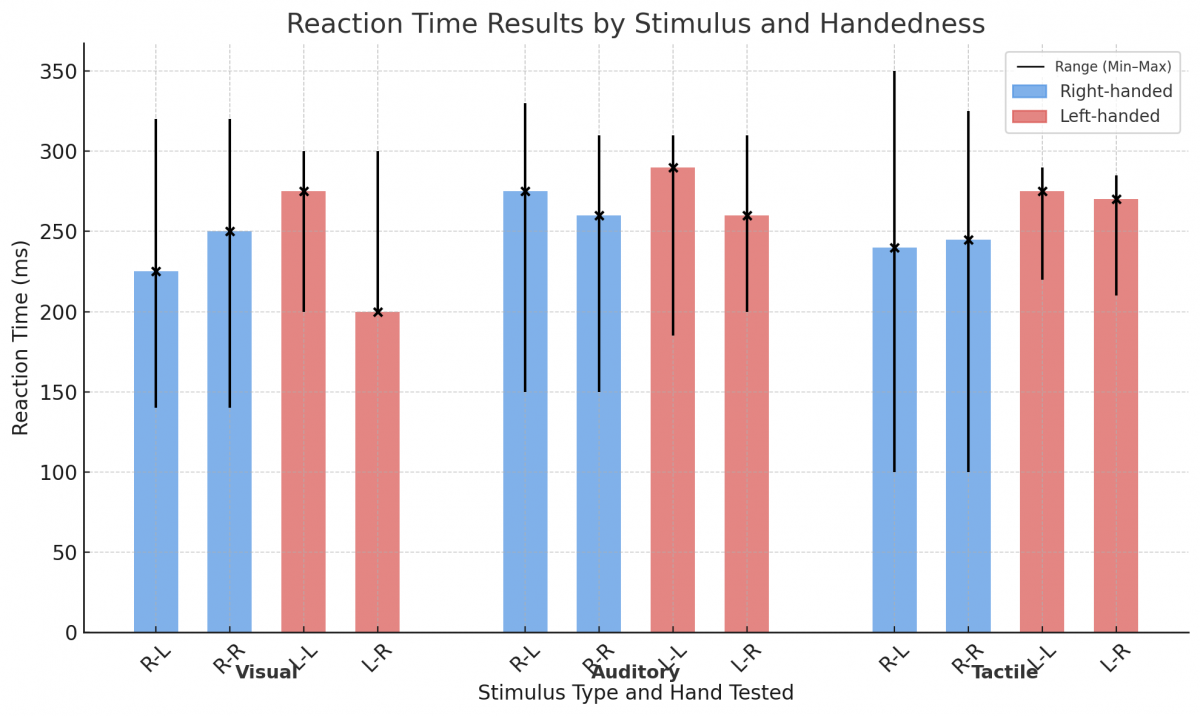
The experiment results show that the reaction time in three categories is lower when the participant’s dominant hemisphere analyzes the signal. For example, the proper hand reaction for visual, auditory, and sensory irritation is quicker than the left-hand response among right-handed people. The protection function is more effective when the person uses the dominant hand and hemisphere to analyze the impulse, as shown in Graph 1.
Results
Discussion
Summary of the Results
The tests indicate that reaction times may differ between the dominant and non-dominant hands. The response time for the left finger among the right-handed participants was longer than the response time for the right finger to the tactile, auditory, and visual stimuli (Ng & Chan, 2012). At the same time, the reaction to the tactile stimuli was shorter than the reaction to the auditory and visual stimuli (Ng & Chan, 2012).
In the group of young people, the average response time for females was higher than for males (Ng & Chan, 2012). It shows that both age and gender are essential characteristics for the test results. The results showed that the right fingers of right-handed people were shorter than their left fingers (Ng & Chan, 2012). This fact can be explained by the practice of using the dominant hand, which makes reactions more automatic. The dominant hand showed faster reactions to the stimuli in all cases.
Comparison of the Empirical Findings with Theoretical Expectations
The results of the different findings coincide with the discussion of the reactions of right and left-handed people. These ideas can be illustrated with the lines from the article by Kosinski, who states that most people exhibit faster reactions when using their dominant hand. According to the investigation, only 20 to 25% of right-handed people have the dominant right hemisphere (Kosinski, 2012). The side of the human body with the non-dominant hand shows significantly slower reactions to the impulses compared to the preferred hand (Kosinski, 2012). Therefore, the findings obtained by the researchers in the reaction time experiment are similar due to the standard way the central nervous system functions.
Reasons Behind Differences Between the Observed and Expected Results
At the same time, specific factors may have contributed to the differences between the results observed in our experiment and the findings in the literature. Among them is the smaller number of participants who participated in the test. It does not allow us to make more generalized conclusions on the topic. Additionally, it is challenging to study the issue across different social groups to connect the results with factors such as gender, age, and educational level.
References
Biga, L. M., Dawson, S., Harwell, A., Hopkins, R., Kaufmann, J., LeMaster, M., Matern, P., Morrison-Graham, K., Quick, D., & Runyeon, J. (2022). Anatomy and physiology. OpenStax.
Kosinski, R. J. (2012). A literature review on reaction time. Clemson University, 1-21.
Ng, A. W. Y., & Chan, A. H. S. (2012). Finger response times to visual, auditory and tactile modality stimuli. Proceedings of the International MultiConference of Engineers and Computer Scientists 2, 1-6.
Solanelles-Farré, L., & Telley, L. (2021). New insights into CNS development from multiomics approaches. Current Opinion in Neurobiology, 66, 116–124. Web.