
Executive Summary
The purpose of this paper is to inform healthcare providers about cerebral palsy. Firstly, the paper aims to enhance clinicians’ overall awareness of cerebral palsy. Secondly, the aim is to describe the types of interdisciplinary collaboration that should be used to treat the condition. Thirdly, the purpose is to explore possible treatment options for cerebral palsy. Ultimately, the paper aims to enhance healthcare providers’ understanding of the pathological process underlying cerebral palsy.
Introduction
Cerebral palsy is a disorder that affects an individual’s motor control and coordination. It is usually caused by damage to the brain during development (Mayo Clinic, 2022). Symptoms may include difficulty walking, maintaining balance, coordination, and speaking. People with cerebral palsy may also experience seizures, muscle spasms, and fatigue (Ball et al., 2021).
Assisted technology can be very helpful in managing the symptoms of cerebral palsy. These technologies may include wheelchairs, braces, and communication devices. Specialized software and apps that aid coordination and mobility may also be beneficial. Physical and occupational therapy can help strengthen and improve coordination and balance. Assistive technology can also aid in communication, enabling people with cerebral palsy to communicate more effectively.
The Significance of Studying Cerebral Palsy
Cerebral Palsy is a serious condition affecting millions of people worldwide. Studying this condition can help further the understanding of its causes, effects, and treatments. This can lead to more accurate diagnosis and treatment of individuals with the condition, as well as an improved quality of life for those affected (Mayo Clinic, 2022).
Additionally, it is a crucial step in helping to reduce the stigma associated with the condition. Researching Cerebral Palsy is essential for understanding its effects and improving the lives of those living with the condition. Students having trouble with the issue have a greater opportunity to improve their outcomes by collaborating.
Disease Process
Cerebral palsy is a neurological disorder caused by abnormal development or damage to the part of the brain responsible for movement. It can result from a variety of factors, including genetic factors, prenatal or perinatal complications, such as a mother’s infection during pregnancy, a lack of oxygen to the baby’s brain during delivery, or a traumatic birth (Mayo Clinic, 2022). Other causes may include infections such as meningitis or encephalitis, head injury, lead poisoning, or exposure to certain toxins or drugs. It is important to note that the cause of cerebral palsy is not always known.
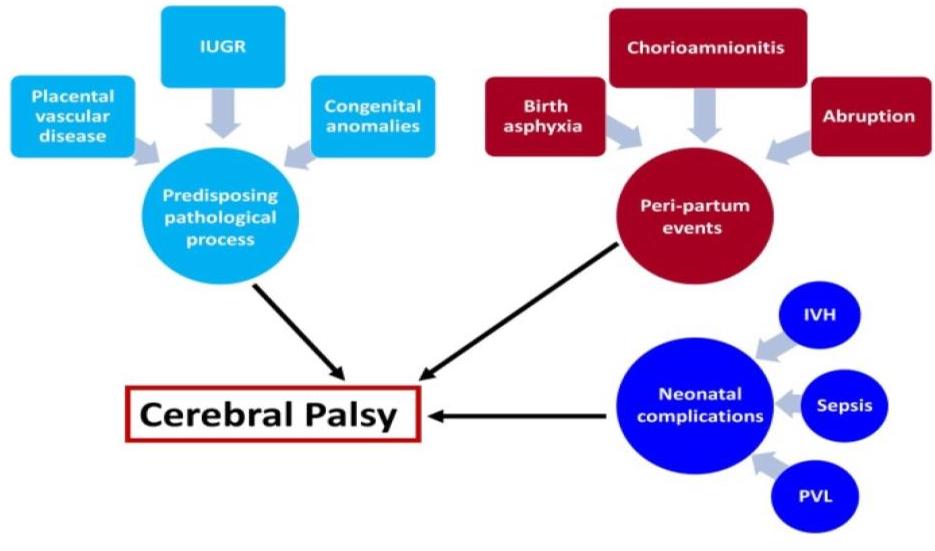
Cerebral palsy is a neurological disorder that affects body movement and muscle coordination. As shown in the figure, this condition is caused by a disruption of the brain parts that control movement, balance, and posture (Stavsky et al., 2017). Predisposing pathological processes, such as a genetic defect or infection in the developing brain, may lead to cerebral palsy.
Peri-partum events such as premature birth, low birth weight, and maternal infection can also increase the risk of cerebral palsy. Neonatal complications such as hypoxia and hemorrhage during the newborn period can also damage the developing brain and lead to cerebral palsy. In some cases, the cause of cerebral palsy is unknown (McConnell, 2013). Treatment and therapies can help control the severity of the condition and manage its associated symptoms.
Cerebral palsy is a neurodevelopmental disorder caused by a non-progressive brain injury that occurs shortly after birth. It can significantly impact a person’s ability to move and communicate. Children who have cerebral palsy often have increasing secondary musculoskeletal disorders that impact both their movement and posture as a result of the brain damage that caused the condition (Bin et al., 2022). The musculoskeletal disorders that are the source of the problem manifest themselves at a young age and worsen over a person’s lifetime, impacting both their well-being and quality of life (Bin et al., 2022). These conditions are caused, among other things, by impaired muscle in cerebral palsy and may be influenced by abnormal development of skeletal muscles.
Treatment of Cerebral Palsy
Non-Surgical Treatment
Although cerebral palsy is a disability that lasts a person’s entire life, several treatments can assist in lessening the effects of the condition on a person’s body and improve their overall quality of life (Mayo Clinic, 2022). Medications prescribed by medical specialists can sometimes alleviate movement problems. Some medications, like diazepam, are meant to be taken orally, while others are supposed to be injected. Injections of botulinum toxin type A into muscles affected by spasticity can be beneficial for a significant number of children with cerebral palsy. The components of physical therapy concentrate on enhancing an individual’s day-to-day mobility skills, such as sitting, walking, playing, dressing, and using the restroom.
Surgical Treatment
Different surgical treatments can be used to manage cerebral palsy. One treatment involves straightening the crooked joints and stretching tight muscles. This ensures the muscles are in the right places to support movement (Levitt & Addison, 2018). The other intervention is to repair a dislocated hip joint. A surgical procedure that straightens a curvature in the spine is essential because it ensures the spine is in the correct posture. Dorsal selective rhizotomy was performed to lessen the stiffness in the legs.
The Types of Interdisciplinary Collaborations
Interdisciplinary collaboration is essential in managing cerebral palsy to enhance patients’ health and well-being. The first collaboration is between physiotherapists and medical specialists to enhance muscle coordination (Levitt & Addison, 2018). The second collaboration involves psychologists and social workers to ensure the patient’s emotional well-being. The third collaboration involves medical specialists and psychologists to support pain management. For example, medical specialists treat pain through medication, while therapists help patients change their perspective on pain.
Treatment for Feeding Problems
People with cerebral palsy may have difficulty swallowing food. Based on this, healthcare providers should determine interventions to help overcome the situation. The first practice is engaging an individual in swallowing activities (Levitt & Addison, 2018). This is supposed to enable a person to swallow the food effectively.
The second treatment for the problem is a modification in diet, such as eating soft foods. The third treatment approach is using a feeding tube, especially in severe situations. A tube can be passed through the nose into the stomach or directly to the stomach through the skin of the tummy.
Treatments for Drooling
Several treatments are available to help reduce excessive drooling. One of the treatments involves using anticholinergic drugs integrated with the strategies and activities presented by a speech and language therapy professional (Levitt & Addison, 2018). Botulinum toxin injections into the salivary glands are an alternative to oral medications or skin patches that can lower the amount of saliva generated. Surgery to reposition the salivary glands so that saliva flows towards the back of the mouth instead of the front is an alternative to injections, which can help alleviate drooling difficulties for a few months.
Complications of Treatment
There are different complications experienced when dealing with people with cerebral palsy. The first challenge is spasticity and contractures, where the muscles cannot stretch as required to enable movement (Levitt & Addison, 2018). In this case, a provider is expected to implement interventions to rectify the situation.
The second complication experienced when managing these patients is feeding difficulties. There is often a need to make alternative feeding arrangements to ensure that patients get adequate nutrients for their recovery. The other complications are communication issues and mental impairment.
There are many complications experienced in the management of cerebral palsy. Urinary incontinence is caused by impaired control of bladder muscles (Levitt & Addison, 2018). This problem makes it challenging for individuals to control their urine.
Gastrointestinal issues, such as vomiting, are among the issues that people with cerebral palsy face, which makes it hard for them to live a healthy life. The lack of selective control of muscle operations and anticipatory control is due to abnormal neurologic control. Finally, individuals with cerebral palsy may have hearing and vision problems.
Current Technology Designed To Promote Health
For individuals with cerebral palsy, simple apps are being developed to enhance their communication, particularly those who struggle with speech. Patients with cerebral palsy can benefit from cutting-edge medical technology (Jindal et al., 2019). People who have cerebral palsy can walk with the assistance of robotic technology.
If someone has trouble speaking, mobile applications are being used to improve their communication ability. Additionally, the apps can be used to deliver instructional materials to the user. Movement can be improved with virtual reality by increasing the amount of exercise done.
Technology is integral in making the lives of individuals with cerebral palsy easier. Functional Electrical Stimulation is an exciting new technology that helps many kids with cerebral palsy (FES). The treatment utilizes a small device that sends electric signals to various muscle groups to stimulate them.
Electric wheelchairs are among the most common mobility-improving assistive technologies (Jindal et al., 2019). They help children with limited arm use because they can be controlled with a simple joystick or button. Families of children with cerebral palsy get a lot of help from online communities like the Cerebral Palsy Family Network. People are aware that networks like these can assist with everything from obtaining an education to securing financial resources.
Conclusion
Cerebral palsy is a physical handicap that negatively influences the development of movement. Because cerebral palsy is a neurodevelopmental illness that causes physical difficulties in children and has a significant impact on a child’s development, healthcare professionals from a variety of fields need to collaborate to provide effective therapy for the condition. For instance, medical professionals and physical therapists could collaborate to enhance the patient’s muscle growth. Therefore, cerebral palsy can be managed by ensuring that all the related complications are treated.
References
Ball, J. W., Dains, J. E., Flynn, J. A., Solomon, B. S., & Stewart, R. W. (2021). Seidel’s physical examination handbook: An interprofessional approach (10th ed.). Elsevier.
Bin Ghouth, S. G., Williams, S. A., Reid, S. L., Besier, T. F., & Handsfield, G. G. (2022). A statistical shape model of soleus muscle morphology in spastic cerebral palsy. Scientific Reports, 12(1), 1-10. Web.
Jindal, P., Macdermid, J. C., Rosenbaum, P., Direzze, B., Narayan, A., & Nayak, S. L. (2019). Treatment and re/habilitation of children with cerebral palsy in India: a scoping review. Developmental Medicine & Child Neurology, 61(9), 1050-1060. Web.
Levitt, S., & Addison, A. (2018). Treatment of cerebral palsy and motor delay. John Wiley & Sons.
Mayo Clinic. (2022). Cerebral palsy. Web.
McConnell, T. H. (2013). The nature of disease: pathology for the health professions. Lippincott Williams & Wilkins.
Stavsky, M., Mor, O., Mastrolia, S. A., Greenbaum, S., Than, N. G., & Erez, O. (2017). Cerebral palsy—trends in epidemiology and recent development in prenatal mechanisms of disease, treatment, and prevention. Frontiers in pediatrics, 5, 21. Web.