
Discussion and Critical Evaluation of Consumer and Business Buyer Behavior Models
Introduction
Consumer behavior studies how people select, buy, and use products and services. Conversely, business buyer behavior refers to how organizations purchase items to meet their operating needs. Comprehending consumer and business buyer behavior is crucial in formulating marketing mix strategies. Kotler’s consumer behavior model and his business buyer behavior model are two popular models that explain the decision-making processes of both individuals and business firms. Understanding customer behavior is fundamental to creating effective marketing plans.
Consumer Behavior Model
The Kotler consumer behavior model is one of the most common models that outlines how consumers make choices. Guan and Zhao (2021) assert that the model has three parts: external factors, internal factors, and consumer reflection (see figure 1). The model comprises five stages: need recognition, information search, evaluation of alternatives, purchase decision, and post-purchase evaluation. Kotler’s model is more structured and analyzes all the different stages a consumer may go through in the buying process (Rusliani et al., 2022). It provides a structured approach for marketers to identify and address consumer behavior.
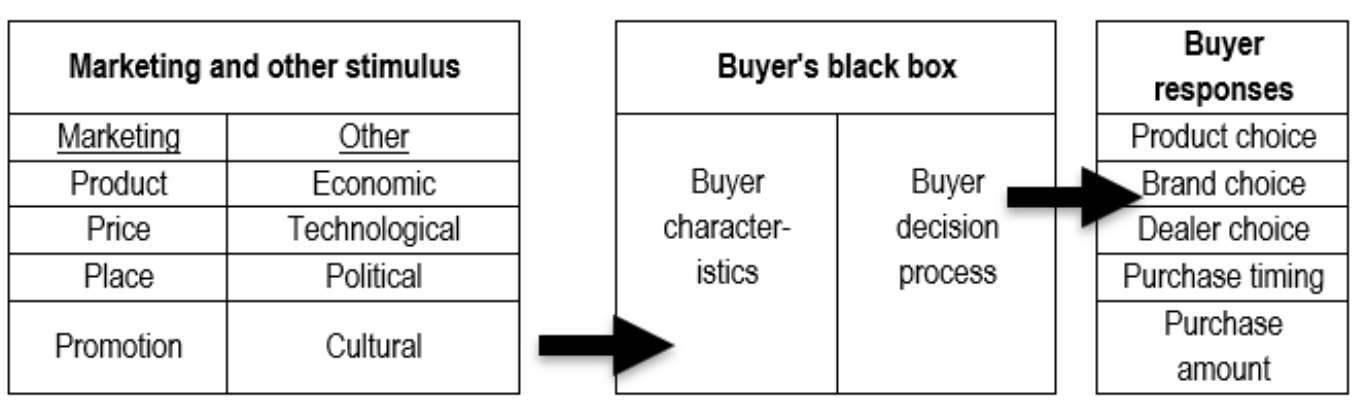
Moreover, the model is broadly relevant, with no industry or product-type restrictions. Because of its flexibility, it can easily be incorporated into many contexts, especially in consumer marketing. Due to the model’s sequential organization, this approach is highly actionable and can be easily implemented in practice (Rusliani et al., 2022). Businesspeople and marketers use it to identify points of contact and potential consumer engagement within the buying funnel.
Although Kotler’s consumer model has advantages, it also has limitations. Some critics of Kotler’s model will likely argue that the marketing model overemphasizes the myriad of factors involved in consumer decision-making (Reina Paz and Rodríguez Vargas, 2023). However, in real life, the consumer decision-making process depends on numerous psychological, social, cultural, and situational factors that the above model does not fully account for.
The model portrays a sequential progression through the decision-making process, with each stage completed before the next is initiated (Reina Paz and Rodríguez Vargas, 2023). But in reality, it is a complex, step-by-step process in which the consumer continuously evaluates the end product and switches between choices. Although the model has incorporated the post-purchase evaluation stage, it does not seem to adequately accommodate or emphasize future contact between consumers and the brand.
Kotler’s Model of Business Buyer Behavior
Kotler’s business buyer behavior model provides insight into organizations’ procedures while buying business products (see Figure 2). The model encompasses problem recognition, general need description, product specification, supplier search, proposal solicitation, supplier selection, order-routine specification, and performance review (Zheng and Liu, 2021).
In the first stage, the business identifies a need or problem that has to be solved, leading to a purchase. Once the problem has been specified, the businesses specify the broad attributes of the ideal solution. Users define the requirements and characteristics of the product or service to meet their needs. During this stage, companies seek suppliers to provide the required product or service. Buyers issue tenders to prospective sellers, requesting comprehensive information on products and prices.
Finally, organizations choose a supplier who delivers the most value out of plans based on factors such as price, quality, time, or service (Zheng and Liu, 2021). After selecting a supplier, business organizations negotiate contracts and terms, place the order, and maintain the relationship. Further, the business entities assess a chosen supplier’s effectiveness to ensure the supplier meets their expectations and to inform future procurement decisions.
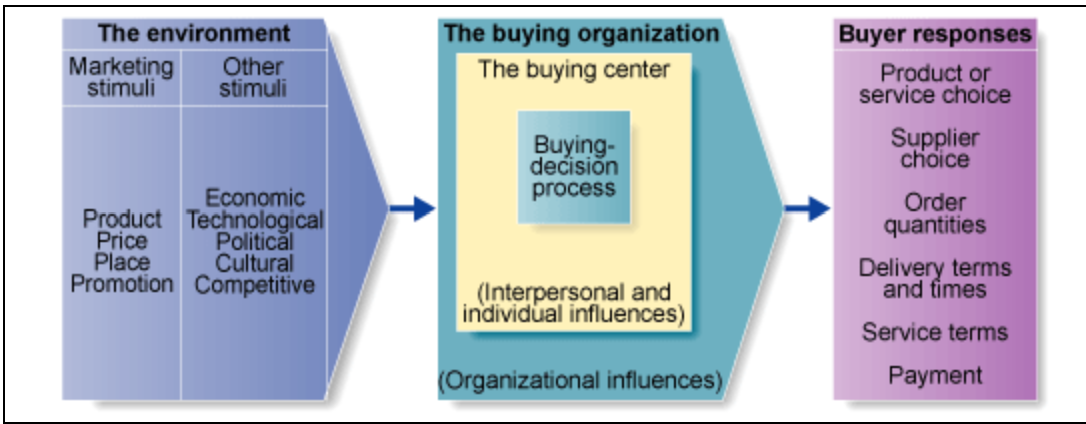
Kotler’s business buyer behavior model has several advantages when utilized effectively. Unlike Kotler’s consumer behavior model, the business buyer behavior model presents a systematic view of business consumers’ behavior and decision-making (Zheng and Liu, 2021). For marketers, it highlights who is making decisions and on what terms suppliers will be selected.
Bakır, Özdemir, and Akan (2021) assert that the model is best applied in B2B markets, where decision-makers are individuals, and the purchasing process is longer than in B2C markets. The model requires interpersonal communication, which is significant for cultivating and sustaining relationships with business buyers. It embraces trust, reliability, and service quality, all of which are factors valued when selecting suppliers.
One area for improvement in Kotler’s model is that it does not consider irrationality in business or the fact that it partly depends on the instincts of its owners and managers. However, it may not focus on specific aspects of buying behavior that occur formally; for instance, it may not consider interpersonal forces, including organizational politics and emotional factors, as determinants in the business buying process. Although the B2B purchasing model features a progressive line of stages, it might lack the flexibility and cyclical character inherent in the B2B environment (Bakır, Özdemir, and Akan, 2021). In many cases, when organizations make purchases, the process is not as straightforward or uncomplicated as it may be assumed, and a degree of flexibility can be more effective. However, the model is more oriented toward the buying center’s buying process and may not capture all facets of business buying behavior, such as post-purchase evaluation and the maintenance of long-term relationships.
Conclusion
The consumer behavior and business buyer behavior models developed by Kotler can be of much use in studying and analyzing the decision-making of people and companies. Despite being effective frameworks that provide marketers with a direct approach to analyzing and handling consumers’ purchase behaviors, the two models have specific weaknesses. The consumer behavior model illustrated by Kotler is comprehensive and easy to apply in various situations.
Nevertheless, it could lead to an overemphasis on the decision-making process while neglecting post-purchase behavior. While Kotler’s business buyer behavior model provides insight into business purchase processes, it overlooks non-rational motivating factors. It should be more dynamic in identifying the various forms of business purchase behavior. Therefore, marketers should integrate additional knowledge and research tools to develop more effective and efficient marketing strategies. By analyzing these models and understanding their strengths and weaknesses, marketers can adopt a more comprehensive perspective when studying and managing buyer behavior in a contemporary commercial environment.
Factors Affecting Consumer and Business Buyer Behavior for a Tire Manufacturer
Introduction
Big players such as Michelin, Pirelli, Kumho, Continental, Goodyear, and Yokohama dominate the tire production industry, which operates in the B2C and B2B sectors. These corporations drive market trends, technology development, and business competition. Comprehensive knowledge of consumer and business buyer behavior is crucial for successfully navigating the complex terrain. Understanding factors that motivate customers to make buying decisions lets manufacturers fine-tune their marketing strategies. Thus, this discovery helps organizations develop highly focused campaigns, refine their product offerings, and increase customer satisfaction.
Factors Influencing Consumer Buyer Behavior in the Tire Industry
Financial factors play an essential role in shaping consumers’ buying decisions in the tire industry. Consumer decisions about when to purchase tires depend on prevailing income levels, inflation, and unemployment rates in the economy (Qazzafi, 2020). Whereas higher-class consumers prefer to buy more expensive brands such as Michelin and Pirelli, others who like to save money may buy cheaper brands such as Kumho and Yokohama during a recession. However, it is essential to note that economic factors are not the only drivers of consumer consumption rates. Even though these aspects contribute to purchasing decision-making and attitude formation towards tire brands, other psychological and sociocultural factors also exist.
Psychological factors are considered significant determinants of consumers’ attitudes and behavior in the tire market. Safety, performance, and brand identity are key factors in the decision to purchase a tire (Zhang and Dong, 2020). Examples of such products include Michelin and Pirelli tires, which rely on consumers’ perceptions of luxury and quality. However, Kotler’s model places psychological factors more centrally in the consumer decision-making process, though the relationships among those factors may not be as clear-cut as portrayed. Therefore, psychological factors such as brand perception and safety concerns are intertwined with the economic and sociocultural aspects of consumer behavior in the tire industry.
Moreover, family influence, reference groups, and cultural considerations also significantly determine the kind of tires to purchase. For example, social class influences consumer-brand relationships by leading high-class individuals to prefer luxury brands such as Michelin for status and performance appeals (Hooper’s Tire Outlet, 2024). Moreover, opinion leaders and reference groups, such as those in the automobile industry, impact consumer behavior and brand selection. As a result, Kotler’s model might need to capture the relationship between sociocultural and economic factors in their fluid interdependence. The critique shows that it is essential for tire manufacturers to understand the social and cultural context in which consumers operate so they can sell their products.
Product, price, place, and promotion are the four marketing mix elements crucial to forming consumers’ perceptions and behaviors in the tire industry. Brand value, product quality, and innovative excellence, as embodied by Goodyear, among other brands, still appeal to consumers (Zubek et al., 2021). Understanding consumer perception and brand preference includes pricing strategies, distribution, and advertising. One of the disadvantages of Kotler’s model is that, by concentrating on the marketing mix elements, it may need to consider the general patterns of the consumer’s economic, psychological, and sociocultural surroundings. Therefore, the marketer needs to take an integrated approach to these factors to successfully address consumers’ concerns in the tire market.
Factors Influencing Business Customers’ Buying Decisions in the Tire Industry
Organizational factors have a significant influence on B2B purchasing decisions within the tire industry. Some factors that dictate the choice of suppliers include the company’s size and structure, as well as the policies in place for purchasing supplies and equipment. Large firms look to established brands such as Michelin and Goodyear for their stronger reputation and quality guarantees (Hooper’s Tire Outlet, 2024).
However, when establishing small-scale industries, one may consider the cost factor and prefer Kumho or Yokohama. Despite acknowledging the organizational influences of Kotler’s business buyer behavior model, B2B buyer behavior may not be as simple as the model prescribes. Therefore, understanding organizational factors such as procurement, budgeting, and purchasing strategies is critical for tire manufacturers to sell to B2B clients.
Moreover, technological factors significantly impact B2B purchasing decisions and marketing in the tire industry. Sustainability trends, including ecological materials and tire treads, appeal to modern companies focused on environmental concerns (Yaghtin, Safarzade, and Karimi Zand, 2020). For instance, Michelin and Yokohama rely on technological advancements to satisfy the technical consumer who prioritizes performance, fuel economy, and environmental impact (Rodrigues and Oliveira, 2020). Kotler’s model includes technological factors that influence B2B purchasing decisions, but it does not adequately capture the dynamic pace of technological change, which in turn affects buyers’ behavior. Therefore, tire manufacturers need to improve their product development by integrating new technologies to better address the challenges faced by their B2B clients.
Environmental factors affect B2B purchasing behavior in the tire industry. Since sustainability is considered a valuable factor for organizations, producers who integrate a green manufacturing approach stand in a better position. Eco-friendly consumers purchasing Michelin tires and other products are drawn to companies with sustainability policies, helping to create a brand identity linked to environmental protection (Thomas and Patil, 2023). However, Kotler’s model considers macroenvironmental factors necessary for understanding B2B buyer behavior, and the application of its elements to analyze sustainability initiatives and buying decisions is questionable. Therefore, there is a need to integrate green attributes into tire manufacturing and marketing to attract businesses interested in reducing the impact of climate change.
The decision-making process within the purchasing center and the roles of influential personnel, such as the initiator, user, decision-maker, and influencer, are significant in B2B purchase decisions in the tire industry. Since the buying center consists of decision-makers, individuals such as transportation management and maintenance supervisors are involved, and manufacturers can appropriately conduct market appeals (Anaza et al., 2023). Kotler’s model recognizes the influences of buying center involvement on business buyer behavior, but may not capture most key relationships and decision dynamics well. Therefore, it is evident that tire manufacturers need to establish a close rapport with their stakeholders. They should ensure direct contact with B2B customers and develop solutions tailored to individual styles.
Developing Effective Marketing Programs for a Tire Manufacturer
B2C Market
Target Market Segment
In the B2C market, the company needs to target consumers who are more likely to prioritize safety, performance, and reputation when purchasing tires. This segment consists of users who consider products from Michelin and Pirelli more reliable and higher quality than those from other brands in the segment. Moreover, environmentally sensitive consumers who prefer eco-friendly materials and are willing to pay a higher price for green tires should also be considered.
Product
For the tire manufacturer’s success, it should endeavor to meet consumers’ different product needs. These options range from safety-enhanced products and high performance for the target clients in the higher income brackets to eco-friendly options, such as tires made from recyclable materials, for the environmentally conscious. New concepts regarding tread patterns and technologies must be incorporated to enhance performance and fuel economy, appealing to the knowledgeable buyer.
Price
The pricing strategy should align with the value the products to be developed convey to their consumers. A higher price is often set for premium tires because of the identity they carry in the market, aimed at attracting consumers with higher purchasing power to buy the best-quality tires. Green tires may also be more expensive due to the cost of sourcing eco-friendly materials and manufacturing processes. However, the manufacturer should also provide middle- and low-priced models to accommodate individuals with smaller budgets.
Place
Distribution channels should be carefully selected to ensure they are easily accessible and visible to consumers. The manufacturer should enlist the support of authorized dealers and retailers to target consumers through both online and physical outlets. Moreover, cooperation with car dealers and auto centers can be crucial, as it may lead to product placement and advertising, thus increasing brand awareness and reducing the number of potential customers.
Promotion
A manufacturer’s existing marketing strategies can and should emphasize the safety, performance, and environmental advantages of its offerings. Publicity in advertising campaigns should highlight the brand’s reputation for quality, dependable products backed by its users. Using social media and other digital marketing communication tools to reach consumers, promote specific features, and express sustainability concerns and solutions is feasible. Specials and discounts can also be offered to boost product sales and encourage people to buy it.
B2B Market
Target Market Segment
In the B2B market, the tire manufacturer should focus on businesses that prioritize the tire’s quality, performance, and durability as high-value purchase factors. These are large corporate entities that use fleets of automobiles, logistics companies, or organizations operating in fields such as transportation or construction, where safety and performance are crucial.
Product
The manufacturer should develop product lines for the business world, including high-quality, long-lasting tires for commercial use, such as those used in vehicles and machinery. Moreover, creating specialized tires with such characteristics as traction and durability for different industries is crucial. Furthermore, the company should sell affordable, durable, and environmentally friendly tires for car businesses that wish to reduce their environmental impact.
Price
The cost charged should be fair and proportional to the value the manufacturers’ stocks bring into the system. Promotional pricing techniques such as volume discounts and bulk pricing help businesses negotiate for large stock purchases and cement their relationships with suppliers. The pricing strategies should be flexible to reflect other companies’ different Budget capacities and purchasing practices.
Place
Distribution channels should be used effectively to ensure the timely delivery of goods and effective service delivery. The manufacturer should also make arrangements with the distributors and wholesalers who deal in commercial tires worldwide to facilitate easy access to the product and effective distribution channels. It is also essential that direct sales channels be developed to offer services that assist business customers with placing orders, modifying them, and receiving after-sales support.
Promotion
Marketing communication should appeal to the rational side of business by promoting the dependability and efficiency of the manufacturer’s products and the opportunity to save money. Precisely, testimonials from corporate customers who have enjoyed the services should be included in the advertisement to support the case the company is making. Attending industry and trade shows, conventions, and business meetings is necessary to engage with specific audiences within selected industries. Furthermore, efforts should be made to use techniques such as internet advertising and Search Engine Marketing to raise brand awareness and generate leads in the Business-to-Business market segment.
Conclusion
A variety of economic, psychological, sociocultural, and promotional factors affect consumer behavior in the tire industry. Lifestyle and other factors, such as social class, affect brand image, with higher social classes showing greater preference for luxury brands. One cannot underestimate the role of marketing decisions, which include the product, price, place, and promotion, since the product quality and the price determination influence consumer behavior or decisions. Customer buying behavior is bound by organizational, technological, and environmental constraints in the tire industry. Budget allocation helps in determining B2B marketing strategies. Moreover, technology is an important driver for those engaged with development, innovation, and environmental issues. Value creation in the context of B2C and B2B markets in the tire industry requires focusing on specific market segments, offering customized products and services, setting attractive prices, delivering products to the right place and time, and promoting them effectively.
Reference List
Anaza, N.A., et al. (2023) ‘B2B brand marketing in Africa? An exploratory investigation of B2B buyers’ perception of supplier brands’, Industrial Marketing Management, 109, pp.90-105.
Bakır, M., Özdemir, E., and Akan, Ş. (2021) ‘A novel MADM approach to the ground-handling agent selection problem in B2B markets’. Journal of Advances in Management Research, 18(5), 684-707.
Guan, S., and Zhao, C. (2021) ‘Computer assisted consumer behavior modeling through big data and internet technology’, in 2021 IEEE Conference on Telecommunications, Optics and Computer Science (TOCS) (pp. 849-852). IEEE.
Hooper’s Tire Outlet (2024) Top 10 best tire brands of 2024: a comprehensive guide for car owners.
Kotler and Armstrong. (n.d.) Principles of marketing (activebook 2.0 ): Chapter 7.
Qazzafi, S. (2020) ‘Factor affecting consumer buying behavior: a conceptual study’, International Journal for Scientific Research & Development, 8(2), pp.1205-1208.
Reina Paz, M. D., and Rodríguez Vargas, J. C. (2023) ‘Main theoretical consumer behavioural models’, A review from 1935 to 2021. Heliyon, 9(3).
Rodrigues, G.F.C. and Oliveira, N.P. (2020) ‘Impacts of green tire technology: case study of environmental and customer perspectives’, in Filho, W. L., Baltazar, J., and Guerra, S.(eds.) Water, energy and food nexus in the context of strategies for climate change mitigation, pp.271-285.
Rusliani, H., et al. (2022) ‘The influence of religiosity toward costumers’ decision making in choosing Bank Riau Kepri Sharia Tembilahan Kota, Indonesia (Transformation of conventional consumer behavior theory, Kotler–Armstrong)’, in Proceedings of the 4th International Colloquium on Interdisciplinary Islamic Studies in conjunction with the 1st International Conference on Education, Science, Technology, Indonesian and Islamic Studies, ICIIS and ICESTIIS 2021, 20-21 October 2021, Jambi, Indonesia.
Thomas, J. and Patil, R. (2023) ‘The road to sustainable tire materials: current state-of-the-art and future prospectives’, Environmental Science & Technology, 57(6), pp.2209-2216.
Yaghtin, S., Safarzadeh, H. and Karimi Zand, M. (2020) ‘Planning a goal-oriented B2B content marketing strategy’, Marketing Intelligence & Planning, 38(7), pp.1007-1020.
Zhang, X. and Dong, F. (2020) ‘Why do consumers make green purchase decisions? insights from a systematic review’, International Journal of Environmental Research and Public Health, 17(18).
Zheng, B., and Liu, H. (2021) ‘Enhancing UX design to support organizational buying behaviour on a B2B website’.
Zsigmond, T., et al. (2020) ‘Interconnection of consumer behaviour of different generations and marketing strategy of a football club-experience In Slovakia’. Marketing & Management of Innovations, (2).
Zubek, N., et al. (2021) An analysis of how the goodyear rubber and tire company should navigate the covid-19 pandemic. Bachelor’s Project, Wilson Honors College.