
Introduction
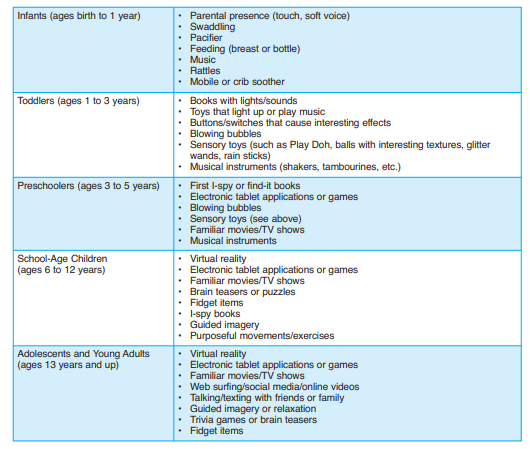
Distraction techniques are vital during medical procedures for children as they serve as coping skills in specific clinical undertakings. Distraction reduces the time staff members require for a given occasion and can save costs for the care facility and patient. Examples of distraction techniques that can be implemented include, but are not limited to, counting objects, coloring, playing GoNoodle games, and listening to music, as shown in Figure 1.
Significance
The rate of children’s treatment in the emergency department is high. For example, in Canada, more than 2.5 million children visit emergency departments (Boles, 2018). Distraction techniques in a clinical setting help children reduce the pain associated with immunization, fear, and the risk of adverse effects from the procedure. Additionally, Boles (2018) states that distraction has a positive impact on children during painful procedures. Therefore, it is crucial to have these procedures in place.
The PICOT Topic
- P- children
- I – playing digital games
- C- use of distraction and non-use of distraction means
- O- combating pain
- T- during injections
PICOT question: “How does playing digital games help children combat pain during injections compared to the absence of distraction procedures for children aged five years and below?”
Articles Selected
The first article used in this paper is by Boles (2019) titled “The powerful practice of distraction”, where the author focuses on decreasing pain and anxiety. The second article is “Effect of active distraction on children’s pain and behavioral response during intravenous catheter insertion” by Moustafa (2021). Lastly, Gates et al. (2020) in their topic “Digital technology distraction for acute pain in children: A meta-analysis” have explored the use of technology distraction for acute pain in children.
Strategies Used to Locate the Articles
The words “digital distraction methods in pediatric clinics” were used as the primary search elements that enabled the identification of the articles. All the pieces were drawn from PubMed, a credible website that features peer-reviewed works. To refine the search, papers that had a general preview of the topic were removed.
Conclusion
Using digital technology, such as playing GoNoodle, is impactful in reducing pain during injections for children. Children involved in these distraction techniques report an improved experience in clinical care, which aids in patient satisfaction and cost savings. When distraction techniques are implemented, children tend not to experience adverse emotional effects and respond positively to treatment.
References
Boles, J. (2018). The powerful practice of distraction. Paediatric Nursing, 44(5), 1–5.
Gates, M., Hartling, L., Shulhan-Kilroy, J., MacGregor, T., Guitard, S., Wingert, A., Featherstone, R., Vandermeer, B., Poonai, N., Kircher, J., Perry, S., Graham, T. A. D., Scott, S. D., & Ali, S. (2020). Digital technology distraction for acute pain in children: A meta-analysis. Pediatrics, 145(2), 17–22.
Moustafa, S. (2021). Effect of active distraction on children’s pain and behavioral response during intravenous catheter insertion. Child Care in Practice, 2(3), 1–12.