Introduction
A new policy has been put in place to improve patient safety in fall prevention. This initiative introduced new door signage, bed alarms, and call lights for patients at high risk of falling to alert staff promptly. This change was made with Hester Davis’ fall risk score in mind and is intended to enhance patient care while lowering the risk of falls-related incidents on the unit.
Annotated Bibliography
Fehlberg et al.’s (2020) study sought to understand how acute care registered nurses make decisions about fall prevention. Nine themes, including hospital-level concerns, unit-level technology assessments, and nurse-level reliance on professional judgment, were identified through qualitative interviews (Fehlberg et al., 2020). Notably, the results point to the need to address concerns about discipline and to support independent nursing practice. The study is essential for creating a supportive practice environment for individuals considering modifications to fall risk policies in acute care settings.
Elderly falls present a serious health risk that can result in ED visits, disability, and higher medical expenses. A transitionally organized fall prevention intervention initiated in the ED for people aged 70 years or older was evaluated by Hepkema et al. (2022). When consent was obtained at the emergency department, participation was higher than with later phone approaches. The study proposes that a workable approach to implementing fall risk policy changes in acute care settings is to start interventions during ED visits.
Montejano-Lozoya et al. (2020) conducted a study at a third-level hospital in Spain to assess the effect of an educational intervention for hospital nurses on the methodical assessment of fall risk. Following training, the intervention group had a lower risk of falling than the control group (Montejano‐Lozoya et al., 2020). The research showed that hospital falls can have serious repercussions, including discomfort, injury, costs, and mistrust. This highlights how systematic risk assessments can effectively reduce falls, suggesting a direction for concise changes to acute care settings’ fall risk policies.
The article by Pop et al. (2020) focuses on how the emergency department (ED) can combat patient falls by implementing a customized fall prevention bundle. Safe ambulation, staff education, and fall risk assessment were introduced over 5 months with success (Pop et al., 2020). The article’s significance stems from the necessity of multifactorial interventions tailored to the acute care environment. This study provides insights that will help shape future policies on fall risk in acute care settings.
The primary goal of the study by Satoh et al. (2022) is to distinguish between early- and late-fall risk factors in acute care settings. Risk factors, including age over 65, impaired extremities, unstable gait, fall history, impaired understanding, and psychotropic use, were discovered through a retrospective cohort study conducted in a Japanese teaching hospital (Satoh et al., 2022). This article clarifies the differences between early and late falls and offers practical advice for developing preventive care plans. It is necessary to consider specific risk factors related to the timing of falls in acute care settings to inform future modifications to fall risk policies.
The effectiveness of multifactorial falls interventions for people over 65 in acute hospital settings is the primary finding of Wallis et al.’s (2022) study. Three major themes emerged from the examination of nine publications: nursing team leadership, information and education, and a thorough framework for change (Wallis et al., 2022). This study highlights the need for collaborative planning with patients and bedside nurses, as well as for tailored care for patients with cognitive impairments, in future projects. It is especially pertinent to changes in fall risk policies in the acute care setting.
Appendix
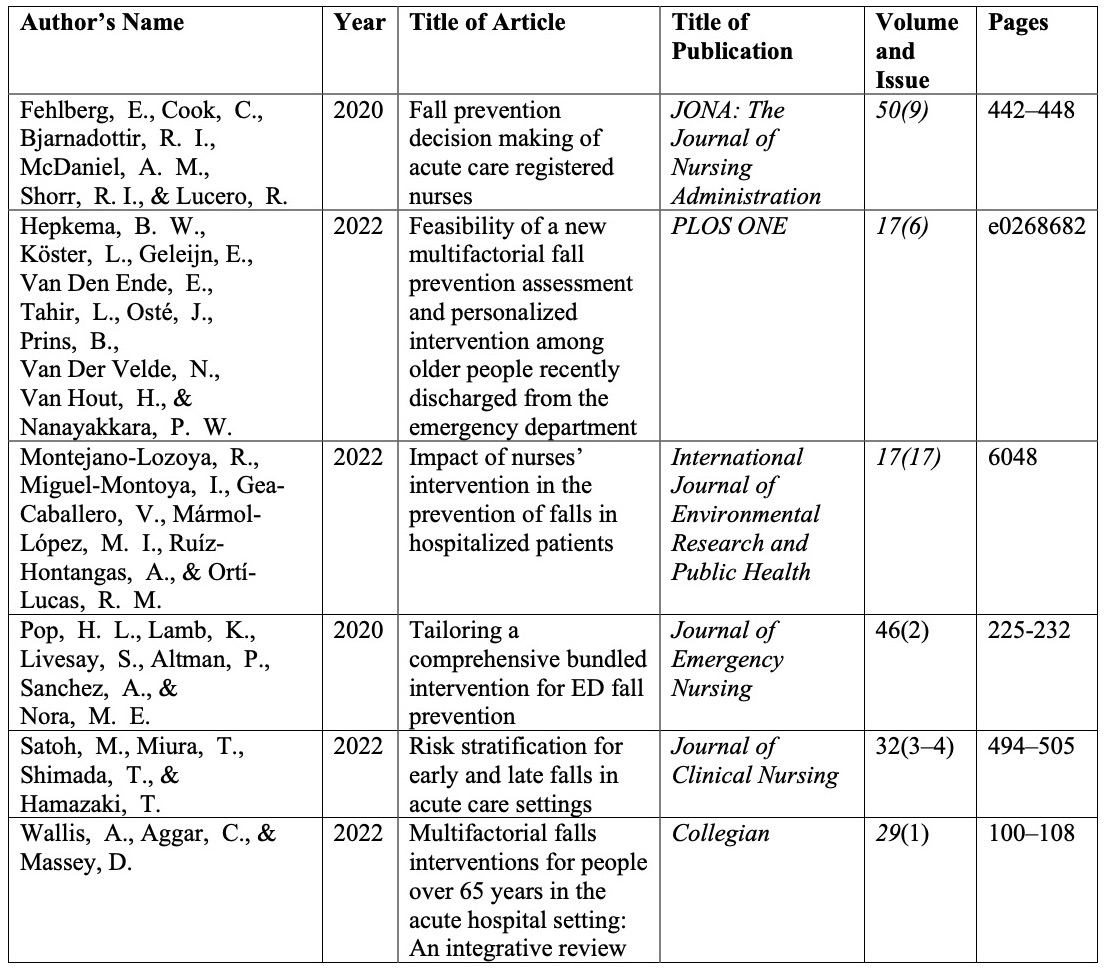
Table 1 – Articles’ Information