
Introduction
This report examines four significant federal laws that influence business trade and operations, with a specific focus on their effects on local and state companies. Comprehensive research on laws that may affect organizations revealed that the Sherman Antitrust Act, the Fair Labor Standards Act (FLSA), the Clean Air Act, and the Sarbanes-Oxley Act (SOX) are widely studied. This report will evaluate their provisions, their immediate and long-term impacts on businesses within the state, and their broader implications for the business community.
The Sherman Antitrust Act
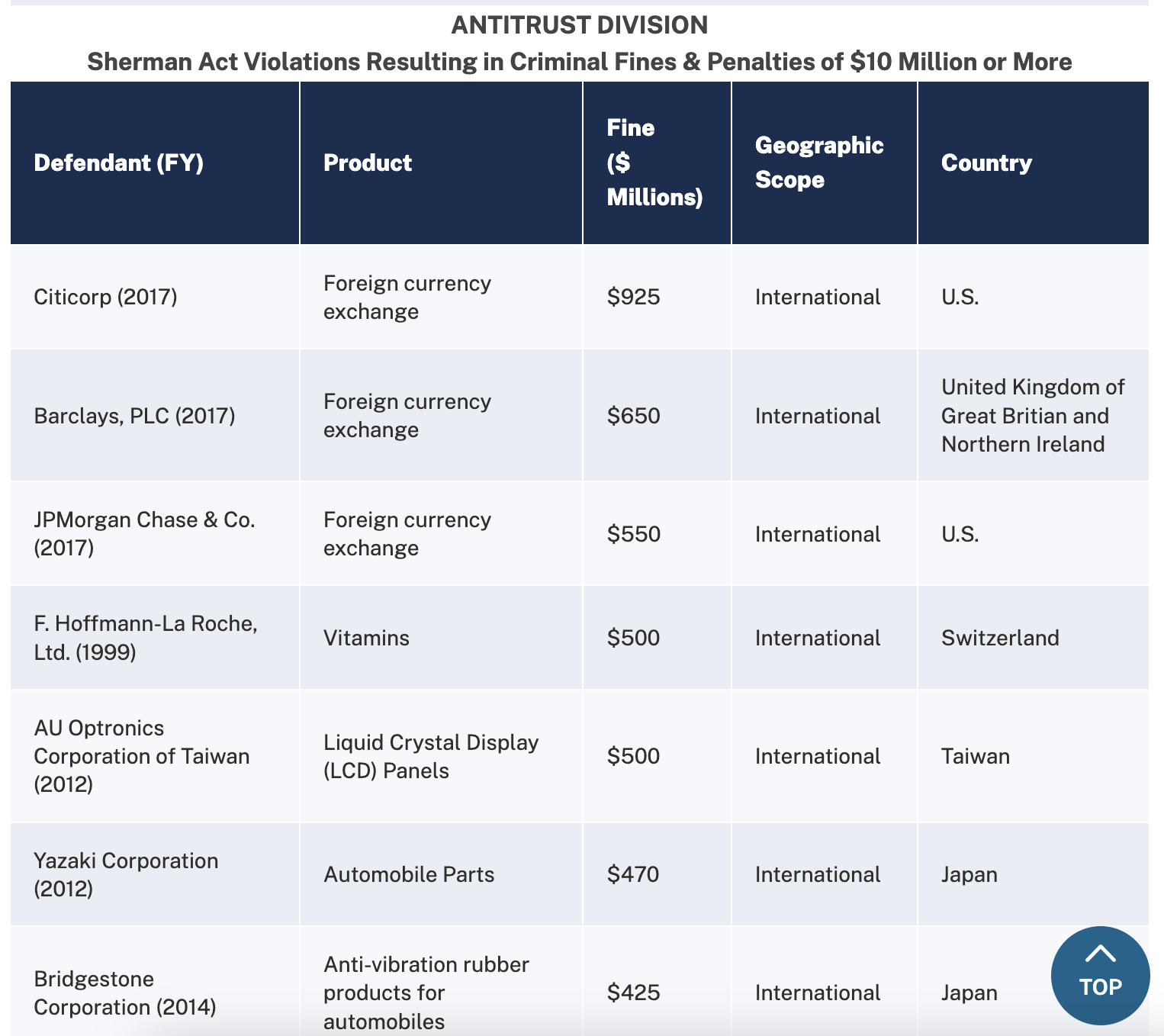
Enacted back in 1, the Act is among the pillars of general Antitrust laws, established to promote competition and prevent restrictive practices. It prohibits activities that restrict interstate commerce and competition in the marketplace, such as monopolies, cartels, and conspiracies to restrain trade. Thus, under the Act, local and state businesses must operate within competitive guidelines to ensure they do not engage in practices that could be deemed monopolistic or anti-competitive. This law encourages small businesses and start-ups by fostering a competitive environment and preventing larger companies from unfairly dominating the market (see Figure 1 for examples of companies fined for violating the Sherman Act).
In the long-term prospects, the Sherman Antitrust Act helps maintain a diverse and competitive market landscape, promoting innovation and consumer choice. According to Ong and Toh (2023), the Act remains applicable to social media platforms, and Facebook illustrates how the legislation is consistently invoked when companies are suspected of violating consumer protection laws. It ensures that local businesses can compete on a level playing field, which is essential for economic growth and for the trust of the customers they serve.
The Fair Labor Standards Act (FLSA)
The Act was initially established in 1938, with provisions setting standards for minimum wage, overtime pay, record-keeping, and youth employment standards affecting employees in both the private sector and federal, state, and local governments. Thus, the law’s implications for local and state businesses are that they must adhere to wage-and-hour standards, which directly affect payroll practices. For instance, ensuring employees are paid at least the federal minimum wage and overtime for hours worked over 40 in a workweek can increase operational costs (U.S. Department of Labor, 2023). Additionally, stringent record-keeping requirements necessitate proper documentation and management systems.
As for the law’s long-term impact, the FLSA aims to protect workers’ rights and ensure fair compensation, thereby enhancing employee satisfaction and productivity. While compliance may increase operational costs, it can also reduce turnover and improve workplace morale. This heightened level of satisfaction can translate into increased productivity, as employees are more likely to put in their best effort when they feel valued and respected. Furthermore, legislation-backed workplace stability reduces performance disruptions and fosters a more cohesive team dynamic, enhancing overall productivity and morale.
The Clean Air Act
The Clean Air Act was originally passed in 1963 and was significantly amended in 1970, 1977, and 1990, regulating emissions from both mobile and stationary sources. It authorizes the Environmental Protection Agency (EPA) to establish National Ambient Air Quality Standards (NAAQS) that safeguard the environment in the country and reduce the subsequent impact of emissions on the population (United States Environmental Protection Agency, 2023). Thus, businesses, particularly those operating in manufacturing, transportation, and energy sectors, must comply with emissions standards and obtain permits for operations.
This often requires establishing pollution-control technologies, which can be costly, and adhering to strict reporting and compliance requirements, which can increase operational costs. Long-term compliance with the Clean Air Act improves public health and environmental quality, benefiting communities and reducing healthcare costs associated with pollution-related illnesses. Over time, businesses may also benefit from innovations in green technologies and sustainable practices, potentially leading to new market opportunities and cost savings through efficiency improvements.
The Sarbanes-Oxley Act (SOX)
Among the four laws, SOX is the most recent, enacted in 2002 in response to major organizational scandals, such as the Enron and WorldCom controversies. Its ultimate goal is to safeguard investors from corporations’ fraudulent financial reporting. SOX mandates strict reforms to improve financial disclosures and prevent accounting fraud. Publicly traded local and state businesses are most affected, even though ripple effects can influence private companies through increased scrutiny and the adoption of similar internal controls to attract investment.
Compliance requires substantial investment in auditing, accounting, and internal controls, increasing operational complexity and costs. In the long run, SOX promotes transparency and accountability, indicators conducive to restoring and maintaining investor confidence (Heller, 2023). Over time, enhanced financial reporting standards contribute to a more stable and trustworthy business climate. For state and local companies, adhering to these principles can attract more partners and investors, thus fostering sustained economic growth.
References
Heller, I. (2023). Understanding and achieving SOX compliance in the age of automation.
Ong, B., & Toh, D. J. (2023). Digital dominance and social media platforms: Are competition authorities up to the task? ICC-International Review of Intellectual Property and Competition Law, 54, 527-572.
U.S. Department of Justice Antitrust Division. (2024). Sherman Act violations resulting in criminal fines & penalties of $10 million or more.
U.S. Department of Labor. (2023). Handy reference guide to the Fair Labor Standards Act.
United States Environmental Protection Agency. (2023). Summary of the Clean Air Act.