
Introduction
Today, it is evident that some works of art have become masterpieces that have marked particular milestones in history and culture. At the same time, they may be reconsidered and reinterpreted by other artists in the future for the creation of works based on them, but from different perspectives. The purpose of this paper is to discuss the similarities and differences in the formal aspects, along with the cultural juxtapositions in the comparisons, using Jean-Honoré Fragonard’s The Swing and Yinka Shonibare’s The Swing (After Fragonard).
Comparison and Contrasting
The Swing, created by the French artist Jean-Honoré Fragonard in 1767, is an oil on canvas painting that may be regarded as one of the most well-known paintings of the Rococo style, characterized by soft lighting, pastel colors, and billowing fabrics. Supposedly ordered by a wealthy patron who aimed to portray his mistress, the work depicts swinging, “one of several outdoor leisure activities common among elites in eighteenth-century France.” In the center of it, a bright, contrasting figure of a young woman in a ruffled, billowing ballet-pink dress sits on a crimson-cushioned swing, operated by a man seated on a bench via a set of connected ropes (see Picture 1).
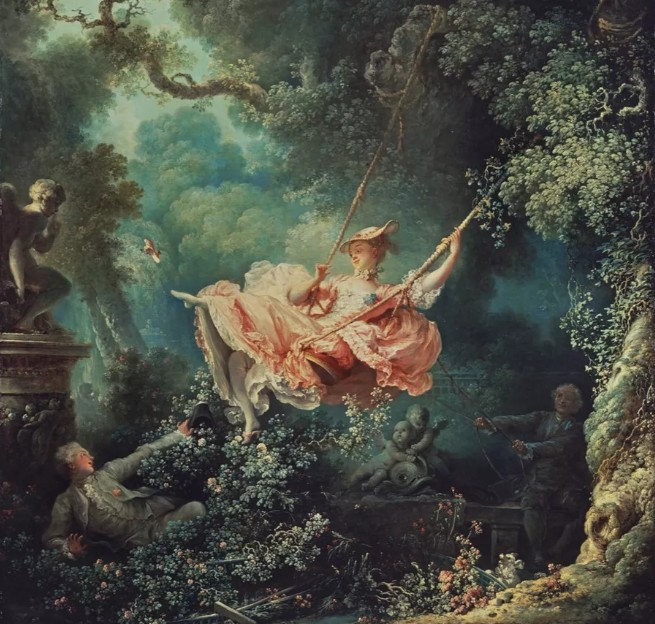
The contrast between the light and brightness of a female figure and the garden’s ark tones draws attention to the woman, emphasizing the client’s admiration of her youth and beauty. In addition, the depicted scene is filled with symbols expressed through the work’s formal elements, including curved lines and shapes, rounded forms, spatial division, figure placement, and color contrast, as well as numerous details and accents. All in all, the mix of artificial items and nature in a lush garden, a young man’s pose, his glance directed to the woman’s open skirt, and her flying heeled slipper pointed at the statue of Cupid symbolize hidden eroticism, frivolity, the rejection of traditional constraints and social norms, adultery, and passion for enjoyment (see Picture 1).
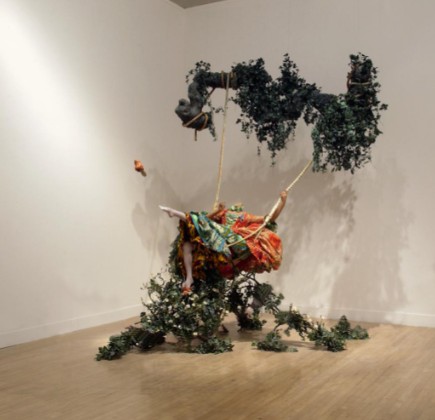
On the one hand, Yinka Shonibare’s The Swing (After Fragonard) differs from Fragonard’s masterpiece by belonging to another form of visual art. It represents a sculpture created in 2001 using a life-sized fiberglass mannequin, artificial foliage, a swing, and Dutch wax-printed cotton textile. Therefore, it is challenging to assess the sculpture’s balance, space, panorama, and light and color contrasts as there are no other figures or landscapes in contrast with Fragonard’s art (see Picture 2). On the other hand, Shonibare’s work partially repeats the scene of Fragonard’s painting, as the mannequin’s posture and a flying slipper resemble the woman’s features, with the absence of a head as the main difference. Therefore, such technical aspects as lines, shapes, and rounded forms are similar.
Meanwhile, the main symbolism of this work is in the woman’s clothes and their texture. Similar to Fragonard’s heroine, Shonibare’s lady wears a dress tailored in the French aristocratic style of the 18th century. At the same time, it is made from abstractly patterned and colorful Dutch wax fabrics with African and Indonesian motifs. The mix of European Rococo style and the elements of Eastern and indigenous cultures symbolizes the impact of colonization.
Cultural Juxtapositions
It goes without saying that works of art reflect not only artists’ emotions and feelings but also the values and norms of the historical periods in which they were created. Jean-Honoré Fragonard’s The Swing and Yinka Shonibare’s The Swing (After Fragonard) share multiple obvious similarities in their formal aspects and subjects. In other words, it is impossible to deny that Shonibare was inspired by Fragonard’s talent expressed in his masterpieces. Both works contain the same visual elements; however, the cultural juxtapositions may nevertheless be observed.
Fragonard’s The Swing reflects changes in the worldview of 18th-century French aristocrats. Overfilled with obsessive details characteristic of the Rococo style, the painting presents its hedonistic subject as a continuous source of visual enjoyment and creative inspiration. The painting depicts the upper class’s weariness under social values and norms that limit freedom and the expression of natural feelings.
That is why the artist shows places and activities that became common for flirting, adultery, and leisure. According to art historian Jennifer Milam, “as participants flew through the air, typical social decorum ceased in favor of play and erotic looking.” A young, beautiful woman at the center of the painting symbolizes the victory of nature and love over constraints.
In turn, Shonibare’s The Swing (After Fragonard) has another cultural meaning – first, the inspiration of the work from the past allows us to interpret historical consequences unknown to the author of the first masterpiece. Therefore, the absence of the woman’s head in Shonibare’s “a playful reference to the beheading of the aristocracy during the French Revolution and the redistribution of power and land.” At the same time, as a person of African origin, Shonibare expresses his attitude to both colonization and cultural expropriation. While colonization resulted in the penetration of cultures into one another, taking elements of foreign cultures in a joyful and meaningful manner signifies “the absence of a head” as a lack of education and respect.
Conclusion
To conclude, Fragonard’s The Swing and Shonibare’s The Swing (After Fragonard) are works of art that belong to different visual forms; therefore, comparing them on technical grounds may be challenging. While they represent the same main figure characterized by particular lines, shapes, and color, the absence of background and the composition of Shonibare’s sculpture create substantial differences. All in all, it is possible to assume that cultural juxtapositions are the most pivotal aspects that make every work unique.
Reference List
Africa. “Yinka Shonibare MBE.” Africa.
Bruckbauer, Ashley. “Jean-Honoré Fragonard, The Swing.” Smarthistory.
Cohen, Alina. “Undressing the Erotic Symbolism in “The Swing,” Fragonard’s Decadent Masterpiece.” Artsy.