
Introduction
Golf is a game believed to have started in European countries. Golf was played first in 1452 in Scotland. Over the years, golf grew and to a popular game among many people in Europe. In 1962, Scotland held its first golf tournament. By the year 1700, golf rose to become one of the most popular games in Britain. In Britain, fans formed golf societies, rules, and guidelines. Also, golf tournaments and matches became more common in Britain.
Increasing golf popularity led to an increase in companies that manufactured golf tournament equipment. In addition to manufacturing these golf equipment, Scotland could export them to other countries such as America, where the game was also becoming popular. In the United States of America, a golf society was established in 1786 in Charleston, South Carolina.
This marked the beginning of golf in the United States of America. Studies show that broadcasting golf tournaments held between the 1950s and 1960s created a major impact in popularizing the game. Tournaments held between the PGA tour players had a positive impact on the growth of golf tournaments in the United States. These tours caught people’s attention and hence created awareness of the game. Before then, golf was considered a game for wealthy people. In the 1990s, golf became one of the most enjoyed games in the United States. This was contributed to by advancement in technology by the golf companies and rising awareness of the game among the people in the United States. Some companies in the United States have greatly contributed to the growth and prosperity of the golf game. These companies include Ping Golf, Callaway Golf, and Tailor-made Golf. Due to the technological advancement and growth in golf games, these companies have increased income (Browning, 1985).
Issues that make this case study relevant for discussion
Various issues make this case relevant to the study. First, I would point out that golf history is well-highlighted in this case. For instance, the case study highlights that golf started in 1456 in European countries. It points out how golf became popular in Scotland and its radical growth, which led to the organizing of a national golf tournament in Scotland. It also highlights how golf grew in Britain. It brings out the idea of how people have continuously developed an interest in golf, which is one of the key factors that has contributed to the emergence of golf societies.
The case highlights golf prosperity in the United States. It also shows how golf companies have contributed to the growth of the game through their relentless advancement in technology. This case study is relevant for discussion because of golf circumstances that are revealing. Over the years, golf has undergone great changes and experienced lots of challenges. This case study highlights how golf initially started. Very few people played the game at the beginning, and it was considered to be played by wealthy people (Stirk, 1998).
As years went by, it attracted many people from various continents. It became the game of people who had the potential to purchase golf equipment. There have been many circumstances surrounding golf. This included the evolution of the game, organizing tournaments, forming golf societies, global adaptation of the game, and advancing in technology by the golf equipment manufacturing companies. Also, golf companies in past years have experienced market challenges, which have led to a decline in their sales and profits; for these companies to thrive well in the market competition, they had to adopt new market tactics geared towards boosting their sale as compared to their competitors.
For instance, many golf equipment manufacturing companies have been forced by market circumstances to outsource their products from foreign countries like China and Asia. Counterfeit goods in the market have caused a decline in sales for golf equipment companies in the United States. This is because counterfeit goods are cheap as compared to those manufactured by the United States based companies (John, 2009).
SWOT analysis
Strengths
Golf equipments manufacturing companies’ internal strength include: having wide variety products. Most of these companies manufacture golf balls, golf clubs, drivers, irons and putters. Technological advancement is also one of internal strength in golf equipments industries. In1990s and early 2000s these companies had developed new golf equipments at a rapid phase. These innovations in golf equipments had positive affects on players’ hits.
These meant players to choose one company’s products over others. Advancements in technology in these companies’ equipment focused on the speed, ball twist, and distance for a shot. Golf equipment companies were able to adjust drastically to changes in rules imposed by the USGA and R& A’s to regulate driver performance in professional and recreational golf tournaments. These golf equipment companies had to comply with the USGA COR test and R&A’s characteristics time test. This drastic compliance ensured that the companies’ products remained viable in the market.
Players prefer to purchase equipment that complies with the USGA’s and R & A’s rules. Some companies detected an increase in counterfeit goods in the market and took the initiative to warn their customer about these counterfeit goods. For instance, Callaway Golf Company warned its customers about the existence of counterfeit golf clubs sold through eBay. Most companies thrived by concentrating on advancing technology as guided by the USGA and R&A rules, better pricing of their product, maintaining a good product image, and tour exposure for players.
These factors formed the basis for competition among these companies. Other companies worked hard to differentiate their products from those of other companies. For instance, Callaway Golf’s I-Mix driver, which came to market in 2008, gave players the opportunity to interchange their shafts in their driver’s heads to give varied ball launches. They also ensured that these changes were in compliance with the USGA rules. Other companies like the tailor-made R9 and Nike’s Dynamo followed suit and introduced interchangeable shaft heads.
Most of these companies utilize professional players to advertise their products through the media. Players are likely to purchase or associate with products with the best-performing player. This has created awareness for these equipments among the upcoming golfers which in turn has led to increased sales and profits by these particular companies. Most of these companies have maintained their product quality by outsourcing them to well-accredited companies that are able to give good quality products. Substandard products can adversely affect customers’ perception of particular products in terms of quality and performance.
They also ensured inspection and security checks on suppliers to prevent their products from getting to the black market. Manufacturers are very selective when determining their overseas suppliers in order to meet the golf governing body requirements. Most of these companies sell their products through pro shops, which give customers a chance to test and inspect the equipment before deciding to buy them. On the other hand, online retailers do not give the buyers a chance to inspect and test equipment before purchasing. Those companies selling their equipment through pro shops offer computerized custom fitting for their buyers. This is to ensure that customer purchase equipment that suits their requirements.
Weakness
Golf companies’ weaknesses include disagreements between the golf manufacturing companies. One instance is when these Golf companies could not agree on spring-like effects. They disagreed on whether metal golf clubs could produce a spring-like effect. This disagreement between the companies affected players’ choice for the game which reflected negatively on their sales. Most companies face challenges from counterfeit goods due to their decision to outsource their products from foreign countries like China and Asia. This has contributed to manufacturers of counterfeit goods being able to make products that almost resemble the original ones from the original companies. The majority of these businesses use professional storefronts to offer their goods. A high number of customers prefer to purchase online because of tax exemption and discounts offered.
Opportunities
External opportunities include increasing growth of the game internationally. This growth means that the companies will have a big market share to sell their products. Incoming Tiger Woods into the golf game was an inspiration for many people who came to join the game, which led to an increase in companies’ sales. Most of these companies outsource their products from foreign countries like Taiwan and china. For instance, Multitech Company in Taiwan makes club heads according to United States-based manufacturer’s descriptions and then ships them to the United States for assembly. Also, some company get their manufactured shafts and club heads in China and then ship them to the United States for assembly and packaging. This practice is aimed at reducing the cost of production by the company. In foreign countries these companies are able to employ cheap labor as compared to the United States (Behrend & Peter, 1998).
Threats
Golf equipment companies have been faced with many threats. 2009 was one of the bad years for golf equipment manufacturing companies. Played rounds declined by 1.8 percent at the start of the year 2008. There was a decline in golf equipment sold in 2008 by 5.7, and in the year 2009, there was a threat of sales declining further to a margin of 15 to 20 percent. Golf equipment companies’ management had to adopt different strategies for them to stay relevant in the market after the golf governing body imposed new rules and regulations limiting technological advancement in golf equipment. Technological superiority in the developing golf equipment was one of the main factors which made these companies to maintain high profits as compared to their competitor companies. The recession negatively affected golf equipment manufacturing companies in the year 2009.
This increased pressure on these companies to sell their products at lower prices. Also the number of sales went down due to reduced number of customers as compared to previous years. Statistics indicate that in 2008 the number of golf players reduced by two million as compared to 1998. This reflected to reduction in sales as number of sales is parallel to the number of players and rounds in a year.
Some of companies’ equipment has faced rejection like Callaway had its club opposed by USGA. Also R & A opposed the introduction of the ERC II with a COR of 0.86. It argued that additional yard of carry attained by using ERC II was a threat to the game. This finally led to decline in sales of Callaway Golf Company because most of professional players shunned away from purchasing their ERC II which was against R & A golf rules.
These rules prevented radical advancement in technology in golf equipment manufacturing companies which affected companies by reducing their sales. This is because players purchased equipment which could give the best shot and companies competed to make the best of these equipments. Also, players were afraid of purchasing equipments which are against the golf governing body rules.
Golf companies in the United States have been faced with stiff competition from foreign countries like China. Studies show that in 2007, counterfeit goods worth six billion dollars were sold globally. This indicates how the business of counterfeit goods has become a major threat to genuine companies in the world. Regarding golf equipment, fake Rolex watches are among the most counterfeit products sold in the United States. They have even posed a threat of knocking off the genuine companies’ products from the market due to their cheap price and resemblance to the original products. In 2007 recession affected most of these companies.
These, in reflection, lead to reduced company sales and profits. Pro shops that sold companies’ equipment only sold the major companies’ products, sidelining the other small companies. This is a threat to these companies, which require equal market representation for them to compete effectively with big companies. Pro shops do not sell cheap and poor technological equipment. On the other hand, small manufacturers can only sell through stores, discounters, and merchandisers, posing a challenge to offering custom fitting services to their clients. Their products are mainly bought by amateurs and those players who are not so keen on investing in golf sport.
PEST Analysis of the Golf Equipment Industry
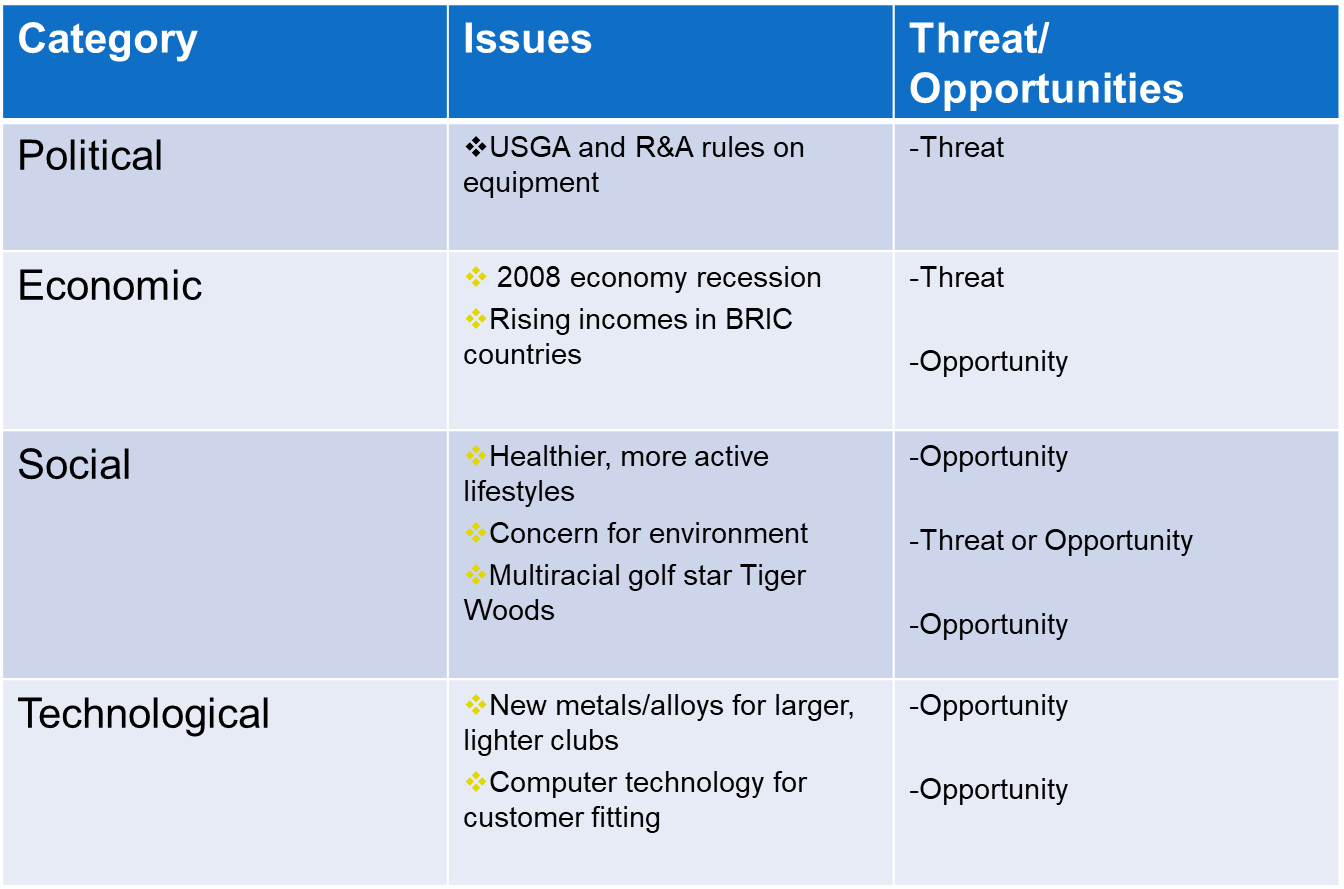
Alternatives to consider
Golf equipment companies should consider alternatives like the key issues which affect the golf equipment market. These companies should consider limiting their product customization. They should make each of these golf equipment according to players’ specific requirements and avoid generalization. This has been the practice in some companies and has drastically increased their sales. It is important to come up with strong measures to curb the production of counterfeit golf products, which have led to a reduction in genuine companies’ sales. To compete effectively in the market and cut down the cost of production, most of these companies need to reconsider recycling old golf clubs. Also, they should consider selling their products through eBay. Rebranding is an essential practice that these companies should embrace.
Companies whose products does not pick well in the market in particular season should consider delaying it for certain period and then reintroducing it under a new name. Also, companies with poor reputation can improve on their weakness and rebrand as a new identity in the market.
Recommendation
I recommend that these golf companies continue producing competitive products. This way, they are able to satisfy customers’ needs and, at the same time, attract more customers, which reflects increased profits. I recommend that all companies make use of all available markets; for the big companies, they should market their products through chain stores like Wal-Mart in order to reach a wide customer range. Also, small companies should consider incorporating pro shops as one of their sales outlets. For these companies to compete with counterfeit goods, I recommend that they should sell their products at discounted and low prices as much as possible since customers go for counterfeit goods because they are cheap and almost resemble the original ones. Also, I recommend that these companies should continuously introduce new lines of products for them to stay relevant in the market and survive the stiff competition.
References
Behrend, J & Peter, N. (1998). Challenges and champions: The royal and ancient golf club, ProQuest sport Journal, 4 (2), 8-24.
Browning, R. (1985). History of Golf, the royal and ancient Game. New York, Ailsa.
John, E. G. (2009). Competition in the Golf equipment industry in 2009. University of South Alabama.
Stirk, D. (1998). Golf History & Tradition: 1500- 1945, England, Excellent Press.