
Background
Destructive factors affecting island biodiversity include natural disasters, human industrial activities, and the introduction of non-native species, which can severely damage ecosystem integrity. Biodiversity should be understood as the saturation of species in local ecosystems, and the higher the rate due to natural causes, the healthier the dynamic island system (Haahtela, 2019; Díaz & Malhi, 2022). Preventive measures to conserve biodiversity are significant, as they help preserve ecosystem balance, maintain the quality of established food chains, and have positive impacts on island bioprocesses, including those related to humans. A simulation study was proposed to investigate the effect of the invasion factor on the survival ability of island species.
The effects of habitat fragmentation physically reduce species’ range, increase their concentration, and create barriers to free migration, with two opposing effects. Fragmentation isolates the island and eliminates the influence of external biological factors. Still, fragmented ecosystems are more vulnerable because they have evolved in a relatively isolated and stable manner, and they can quickly lose evolutionary advantages when species invade.
The theory of island biogeography explores these aspects, a scientific concept that explains species diversity on isolated islands based on a balance between island size and species extinction rates (Matthews & Triantis, 2021). The principles provide opportunities to predict the impact of isolation factors on species survival in island ecosystems. The theory allows for the development of strategies that increase the chances of biodiversity conservation on fragmented islands. Using this theory, it would be necessary to determine the optimal size and location of forested areas outside the city to minimize isolation and improve connectivity.
Hypotheses
This project investigated the effect of island remoteness on current species biodiversity. Specifically, the project’s research question was: “Between two identical islands with different distances from the mainland, which island will have a higher biodiversity score?” Based on this, a hypothesis was formulated: increasing the distance of an island from the mainland would lead to a decrease in biodiversity. Thus, it was postulated that the remoteness of an island decreases the probability of invasion, leading to fewer species from the mainland arriving and, in turn, decreasing biodiversity.
Methods
Virtual Biological Laboratory (VBL) modeling was used to manipulate variables and investigate their effects on island biodiversity (VBL, North Carolina). The distance of the island from the mainland was used as the independent variable. This variable was measured on an ordinal scale with two levels: 410 and 110 kilometers from land. The average number of species was used as the dependent variable to estimate biodiversity. Ten trials were conducted with prespecified settings to reduce bias; the results were averaged. The biological cluster (reptiles), type of environment (subtropical), island diameter (224 km), migration rate (r = 2), mortality rate (r = 0.05), and testing time (t = 400 weeks) were used as control variables for the project.
Results
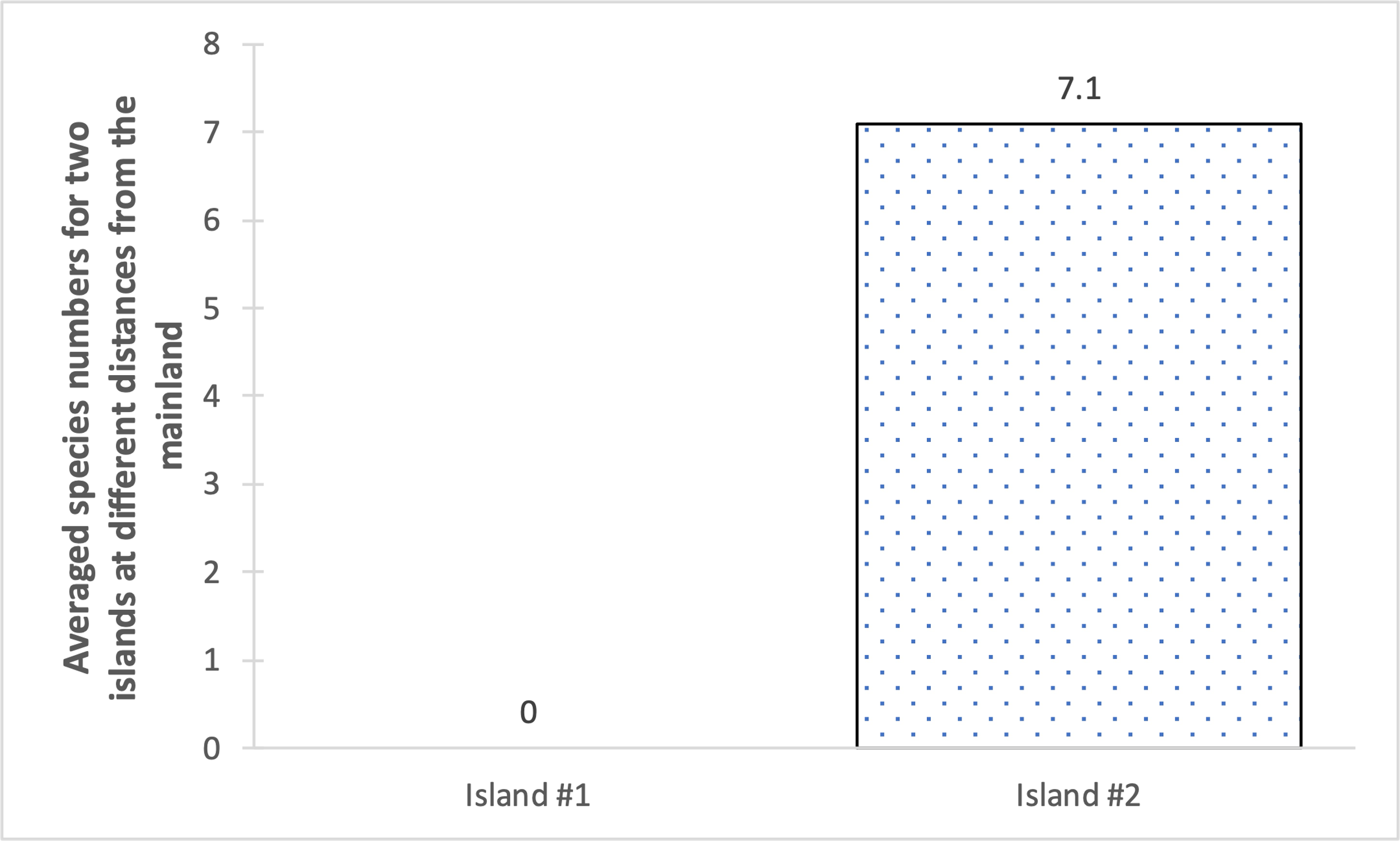
Table 1. Results of the ten trials for the average number of species for the two islands, showing the average values
Discussion
The results showed that the more remote island #1 has significantly lower mean biodiversity (M = 0.0) than island #2, which is closer to the mainland (M = 7.1). The results obtained support the previously hypothesized hypothesis. It is concluded that distance from the mainland is an essential predictor of biodiversity on an island: the farther away an island is, the fewer mammals can penetrate and survive there. The logical rationale for this conclusion seems obvious: mammals cannot physically reach a more distant island by water in large numbers, which affects the outcome.
The results have broad practical implications: the forest reserve would benefit from placing the fragments closer together to help increase biodiversity and thus improve ecosystem balance. In conclusion, the lack of adequate measures to support biodiversity results in a decline in ecosystem integrity, with implications for human life. The reduction of biodiversity can affect agriculture and livestock production, as well as political conflicts, as eco-activists disagree with the authorities’ actions (or inaction). Moreover, it would be interesting to examine how island diameter affects the average number of introduced species.
References
Díaz, S., & Malhi, Y. (2022). Biodiversity: Concepts, patterns, trends, and perspectives. Annual Review of Environment and Resources, 47, 31-63.
Haahtela, T. (2019). A biodiversity hypothesis. Allergy, 74(8), 1445-1456.
Matthews, T. J., & Triantis, K. (2021). Island biogeography. Current Biology, 31(19), R1201-R1207.
VBL. (n.d.). Island biogeography. Virtual Biology Lab.