
Introduction
The main issue that will be discussed is the importance of inflation to the economy. Inflation is an essential objective for the government because it helps keep prices stable. It makes it easier for businesses to plan their operations and allows consumers to make informed decisions about how much they will spend on goods and services.
For example, tax incentives and subsidies can help businesses keep prices low while they develop new products or expand their operations. Monetary policy or changing interest rates can also help reduce inflation by making loans cheaper and pushing down long-term interest rates. This study will discuss how the central bank can use several policies to reduce inflation and argue that this is the best method to achieve this goal.
Inflation and its Importance
Inflation is a sustained rise in prices; it lowers money’s buying power, requiring more money to acquire the same products and services. Demand, supply, government policy, and the global economy may generate inflation (Kelton, 2020). Demand-pull inflation arises when demand for products and services exceeds supply. Since people will pay more for what they need, prices rise. Cost-push inflation occurs when salaries, raw materials, or taxes rise, raising product and service prices (Olson, 2022). Prices rise rapidly in hyperinflation, devaluing money;
Economists utilize the aggregate demand and supply (AD-AS) model to study inflation and the economy. Figure 1 below demonstrates the link between real GDP and the price level. The AD curve reflects the economy’s overall demand for products and services at various prices, whereas the AS curve illustrates producers’ willingness to sell at different prices.
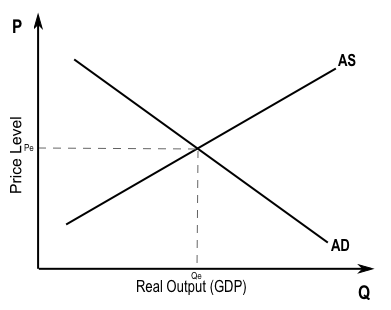
Inflation or deflation may result from AD/AS curve shifts; if the AD curve moves right, demand for products and services at the present price level rises, raising prices. If the AS curve swings left, commodities and services supply will decline, raising prices. The government prioritizes inflation because it affects the economy and society. High inflation creates economic uncertainty, making it hard for firms to plan and invest (Afonso et al., 2019).
People with fixed incomes or savings may struggle when prices rise, contributing to income and wealth inequality. As such, governments use monetary and fiscal measures to reduce inflation. Ultimately, inflation is a rise in goods and services prices over time due to various variables. The AD-AS diagram depicts how demand and supply affect real GDP and inflation. The government must limit and stabilize inflation since it affects the economy and society.
The Use of Monetary Policy to Reduce Inflation
The central bank controls inflation by adjusting the money supply and interest rates. The theory is that by limiting the money supply or raising interest rates, individuals and corporations will have less disposable income to spend, slowing demand and lowering inflation (Bernanke, 2020). Thus, increasing the money supply or decreasing interest rates boosts expenditure, economic activity, and inflation.
Figure 2 below explains how Monetary Policy affects the economy. The vertical axis indicates the overall price level and the horizontal axis output. The short-run aggregate supply curve reflects short-term products and services, whereas the aggregate demand curve represents overall economic expenditure.
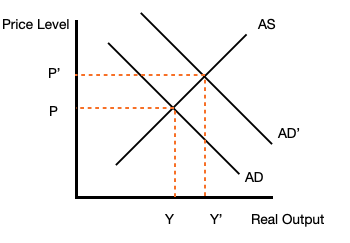
The aggregate demand curve moves left from AD to AD’ when the central bank lowers the money supply or raises interest rates. Reduced aggregate demand lowers the overall price level from P’ to P and production from Y’ to Y. The reverse happens when the central bank raises interest rates or money supply. The central bank implements a monetary policy by altering bank reserve requirements, open market activities, and the discount rate.
For example, the US Federal Reserve employed Monetary Policy to combat 1980s inflation (Afonso et al., 2019). To dampen demand, the Fed raised interest rates, lowering inflation. Central banks utilized expansionary monetary policy during the 2008 global financial crisis (Olson, 2022). Increased money supply and reduced interest rates stimulated economic activity.
The advantages of monetary policy are that it can adapt quickly to changing economic circumstances and is flexible and effective in addressing inflation. However, its disadvantages are that it may take time, and its effects may vary among economic sectors (Kelton, 2020). In addition, overreliance on Monetary Policy may cause asset bubbles or currency depreciation.
Ultimately, the short-term monetary policy may lower inflation; the economy and inflationary pressures affect its efficacy. Therefore, policymakers should weigh the pros and drawbacks of monetary policy and utilize it in conjunction with other fiscal and structural measures to maintain economic stability.
The Use of Tax Incentives to Reduce Inflation
Governments provide tax incentives or raise taxes to promote or discourage economic performance. Tax incentives lower inflation by increasing supply and decreasing demand for goods and services. Tax incentives lower corporate production costs, encouraging them to produce more products and services (Olson, 2022). More supply may lower prices and inflation; tax incentives lower inflation, as shown in the diagram below.
Figure 3 below shows how products and service prices affect economic production. Goods and services cost less when production rises and vice versa; tax incentives may boost corporate production, lowering prices.
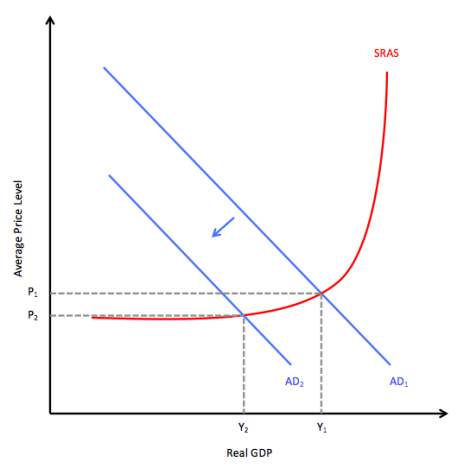
Tax incentives may lower inflation by increasing company production. In 2009, Nigeria adopted agricultural tax incentives to boost food production and lower inflation (Olson, 2022). Imported agricultural equipment was duty-free, and agricultural enterprises had lower corporation tax rates. This program achieved increased food output, lower food costs, and lower inflation. Tax incentives to lower inflation may boost output and economic development. Business production increases employment, which reduces poverty and raises living standards.
This policy has drawbacks; tax incentives may distort the market, causing resource inequality. It may lower government income, which hurts public services and infrastructure. Consequently, tax incentives to prevent inflation may boost corporate production and lower prices. Its drawbacks must be addressed before adopting the policy; tax incentives to lower inflation should be used and carefully considered in a given economic setting.
The Use of Subsidies to Reduce Inflation
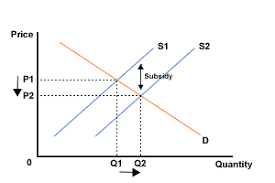
Subsidies are government payments to producers or consumers; it lowers the cost of producing or using goods and services, lowering their overall price. Supply and demand underpin the subsidy-inflation hypothesis; prices and inflation fall when supply surpasses demand (Afonso et al., 2019). The government may lower prices and boost supply by subsidizing manufacturers. Figure 4 below shows the effect of subsidies on the supply of goods and services and the price level. As seen in the figure, subsidies move the supply curve from S1 to S2; Q1-Q2 goods and services supply increases. The price drops from P1 to P2; the subsidy decreases manufacturing costs, making it more economical for companies to deliver more products and services.
Several governments lower inflation using subsidies; food and fuel subsidies are one example. In many developing nations, the government subsidizes farmers to boost the food supply and cut consumer prices (Bernanke, 2020). The government may also subsidize fuel production or imports to cut transportation costs and product prices; wind and solar power subsidies are other examples. Renewable energy providers may get government subsidies to boost supply and lower prices, making them more accessible to consumers. This lowers prices and encourages green energy, benefiting the environment.
The advantages of subsidies include their ability to boost supply and economic growth, and they encourage eco-friendly goods and services, which help the environment. They lower inflation, improving economic stability and investor confidence. The disadvantages of using Subsidies are that it may cost the government, increasing public debt.
Additionally, if exploited or targeted at a specific group, they may burden taxpayers. Based on the research above, subsidizing inflation can work if done appropriately. It boosts supply, lowers prices, and boosts the economy. It is costly, inefficient, and abused; thus, the government must weigh the pros and downsides before enacting this policy; subsidies may help fight inflation if utilized wisely.
Conclusion
Inflation causes money’s buying power to decrease as prices rise. Money depreciation reduces consumer spending and investment, which may hurt economic development. Therefore, governments prioritize inflation control for economic stability. High inflation raises the cost of living, reducing consumer purchasing power and economic growth.
Central banks utilize interest rates, reserve requirements, and open market activities to manage the money supply. Subsidies boost production, while tax incentives boost demand; analyzing the economy and inflation helps establish the best policy. Raising interest rates may work better if inflation is high. The most effective option is using tax incentives because it works better if inflation and demand are low.
To accomplish goals, most policies should be employed simultaneously; several policy choices may reduce inflation synergistically. If a government raises interest rates, consumer spending power decreases, lowering inflation; thus, tax incentives boost consumer spending and economic development.
References
Afonso, A., Alves, J., & Balhote, R. (2019). Interactions between monetary and fiscal policies. Journal of Applied Economics, 22(1), 132-151. Web.
Bernanke, B. S. (2020). The new tools of monetary policy. American Economic Review, 110(4), 943-83. Web.
Kelton, S. (2020). The deficit myth: modern monetary theory and the birth of the people’s economy. PublicAffairs.
Olson, M. (2022). The rise and decline of nations: Economic growth, stagflation, and social rigidities. Yale University Press.