
Research Article Summary
Topic
Several studies have been conducted on the intersection of technology and education. Khlaif and Salha (2021) conducted a study investigating the issues that influence the integration of mobile tech in higher education. The study was presented in academic and professional prose by arranging the content into various sections, each intended to convey a specific aspect of the authors’ research. Their study involved empirical model testing that examined the association between concepts that influence the integration of mobile technology in higher education. The study focused on the perspectives of students and faculty, with approximately 300 students participating to provide qualitative data (Khlaif & Salha, 2021).
Structure and Organization
One of the sections in the paper is the abstract, which provides a general overview of the paper by indicating its purpose and describing how the study was conducted. The abstract enables readers to understand that specific factors influence the integration of mobile technology. For example, attitudes and beliefs, patronization, and service quality are some factors that influence integration.
The authors included an introduction section that provided a background view of the paper by elaborating on advanced technology and the development of education through various concepts, such as technology. Through the introduction, the audience can learn that higher education institutions (HEIs) have been working tirelessly to achieve mobile technology integration. Mobile technology is effective in both public and private universities, as the rate of innovation and levels of infrastructure enable a smooth transition to the latter when implemented correctly (Khlaif & Salha, 2021).
The other important section was the literature review, which aimed to establish what other authors had written about the subject. Through the literature review, the audience can read about the broad issue of mobile technology, the factors influencing it, the justification for a model change, and the research questions. All the above elements were examined by incorporating external sources with the proper attribution. Other essential sections were the research design, results, and discussion.
Article Critique
Audience
The study’s audience comprises education policymakers and stakeholders in higher education, including students, instructors, and scholars. The authors have not mentioned directly to whom they are addressing their issue, but reading between the lines, the above are the respective audiences. In the managerial implications section of the paper, Khlaif and Salha (2021) suggest that decision-makers in HEIs can apply the given factors to boost students’ use of mobile technology. Additionally, the entire paper mentions instructors and researchers who need to get to the matter. Therefore, the study was addressed to all the above groups.
Purpose
While reading any peer-reviewed journal, there must be a specific idea that authors have to drive as they write texts. In this case, Khlaif and Salha (2021) sought to investigate the factors that influence the incorporation of mobile technology in public and private universities. From the examination, the authors wanted to convey the need to use new models to predict users’ acceptance of new technologies. Among the key research items was to get the most appropriate model to give a comprehensive relationship between the factors. The authors wanted to justify whether or not influence from tutors and colleagues, patronization, quality of service, and students’ attributes affect the integration of mobile technology in HEIs.
Research Questions
The study used two specific questions that were the key focus of the paper. The first question was: What are the critical factors impacting the use of mobile technology as perceived by higher education students in Palestine? (Khlaif & Salha, 2021). The second question included: What is the best model to explain the relationships between instructors’ influence, colleagues’ influence, patronization, previous experience, quality of service, individual innovativeness, students’ attitudes and beliefs, and mobile technology integration? (Khlaif & Salha, 2021). The research was based in Palestine and sought to examine only higher education levels.
The questions used were relevant because they helped the authors to cover their broad topic by addressing all the required elements. When the authors investigate the factors that impact the adoption of mobile technology, the results give a broad picture of how education is with and without technology. That question enables the audience to understand the integration of mobile tech in HEIs based on Palestine’s point of view. The only challenge would be the location chosen by the authors to undertake their study. The result may be significantly centered on the Mediterranean region, which is a key limit, as the world is vast in terms of civilization and technology.
The other question was equally relevant since it provides the framework to drive awareness of the association of factors regarding mobile technology in HEIs. Through the question, the audience obtains details relating to integrating innovations in higher learning institutions, which is the study’s central focus.
Literature Review
The study comprised a literature review, as seen in the first part of this critique report. Reviewing the literature is essential since it helps the authors see their study’s relevance in evidence-based practices (EBPs) in education. From the research, Khlaif and Salha (2021) conclude that there is no consistency in the literature about the role of models in driving mobile tech acceptance in HEIs.
Regarding EBPs, the unified theory of acceptance and use of technology (UTAUT) suggests that the actual adoption of technology is influenced by the behavior and intentions of students in HEIs (Khlaif & Salha, 2021). The researchers had to use the UTAUT framework to form their recommended model, which is part of EBP in education. The model hypothesized comprised elements like individual innovativeness connected with the other key factors, as seen in Figure 1 below.
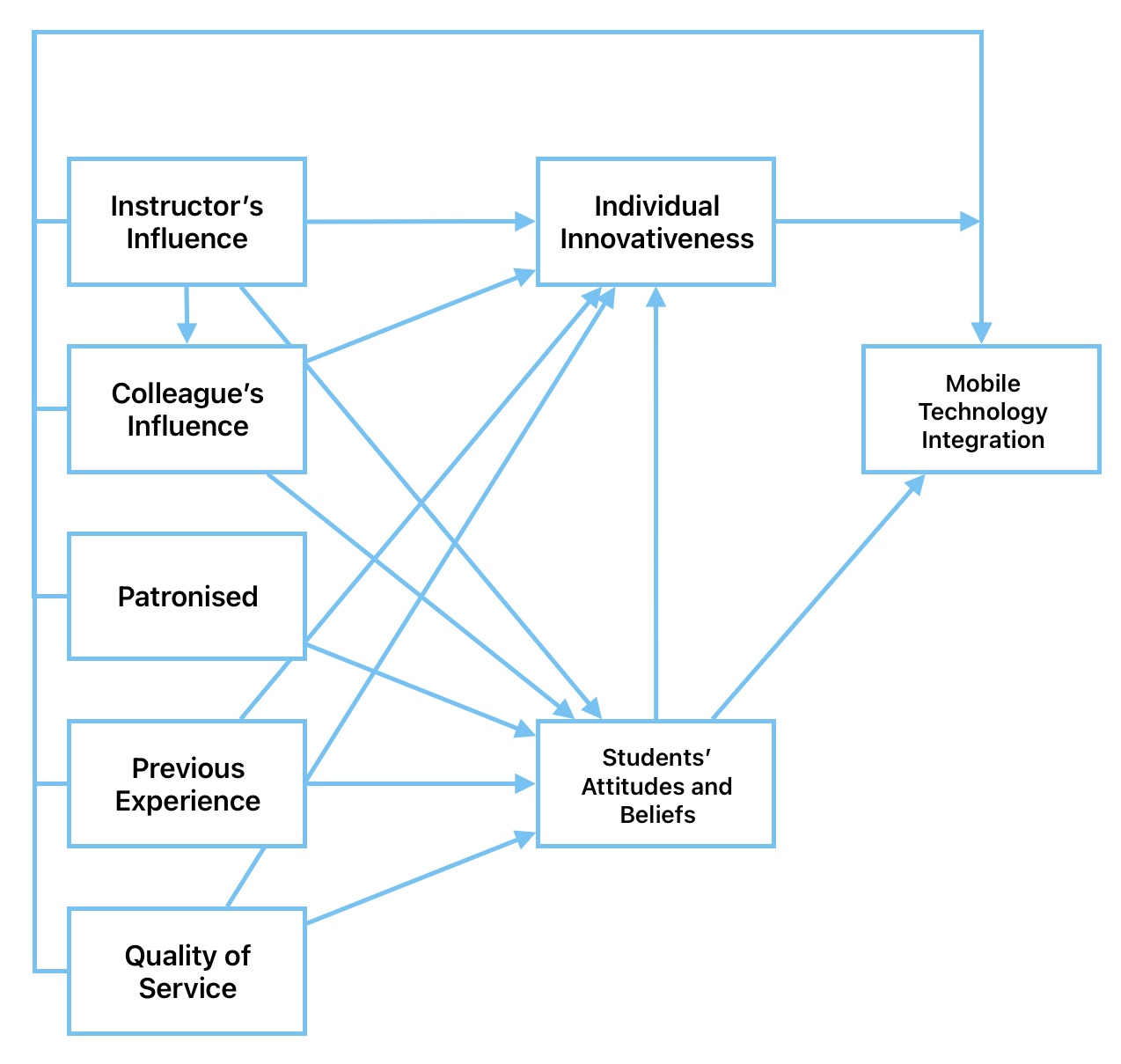
When it comes to research questions, the researchers do not say yes or no since they are open-ended. To answer the questions, Khlaif and Salha (2021) explore the relationship between the factors regarding mobile technology and give candid results that answer the questions. Based on the evidence, the author’s conclusions are valid since they employ respective concepts from the utilization of research from various people and compare the results to draw a conclusion.
Evidence Collected
The study employed interviews and developed constructs from the literature review to expand on the study. Through the interviews, Khlaif and Salha (2021) identified the types of mobile devices used on campus and their effect on students. Getting answers from the participants showed evidence through the study field and influence from other factors, such as students and instructors.
The other evidence was based on the UTAUT model, which created a pool of items in the survey, adapting the readiness to use the technology model. Through data from Google Forms, the estimations from the models were analyzed based on research aims. All the evidence used was necessary since it supports the author’s conclusion, as it was measured according to the subject of study and not randomly.
Experimental Methods
The experimental methods were described effectively because the study used students and faculty members. The description through semi-structured interviews and instrument design and development gave the results a top-notch complexity to fit the research demands. For example, Khlaif and Salha (2021) say that ‘The first part of the survey was related to the characteristics of the participants, including gender, age, education level, having mobile technology, and using Wi-Fi.
A 5-point Likert scale was used to score the survey responses. It consisted of five answer options ranging from strongly agree to disagree strongly.’ The reader can duplicate the procedures since the content assessment was undertaken with valid parties specialized in the respective pool of items used in the paper. Furthermore, in the model building and testing phase, the authors describe an online survey that comprised graduate students from various faculties, where different estimations were derived from all the effects of the technical factors.
Assumptions
The article used critical assumptions, although the authors did not specify them. First, Khlaif and Salha (2021) assumed that integrating mobile technology in HEIs was ineffective based on the student experience. The reason is that despite the outgrowing rate of advanced technology, the infrastructure required to stabilize the latter is not easy to establish.
The other assumption is that exposure to technology through higher education institutions is a qualitative measure to weigh the integration. The assumptions influence the conclusion by ignoring any contrary factor that may be exceptional from the results. There is an original contribution to the study because the authors have developed a model of readiness to use mobile technology from the data collected and the hypothesized elements in the study.
Reference
Khlaif, Z. N., & Salha, S. (2021). Exploring the factors influencing mobile technology integration in higher education. Technology, Pedagogy, and Education, 31(3), 347–362.