
Introduction
It cannot be attributed to his military genius or political acumen that Napoleon Bonaparte emerged as a great leader during the tumultuous times that followed the French Revolution. A significant tool in forging this elevation was propaganda. Napoleon created an image of himself as the nation’s savior, a soldier extraordinaire, almost invincible on the battlefield, through paintings, sculptures, newspapers, and bulletins.
The study aims to examine the effectiveness and ethics of Napoleon’s propaganda machine by comparing it to other historical figures. In focusing on the theoretical frameworks, historical background, and literature review, this study employs a multidisciplinary approach to develop a holistic understanding of how Napoleon Bonaparte leveraged propaganda to consolidate public opinion. Visual arts, combined with textual media, were perhaps among those that Napoleon had mastered within his multifaceted approach to leveraging propaganda for shaping public opinion and significantly enhancing his political power, both within France and internationally.
Historical Context
The French Revolution proved to be a historical turning point in the history of Europe that completely changed its political and social scenario. During that haphazard period, Napoleon Bonaparte emerged as a military hero who later even captured power. The Revolution became the best occasion for Napoleon to build his public image as the savior of the French Republic.
The leader glorified himself through propaganda, which depicted him as one of the most outstanding military leaders ever known and a defender of revolutionary principles. His ability to mold the news helped him ascend into power using state-controlled newspapers like “Le Moniteur Universel.” Napoleon’s propaganda machinery was so effective that he not only formed a solid base in France but also forced public opinion across Europe.
The 19th century was the brilliant age of advancement in media and communication. The printing press had just started to revolutionize people’s lives by making books more widely accessible, while daily papers were progressively infiltrating themselves into people’s way of life. During this time, lithography would also make it conceivable for much larger-scale pictures to be created for open utilization.
Napoleon utilized these forms of media innovation successfully as propaganda tools. He knew how visual symbolism influenced the human intellect, so he made larger-than-life images of himself through painting, engraving, and sculpting. Daily papers would have accounts of his military triumphs, many of which were exaggerated or carefully chosen to depict him in the best possible light.
Literature Review
Napoleon’s influence and propaganda have long fascinated historians, political scientists, and art critics. One such classic work is “Napoleon Bonaparte and the Legacy of the French Revolution” by Lyons Martyn. During the time of Napoleon, art was used as a medium to propagate and position him in the public eye as not just another political leader but also as a sellable commodity among many others available at that time. This book thoroughly examines this use of art and its impact. Whether it was painting, sculpture, or even architecture, everything would find its way into glorifying their Emperor.
Yet another work in this category is “The Campaigns of Napoleon,” which tells the story of the Napoleonic wars from Italy to Russia, emphasizing the importance of propaganda in shaping public opinion. The work explains that Napoleon had bulletins and newspapers printed, which gave doctored accounts about his campaigns, thus projecting him as a hero. All these pieces help people know how the propaganda vehicle operated under Napoleon, as it traces the close interrelation between graphic media and textual forms of information to create public opinion.
A considerable amount of academic work has been conducted on Napoleon and propaganda, each with its unique perspective. For instance, “From the Napoleonic Empire to the Age of Empire” is an interdisciplinary approach combining political history, cultural studies, and even psychology, giving an overall picture of the era. This book talks about how propaganda is not only for manipulation but also as a mirror for social and cultural dynamics.
On the other hand, “The Diplomacy of Napoleon” has a narrower subject and explores how propaganda efforts influenced diplomatic relations between France and other European powers. It shows the role played by ambassadors, treaties, and even espionage in waging “war” through propaganda, thus presenting another aspect of the study. These different approaches to studying the topic help provide varied insights that can enlighten our understanding of what was going on regarding propaganda during Napoleon’s reign.
Although much literature has been written about Napoleon and propaganda, several gaps in this field require further investigation. For instance, “Napoleonic Governance in the Netherlands and Northwest Germany” has addressed governance structures in great detail without focusing on how Napoleonic propaganda shaped these administrative systems. In this case, it raises unanswered questions on how propaganda could be used to enforce Napoleonic laws or bring regions like the Netherlands and the Northwestern parts of Germany into the French Empire.
Equally important, “Napoleonic Leadership” provided helpful explanations of Napoleon’s leadership skills and strategies, but did not describe how his use of propaganda influenced him. This gap is essential since understanding the role of propaganda in leadership may provide a more holistic view of how Napoleon was able to retain power and inspire loyalty from his people.
Theoretical Framework
The definition of propaganda has been put forth and revised from time to time, but its essence lies in the manipulation of opinions for some particular purpose. One of the best works providing an elaborate definition of propaganda is Jacques Ellul’s “Propaganda: The Formation of Men’s Attitudes.” According to this work, Ellul suggests that propaganda is not mere information dissemination but a complicated psychological process to shift attitudes and behaviors. He concludes his study by stating that propaganda is used to incorporate individuals into a social framework through their emotions, rather than their reasoning, by utilizing them for specific purposes. This definition is exceptionally well-suited to the study of Napoleon because his propaganda works not only disseminated information but also created a personality cult, making his rule unshakable.
Understanding propaganda, especially as it relates to the case of Napoleon, means blending different models and theories. One such theory is the “Propaganda Model,” elucidated in the book “Manufacturing Consent,” by Edward S. Herman and Noam Chomsky. The model describes how media are used for the interests of dominant social groups that can be superimposed over Napoleon’s use of newspapers and bulletins for political motives. Another theory related to the subject would be the “Spiral of Silence,” which states that people fear isolation and do not give unpopular opinions. This best goes with what it means when examining how dissent was suppressed during Napoleon’s rule.
Napoleon’s Use of Propaganda
Early Use
The French Revolution was a time of chaotic social change, political intrigue, and warring ideologies. Amidst this chaos, Napoleon Bonaparte shrewdly saw propaganda as a way to shape public opinion – and hold power. “Art, Propaganda and the Cult of Personality” is a book that details how Napoleon used art in powerful propaganda during those years.
Notably, Napoleon commissioned artists to create paintings or sculptures where he was heroically revolutionary in Roman emperors’ or Greek gods’ garb. They were set up in public squares, government buildings, and churches to ensure everyone could see them. This visual propaganda was then supplemented with pamphlets, songs, and speeches repeating the same heroism tale.
His Italian Campaign is a perfect example of how propaganda could be used in military campaigns. The book “Napoleon Bonaparte and the Legacy of the French Revolution” goes deep into the nuances to describe how each strand of propaganda was neatly woven into the fabric of his entire military Campaign. Napoleon was keenly aware of the power of narrative; he weaponized bulletins and newspapers to serve up blow-by-blow accounts of his various military forays, often overstating his victories and defeats. These were then translated into many different languages and distributed not just among French soldiers but also to the local Italians as well.
Apart from this, Napoleon also made arrangements for theatrical events that highlighted his military victories, which portrayed him as the liberator of Italy who had landed to free the Italian states from the Austrian yoke. Such propaganda also served dual purposes – it deeply demoralized the enemy Austrian forces and simultaneously worked to create enthusiasm among the Italians. It was not a battle fought only with guns but waged deep into human minds, and it was propaganda that helped Napoleon get the upper hand in this psychological war.
Military Campaigns
As mentioned above, Napoleon’s Italian Campaign was the epitome of a propaganda masterpiece. Yet, it is worth exploring what he used as a technique in this display. One after another example exists within “The Campaigns of Napoleon,” in which Napoleon used methods of high-quality propaganda to rally his troops and thus capture the hearts and minds of Italians everywhere. For instance, bulletins sent out from Napoleon’s headquarters gave accounts not only of victories on the battlefield but elaborated them with tales of heroism and honor. These bulletins were also sent to boost troop morale and gain public support among the Italians.
Political Reforms
The Napoleonic Code became a centerpiece in Napoleon’s political reforms and would emerge as an effective propaganda tool. It was depicted as an equalizing body of law that brought rationality into what had previously been a dizzying legal system in France. Napoleon hoped his modern legal edifice would be perceived as a creation he authored, containing revolutionary principles such as equality before the law and protecting private property.
In books like “The Campaigns of Napoleon,” it was brought out that the Napoleonic Code had become propaganda material in his quest to centralize power and legitimize his reign. The code is not just a set of laws but more of a political statement, an embodiment of the new France he is establishing. It was spread around, beyond French borders but throughout all lands under its jurisdiction, testifying how refined Napoleon’s reign was.
Educational reforms by Napoleon were just another form of propaganda for him. The lycées and other educational institutions were represented as democratizing educational facilities to be available to all the citizens of France. However, the syllabus was designed to present Napoleonic ideals and the French Empire’s glory.
Works like “Napoleon: Life, Legacy, and Image: A Biography” have been written, which describe how these educational reforms were primarily used for indoctrination purposes rather than educational purposes. Students were made loyal to the state and to Napoleon himself, so that he could utilize this new generation later on, who would become his followers once again. The educational reforms were not just to create an educated populace but a populace educated in the ‘correct’ ideals, those which would support the Napoleonic regime.
Personal Image Building
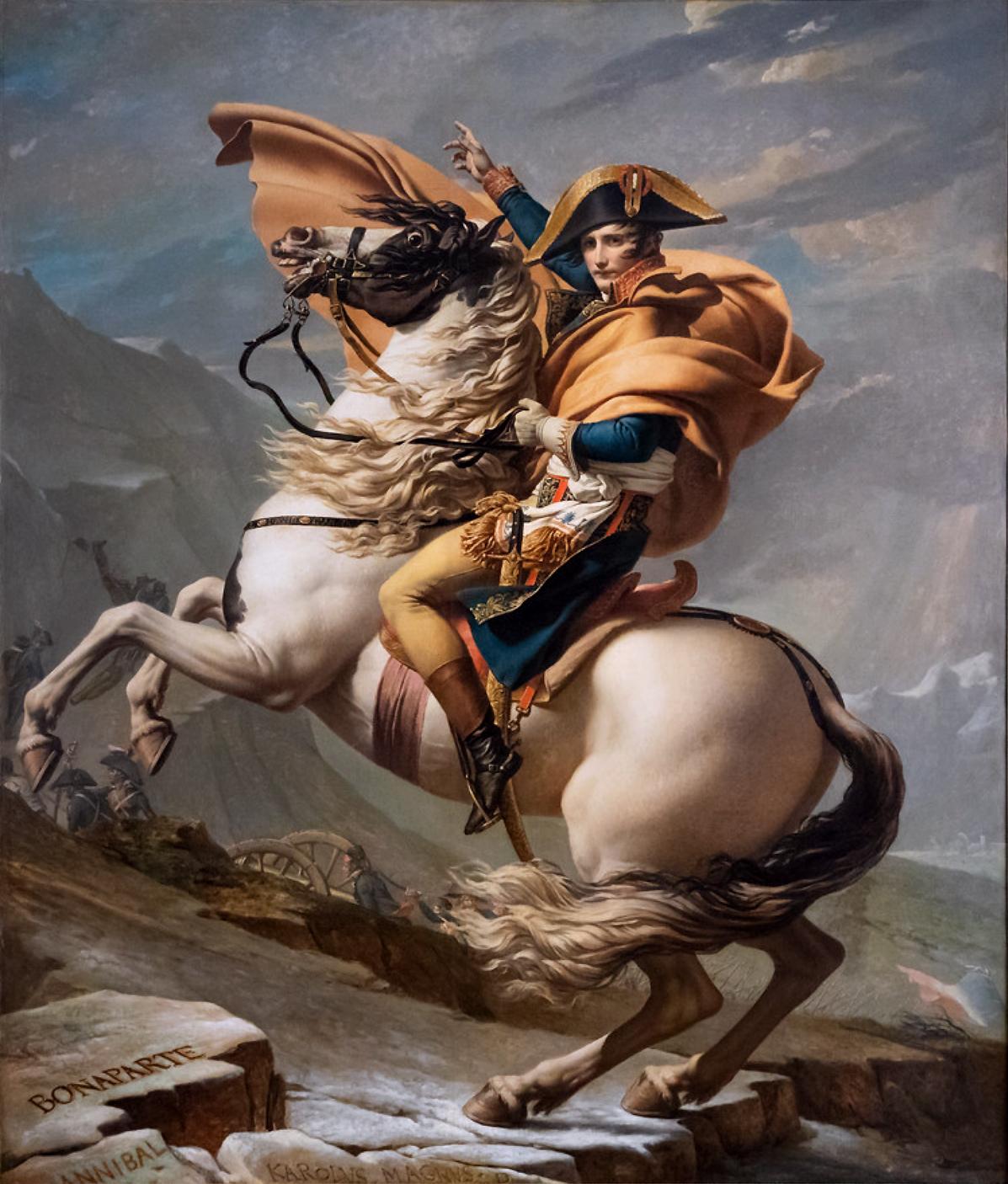
Napoleon Bonaparte mastered the art of manipulating self-image, and one of his most effective weapons was painting and portraits. Art became a great way to illustrate his power, heroism, and divine right to govern. Jacques-Louis David’s work “Napoleon Crossing the Alps” is essential, which was strategic visual propaganda (image 1). Unlike historical texts that present Napoleon crossing on a mule, the painting presents him on a rearing horse, looking heroic – a brave leader par excellence. This painting is not just an artwork, as he succeeded in maintaining his image of a courageous leader who could overcome all the odds.
Yet another essential painting by David, “The Coronation of Napoleon,” portrayed Napoleon crowning himself, thereby asserting that the authority he gained was self-made and would have nothing much to do with the conventional monarchical powers. Extensive publication of these paintings created a godlike portrayal of Napoleon, consolidating his power and inspiring loyalty among his subjects.
Apart from the visual arts, Napoleon also used the written word as an instrument of public opinion control. He established “Le Moniteur Universel,” a newspaper acting as his government’s official organ of expression. This paper became instrumental in broadcasting his political and military successes, usually hyperbolically, to magnify his greatness. Napoleon also called for bulletins during his campaigns, especially. They were not just works describing facts but sensitively designed news as retrospectives signaling success while minimizing defeat.
For example, one of his most significant victories at the Battle of Austerlitz was followed by portrayals in bulletins as a military genius who had planned and executed an unprecedented campaign. Robert Goetz states, “Although another war would be needed to force Prussia fully to accept the subservient role it had been backed into by its indecisiveness in 1805, the victory of Austerlitz had launched Napoleon into a position of domination over all of continental Europe to the frontiers of Russia.” When things did go wrong, such as the disastrous Russian campaign, it was presented in ways that exonerated him from blame. Having these media outlets available to influence gave Napoleon opportunities to craft messages that would keep his image intact and control over his troops and the French people.
Analysis and Discussion
Napoleon Bonaparte was a master of using propaganda to wield control and maintain the heroic figure that he took on. His use of propaganda took different forms, from newspapers to paintings, and even when it came down to restructuring the curricula for education at various levels. Napoleon understood the narrative power behind his campaigns and created stories around him with the full intent to ensure everyone would remember him as their hero. He appointed artists like Jacques-Louis David to develop paintings that reflected not just art but politics about himself and how big he was, always to be remembered. Thus, they often had him painted larger than life or shown wearing heroic postures.
He managed to convert the influential newspaper of his time, “Moniteur Universel,” into a government instrument and used it extensively to play up his military and political achievements. He also revised educational books to incorporate his thoughts, ensuring that generations to come would grow up with an intrinsic admiration for him. These combined factors made his tactics work wonders because they catered to various sections of society and became inherent parts of social life.
Compared to historical figures like Julius Caesar or Adolf Hitler, Napoleon’s propaganda techniques could be considered novel and compelling. Although Caesar used public works and pieces of writing such as “Commentarii de Bello Gallico” to glorify his deeds, he did not have the luxury of a mass media through which this information could be distributed effectively. Though partially created by science but primarily for evil, Hitler utilized modern technology, such as radio and film, primarily via fear-based propaganda to keep people under control.
Napoleon found the middle ground between using available forms of media to their maximum extent while ensuring that the message was constructed to inspire awe rather than fear. His propaganda wasn’t only meant for self-aggrandizement, but was a carefully crafted plot that could make him indispensable in the eyes of the French. This complexity differentiates Napoleon from other leaders who’ve used propaganda as an instrument of control.
The ethical implications of Napoleon’s propaganda are hard to simplify. On the one hand, his micromanagement of media and information calls into question controlling the public in such a way as an individual who is, after all, meant to serve at will. The squashing of dissident voices and rewriting of educational content to promote his agenda could be seen as robbing individuals of their freedoms.
Others argue that this type of propagandistic sophistry was needed even if it was a necessary evil to stabilize what might arguably have been called the most anarchic nation-state following its revolution. It fostered feelings of nationalism, no matter how organically produced or artificial those sentiments may have been construed. Still, the question of morality continues to arise: is it right that one may do whatever needs to be done to reach an end? While perhaps Napoleon’s propaganda succeeded because he realized his objective, there is also a price when one manipulates.
Napoleon Bonaparte mastered propaganda, using it to mold public opinion and as a weapon of war. He supervised these vital government functions and sometimes even wrote some news items himself or commissioned others to write articles that he desired to be published in the press. Yet this control over information is open to several criticisms.
First, it produced a god-like image in Napoleon’s favor – he could seem faultless to most people. It can be seen as manipulating the public, where they were made to believe in a version of events or even a personality that may not have been entirely true. Also, with the purposeful publication of false information in the European press, Hitler intended to mislead his enemies and the general populace. It then raises ethical questions surrounding propaganda and its role in governance and warfare.
While the criticism of Napoleon’s use of propaganda is justified, it should be put into the context in which he operated. Imperial France did not have a Ministry of Propaganda or a Ministry of Information that all modern regimes enjoy today; therefore, Napoleon had to perform these functions himself. As was already mentioned, by using propaganda as an instrument with which to consolidate France and inspire his troops, he achieved considerable success because constant war, followed by internal disturbances, left him no other choice.
After all, the application of propaganda techniques is not particular to Napoleon either: political and military leaders have used them throughout history. For instance, a supporter of Napoleon might argue that his propaganda was novel during his time and influenced some of his military successes. Furthermore, ethical implications are often never black-and-white issues because they depend on the context. Some even say that, in this case, the ends justified the means.
Conclusion
In the final analysis of this paper, it can be said that Napoleon Bonaparte was a propaganda master who used different media—from paintings and sculptures to newspapers and educational reforms—to craft his story and establish his regime on the one hand while shaping public opinion on the other. Far from mere acts of self-promotion, those were his propagandist methods as strategic tools whose role in military warfare, political reforming, and international diplomacy cannot be overemphasized. Comparing him with other leaders of all time and evaluating the ethical aspects involved, we see how entangled the power play of history is conducted by propaganda at every level. Accordingly, in more than one sense of the phrase, Napoleon’s diversified approach to propaganda is a seminal case study offering valuable insights into the intricate relationship between media, public opinion, and power.
Bibliography
Abbott, John. The History of Napoleon Bonaparte. Hansebooks GmbH, 2019.
Burg, Martijn van der. Napoleonic Governance in the Netherlands and Northwest Germany Conquest, Incorporation, and Integration. Cham: Springer International Publishing : Imprint: Palgrave Macmillan, 2021.
Chandler, David. The Campaigns of Napoleon. London: Weidenfeld & Nicolson, 1995.
David, Jacques-Louis. Napoleon Crossing the Alps. Independently Published, 2019.
Dodman, Thomas, and Aurélien Lignereux. From the Napoleonic Empire to the Age of Empire. Springer Nature, 2023.
Ellul, Jacques. Propaganda: The Formation of Men’s Atitudes.1965. Reprint, New York: Vintage Books, 1973.
Forrest, Alan. Napoleon: Life, Legacy, and Image: A Biography. St. Martin’s Press, 2012.
Gérard, Alain. “Les Visites de Bonaparte et de Napoléon À Lille.” Revue Du Nord 56, no. 220 (1974): 79–89.
Goetz, Robert. 1805 Austerlitz: Napoleon and the Destruction of the Third Coalition. Havertown: Frontline Books, 2017.
Hakobyan, Anahit. “Digitalization of Communication and the Spiral of Silence Theory.” Wisdom 14, no. 1 (2020): 19–30.
Herman, Edward S., and Noam Chomsky. Manufacturing Consent: The Political Economy of the Mass Media. New York: Pantheon Books, 2002.
Jones, Stephanie, and Jonathan Gosling. Napoleonic Leadership: A Study in Power. Los Angeles: Sage, 2015.
Lyons, Martyn. Napoleon Bonaparte and the Legacy of the French Revolution. Bloomsbury Publishing, 1994.
Mark, Harrison W. “Coronation of Napoleon I.” World History Encyclopedia, 2023.
Mikaberidze, Alexander. The Napoleonic Wars: A Global History. New York: Oxford University Press, 2020.
Mowat, Robert Balmain. The Diplomacy of Napoleon. Longmans, Green & Company, 1924.
Nikolic, Dusan. “A Portrait of Napoleon Bonaparte as a Work of Propaganda.” TheCollector, 2022.
Philippe Bordes, Jacques Louis David, and Sterling And. Jacques-Louis David: Empire to Exile. New Haven, Conn.; London: Yale University Press, 2007.
Pollitt, Ben. “Jacques-Louis David, Napoleon Crossing the Alps.” Smarthistory, 2011.
Truesdell, Matthew N. Spectacular Politics. Oxford University Press, 1997.