
Abstract
This essay examines how negative stereotypes and discrimination can be seen in social media posts, concentrating on two tweets that suggest black American women are unsuitable for marriage. The user base of the chosen site, Twitter, is diverse, allowing for a thorough investigation of the influences and demographics on the postings that were retrieved. Cognitive dissonance and stereotype threat are two psychological theories that shed light on the attitudes and ideas of the people posting. The psychological idea of deindividuation is also studied, as are the implications of disguised identities on post content and tone. In addition, the report explores the illusory truth effect and the risks of algorithmic control in maintaining unfavorable preconceptions.
Introduction
Social media platforms have developed into potent tools for communication and self-expression, enabling people to reach a wide audience. The fact that these platforms are public makes it possible for prejudice and harmful stereotypes to exist. This essay discusses and analyzes two tweets (Figures 1 and 2) that represent unfavorable preconceptions of black American women.
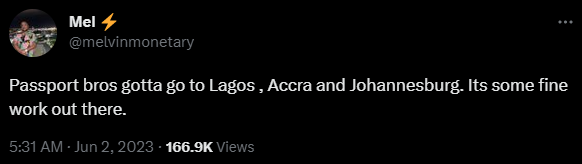
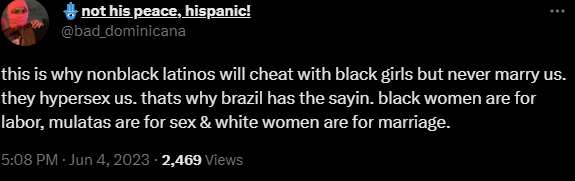
A thorough understanding of the underlying influences, psychological factors, and algorithmic controls perpetuating and reinforcing these harmful narratives is required to combat and end such discriminatory practices. Two specific tweets demonstrate the prevalence of negative stereotypes and discrimination targeting black American women on social media.
Background
Twitter Demographics
Twitter was selected as the platform to search for tweets that reflected stereotypes. The reason for selecting Twitter is that it is renowned for having a broad user base, which enables a thorough analysis of the factors influencing the demographics surrounding the postings. The website is suitable for studying the prevalence of negative stereotypes and biases towards black American women since it attracts users from a range of backgrounds (Jackson et al., 2022).
The website attracts people from different origins, ages, and interests due to its varied user base. Studies suggest that Twitter has a slightly younger audience, with a higher percentage of urban users and a considerable presence of minority groups (Hassan & Barber, 2021). This is despite the challenge of determining the specific demographics.
Keywords and Searchability
The terms “black women,” “marriage,” and “stereotype” were used to search for posts that reflected stereotypes about black American women. They were selected to target tweets discussing marriage and featuring black women. The procedure involves checking relevant user profiles, current topics, and hashtags. Although difficult, it is feasible to find relevant postings by using relevant keywords and multiple search techniques.
Twitter Demographics’ Effect and Posters’ Beliefs and Attitudes
Twitter demographics might have influenced the posts retrieved. They could come from people with various ancestries, philosophies, and viewpoints because of Twitter’s diverse user base (Felmlee et al., 2023). However, considering that the search was focused on derogatory preconceptions about black women, it is likely that persons with biased views or attitudes toward them were responsible (fig. 1). It may be concluded from the content that the posts convey the negative perception that black American women are viewed as undesirable marriage partners, diminishing their value and fostering discrimination.
Beliefs and Psychological Concepts
- Stereotype Threat: The concept of stereotype threat, which holds that unfavorable stereotypes about a particular group can cause fear and poor performance, may have an impact on the person posting. According to this hypothesis, cultural stereotypes can influence people’s attitudes and views, which can subsequently be transferred to social media sites.
- Theorizing Cognitive Dissonance: The people posting might experience cognitive dissonance, which is discomfort caused by existing ideas that are at odds with individual experiences. They might post on social media, desiring approval, or try to persuade others to share their viewpoint in an effort to explain their prejudices.
Evidence of Beliefs and Attitudes
Clearly, negative prejudices about black women and their desirability for marriage are expressed in the posts that were found. Explicit statements or implicit biases in the language employed make these ideas apparent (fig. 2). Twitter demographics may also have an impact on the individuals’ decision to post their opinions since they may believe that it is a place where their ideas can be heard or receive attention.
Face-to-Face Communication and Confidentiality
In a face-to-face conversation, it is highly improbable that people would communicate their opinions in the same way. Due to social norms, responsibility, and the potential for prompt reaction, such connections may result in more cautious and filtered communication (Criss et al., 2021). On social media sites, anonymity and the lack of personal identification create a sense of separation and lessened accountability, allowing users to openly express their biased opinions. The individuals used their names and photos, although it was difficult to tell whether they were the ones on their profiles.
Hidden Identities’ Effects and Theory of Hidden Identities in Psychology
The posts’ tone and content can change if pseudonym profiles are used. Individuals can share prejudiced views anonymously without fear of repercussions. As they are less intimidated, poor sentiments might be amplified. Deindividuation can be used to describe how concealed identities affect public actions and behaviors (Firmansyah & Jones, 2019). This happens when people lose self-awareness and are more likely to act negatively as they feel less responsible for their behaviors. In social media, concealed identities might promote this and give people the confidence to voice prejudiced opinions without worrying.
Psychological Theories and the Desired Message
The Twitter users’ primary goal is probably to persuade readers that black women are unsuited for marriage. The two psychological theories align with the intended message:
- Confirmation Bias: Users may try to reinforce their present prejudices and preconceptions by posting or disseminating information or anecdotes that do so (Southern & Harmer, 2021).
- In-Group Favoritism: By disparaging others, the individuals may be driven by a desire to uphold a sense of superiority and promote their own social group. They reinforce the borders between social groups and uphold their perception of status by promoting negative stereotypes.
The Effect of Algorithms on Social Media Feeds and Algorithmic Control Risks
What people see on social media feeds is influenced by algorithms. Algorithms examine a number of characteristics, including user preferences, to provide tailored feeds. People are exposed to material that is congruent with their ideas (Nguyen et al., 2019). This can affect people who might see the post; in essence, they can see posts supporting unfavorable stereotypes, which would confirm their biases.
The dangers of this are related to the psychological ideas of frequency effect and illusory truth (Popov & Reder, 2020). The frequency effect hypothesizes that information’s perceived veracity rises with repeated exposure (Kramera et al., 2014). Individuals are constantly exposed to such signals when algorithms favor specific types of information.
Conclusion
An in-depth knowledge of the underlying effects, psychological variables, and algorithmic controls that sustain and promote these damaging narratives is urgently required, as evidenced by the analysis of harmful stereotypes and biased treatment directed at Black American women on Twitter. Twitter was chosen as the social media channel because of its wide range of users and succinct structure, which provides a window into the dominant attitudes and opinions about this subject.
The prevalence of discriminatory and unfavorable preconceptions on Twitter highlights the need for group efforts to eradicate these behaviors. We can address the complications that contribute to the persistence of damaging narratives by understanding the role of cognitive dissonance, stereotype threat, deindividuation, the illusory truth effect, and algorithmic control.
References
Criss, S., Michaels, E. K., Solomon, K., Allen, A. M., & Nguyen, T. T. (2021). Twitter fingers and echo chambers: Exploring expressions and experiences of online racism using Twitter. Journal of Racial and Ethnic Health Disparities, 8, 1322-1331. Web.
Felmlee, D. H., Julien, C., & Francisco, S. C. (2023). Debating stereotypes: Online reactions to the vice-presidential debate of 2020. PloS one, 18(1), e0280828. Web.
Firmansyah, F. M., & Jones, J. J. (2019). Did the black panther movie make blacks blacker? Examining black racial identity on Twitter before and after the black panther movie release. In Social Informatics: 11th International Conference, SocInfo 2019, Doha, Qatar, November 18–21, 2019, Proceedings 11 (pp. 66-78). Springer International Publishing.
Hassan, A., & Barber, S. J. (2021). The effects of repetition frequency on the illusory truth effect. Cognitive Research: Principles and Implications, 6(1), 1-12. Web.
Jackson, S. J., Bailey, M., & Welles, B. F. (2020). # HashtagActivism: Networks of race and gender justice. MIT Press.
Kramera, A. D., Guilloryb, J. E., & Hancockb, J. T. (2014). Inder M. Verma. PNAS, 111(29), 10779.
Nguyen, T. T., Criss, S., Allen, A. M., Glymour, M. M., Phan, L., Trevino, R.,… & Nguyen, Q. C. (2019). Pride, love, and Twitter rants: Combining machine learning and qualitative techniques to understand what our tweets reveal about race in the US. International journal of environmental research and public health, 16(10), 1766. Web.
Popov, V., & Reder, L. M. (2020). Frequency effects on memory: A resource-limited theory. Psychological Review, 127(1), 1.
Southern, R., & Harmer, E. (2021). Twitter, incivility, and “everyday” gendered othering: An analysis of tweets sent to UK members of parliament. Social Science Computer Review, 39(2), 259-275. Web.