
Introduction
The assessment framework for NURS 3017: Parent & Child Nursing Course is designed to gauge students’ understanding of both theoretical concepts and applied nursing skills relevant to maternity care. It encompasses a variety of question types, including multiple-choice, short-answer, and essay formats, aimed at evaluating students’ capacity to recall, explain, and apply fundamental principles. This examination is crafted in accordance with the course’s objectives, fostering the cultivation of ethical conduct, proficient communication, and analytical reasoning within the realm of nursing care for families with children. Its overarching aim is to ensure that students are adequately equipped for practical clinical settings by amalgamating theoretical comprehension with hands-on proficiency.
Selected Units and Learning Objectives
Unit 1: Theory Content – Historical, Current Perspectives, and Theoretical Foundations of Maternity Nursing
- Low-Level Objective: After Unit 1, students should remember key historical events and theoretical frameworks in maternity nursing.
- Moderate Level Objective: After Unit 1, students will articulate the influence of theory and history on modern maternity nursing practices.
- Higher Level Objective: Upon completing Unit 1, students will be able to critically evaluate how past occurrences and theoretical constructs have influenced contemporary methods of providing maternity and child health care.
Unit 2: Practicum Content – Nursing Skills Lab Sessions
- Low-Level Objective: After completing Unit 2, students can do fundamental nursing tasks related to caring for mothers and newborns, such as assessing mothers’ well-being and executing newborn care procedures, with basic competency.
- Moderate Level Objective: By the conclusion of Unit 2, students can integrate classroom topics into nursing skills lab sessions by applying their theoretical knowledge to real-world situations.
- Higher Level Objective: Students will demonstrate advanced proficiency in nursing skills upon completion of Unit 2, including the capacity to independently carry out and critically assess maternity and newborn care treatments in clinical settings.
Table of Specification
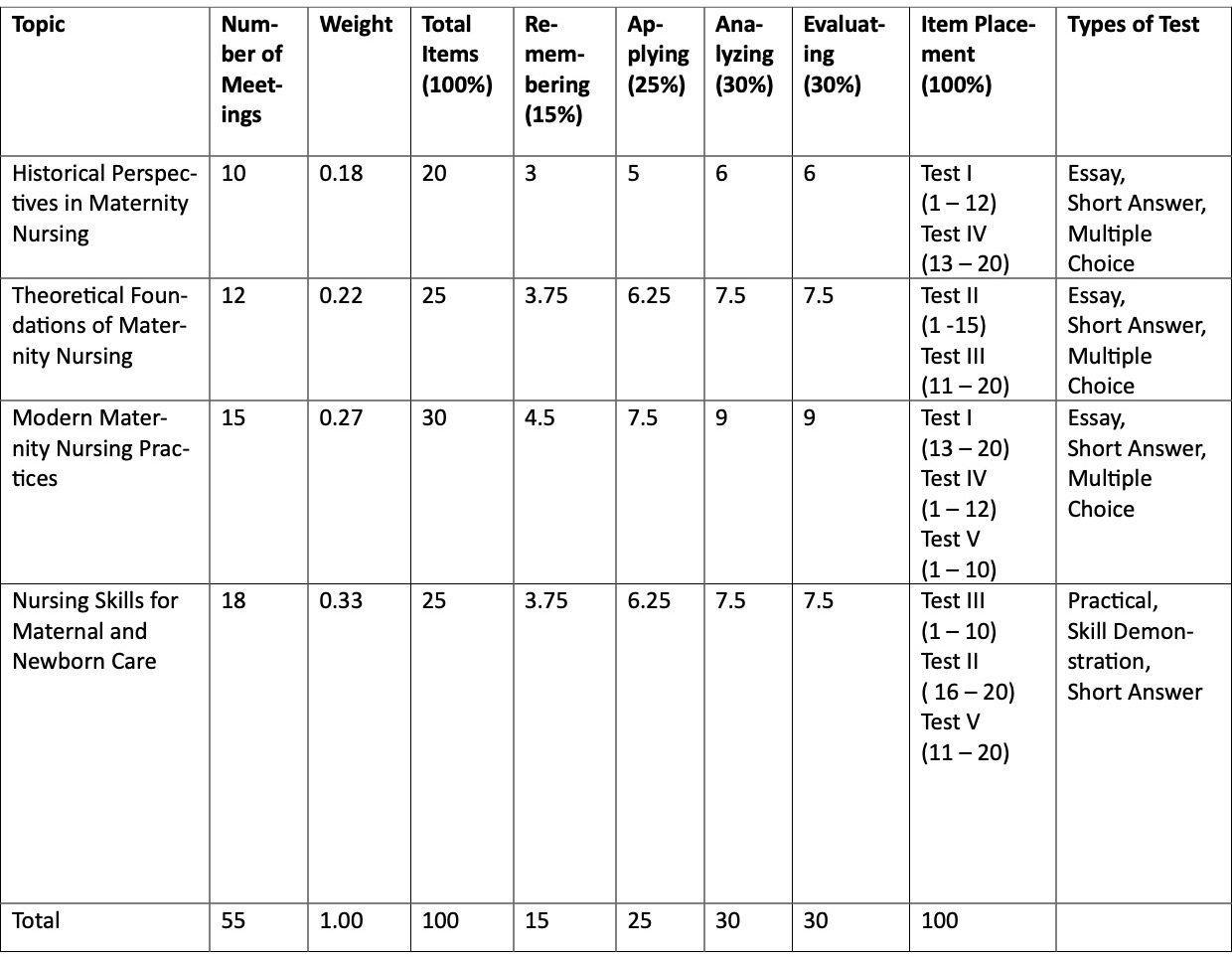
Five-line summary of the test plan:
- Evaluates theoretical knowledge and practical skills in maternity care.
- Incorporates essay, short-answer, and multiple-choice problems.
- It aligns with the course objectives on moral behavior and critical thinking.
- Ensures that theory and skills are integrated to provide readiness for clinical practice.
- Considers the practical, historical, and modern aspects of maternity nursing.
Unit 1: Theory Content
Multiple-Choice Question
Which historical event significantly influenced the development of modern maternity nursing?
- World War II
- Industrial Revolution
- Renaissance
- French Revolution
The correct answer is (2) Industrial Revolution, which is marked by urbanization and hospital birthing, necessitating modern maternity nursing techniques and the formalization of care (1). This pivotal turning point in nursing history highlighted the importance of professional training and standardized care in improving maternal and newborn health outcomes.
Short-Answer Question
Describe the steps involved in assessing maternal well-being during prenatal visits.
To ensure a successful pregnancy, a pregnant woman must have a complete medical history, undergo a physical examination, and perform laboratory testing to detect potential issues like preeclampsia. A supportive environment is created through candid dialogue, in which emotional and social health evaluations are conducted. Prenatal care scheduling, exercise, and nutrition are discussed, allowing women to make informed choices for a healthy maternity. Addressing questions and concerns boosts self-assurance and ensures collaboration between the mother and healthcare professionals in providing prenatal care.
Essay-Type Question
Discuss the role of theoretical foundations in shaping maternity nursing practice. Provide examples to support your answer.
Maternity nursing practice is significantly shaped by theoretical underpinnings, which provide a framework for comprehending the physiological, psychological, and social aspects of childbirth and maternal health. The bio-psycho-social model is a well-known theoretical paradigm in maternity nursing that recognizes the interdependence of biological, psychological, and social elements in determining the health outcomes of mothers and newborns (2). This framework helps nurses provide treatment that is not just focused on the patient’s physical health but also on their emotional and social well-being.
Moreover, theories such as Piaget’s cognitive development and Erikson’s psychosocial development help nurses understand the unique needs of expectant mothers and anticipate potential challenges across the prenatal, intrapartum, and postpartum phases. For example, Erikson’s theory informs nurses’ attempts to offer supportive care that builds maternal confidence and self-esteem by highlighting the significance of identity development and role transition throughout pregnancy and motherhood.
Additionally, nurses may support pregnant women in changing their lifestyles and encouraging healthy habits using theoretical frameworks such as the transtheoretical model of character shift. Nurses may customize treatments to meet specific needs and help women adopt beneficial health habits, such as quitting smoking or taking prenatal vitamins, by understanding the phases of behavior change (3). Furthermore, feminist ideas have influenced the practice of maternity nursing by supporting care that is oriented to women’s needs and choices, with respect for their autonomy and cultural values. This method recognizes the varied experiences and viewpoints of expectant mothers and prioritizes collaborative decision-making.
Unit 2: Practicum Content
Multiple-Choice Question
The nurse palpates a hard mass above the umbilicus during an abdominal examination. What action should the nurse take next?
- Notify the physician immediately.
- Document the findings and continue with the examination
- Perform auscultation of fetal heart sounds
- Instruct the client to change positions
The correct response is (1) Notify the physician immediately. During an abdominal examination, a hard mass above the umbilicus may indicate a dangerous condition like a tumor or aneurysm (4). Alerting the healthcare provider promptly ensures the patient’s safety and well-being, preventing potentially fatal consequences.
Short-Answer Question
Demonstrate proper infant eye and cord care.
Carefully cleanse both hands before providing eye and cord care for a newborn. Using a fresh, wet cotton ball or sterile gauze pad—one for each eye—gently wipe each one. From the inner to the outer corner, wipe. Next, please ensure the area around the umbilical cord base is dry and exposed to air by gently cleaning it with a dry cotton ball or gauze pad. Do not put clothes or diapers over the cord. Follow these instructions daily until the eyes appear clean and discharge-free, and the cord stump comes off, usually in 1 to 3 weeks.
Essay-Type Question
Explain the importance of teamwork and communication in the delivery room environment. Provide examples of how effective communication can enhance patient outcomes.
Teamwork and communication are essential in the delivery room to provide both the mother and the infant with safe and effective care. To coordinate work, anticipate potential issues, and respond quickly to emergencies, healthcare personnel must communicate clearly and efficiently in this high-stress environment. For example, efficient communication among nurses, midwives, and obstetricians during labor allows prompt updates on the mother’s status, enabling well-informed decisions about interventions or the need for cesarean sections.
In addition, cooperation fosters a collaborative environment in which each team member contributes specialized knowledge to maximize patient outcomes. Among others, obstetricians, nurses, midwives, anesthesiologists, and neonatologists are often members of obstetric teams; each has specific duties and responsibilities (5). Together, these experts can provide comprehensive care tailored to the mother and child’s specific needs. For instance, efficient collaboration guarantees prompt and coordinated attempts to stabilize the infant while concurrently attending to the mother’s requirements during a complex birth necessitating resuscitation.
Additionally, good communication supports patient-centered care by addressing the mother’s preferences and concerns and by including her in the decision-making process. Promoting patient-centered care requires patient and caregiver participation in the care process, which is enabled by patient-centered communication (6). Healthcare professionals enable women to make informed decisions about their care by actively listening to their needs and clearly explaining procedures and treatment options. Improved patient satisfaction and better maternal outcomes result from the healthcare team’s increased trust and confidence fostered by this collaborative approach.
Conclusion
In conclusion, it is critical to stress the value of academic understanding and practical skill development in nursing education. Although theoretical knowledge provides the fundamental structure, practical skills ensure proficiency in actual clinical situations. By integrating these components, nursing students may cultivate a comprehensive understanding of patient care, thereby augmenting their capacity to provide safe and effective therapies. Thus, it is critical to promote mastery of theoretical ideas and handy skills to produce competent and compassionate nurses.
References
- Mackenbach JP. Health problems of industrializing societies. In: BRILL eBooks. 2020. p. 149–216.
- Duberstein ZT, Brunner J, Panisch LS, Bandyopadhyay S, Irvine C, Macri JA, et al. The biopsychosocial model and perinatal health care: Determinants of Perinatal care in a community sample. Frontiers in Psychiatry. 2021.
- Morris T, Strömmer S, Vogel C, Harvey NC, Cooper C, Inskip H, et al. Improving pregnant women’s diet and physical activity behaviours: the emergent role of health identity. BMC Pregnancy and Childbirth. 2020 ;20(1).
- Mealie CA, Ali R, Manthey DE. Abdominal exam. StatPearls – NCBI Bookshelf. 2022.
- Gill P, Lende MN, Van Hook JW. Induction of labor. StatPearls – NCBI Bookshelf. 2023.
- Kwame A, Petrucka P. A literature-based study of patient-centered care and communication in nurse-patient interactions: barriers, facilitators, and the way forward. BMC Nursing. 2021; 20(1).