
Introduction
The stable work of the healthcare sector is one of the major determinants of the nation’s health. It is critical to guarantee that all individuals have access to care to manage their conditions. Furthermore, the challenges health workers face are becoming increasingly diverse each year, requiring greater effort to provide specialized, customized patient care. At the same time, the emergence of various problems undermines the sector’s readiness to respond to new problems and preserve high efficiency levels. Addressing these issues and promoting positive change is a critical task today.
Thus, the nursing shortage is a fundamental problem in the healthcare sector nowadays. The shortage of skilled and trained specialists affects all areas and worsens outcomes. For this reason, it is essential to find a solution and promote positive change within a sector. It would lead to higher patient satisfaction levels and treatment outcomes.
The nursing shortage problem is not new to healthcare; however, in recent years, especially after the COVID-19 pandemic, it has become especially topical. The high turnover rates and inability to retain workers that the healthcare sector faces challenge the sector’s ability to provide quality patient care, resulting in significant nurse losses (Soósová, 2021). Furthermore, the problem affects patients and puts them at risk, as it becomes more difficult to follow established protocols and care for them.
Patients suffer from missed care and the growing number of infections contracted in the hospital (Haddad et al., 2023). These consequences of the nursing shortage are critical, meaning that the problem is significant and requires immediate action. The question is also multifaceted, as it is associated with specialists’ well-being and their ability to perform their jobs and provide care. Thus, resolving the problem at the local level by promoting positive change within a single selected unit will lay the foundation for future, more substantial improvement.
Thus, the nursing shortage has a specific background that should be considered to design an effective solution. First, the lack of desire to continue working is associated with stress. Nurses experience extreme pressure, especially during the recent COVID-19 pandemic (Martin et al., 2023). As a result, they lose motivation to work and to deliver patient care. Second, around half of health workers experience burnout: 45% report physical exhaustion, and 51% admit mental health exhaustion (Lasater et al., 2021).
The problem of burnout is critical to the sector as it reduces productivity and increases the risk of mistakes. For nurses, it also means lower retention rates. The lack of security at the workplace and the fear of death are also among the reasons promoting the higher rates of nursing burnout (Tamata & Mohammadnezhad, 2023). As a result, the complex background of the problem influences the choice of the methods that might help to address it.
Furthermore, the scope of the nursing shortage problem is evident in its impact on healthcare and related factors. For instance, the reduction in the number of educated and experienced specialists increases the risk of malpractice and medication errors. According to the relevant statistics, events of this sort are increasing; 6% are linked to patient deaths, and 40% are linked to inappropriate pharmaceutical choices (Yoon et al., 2022). It means that the healthcare sector suffers from the problem, and the quality of care worsens.
The nursing shortage leads to a significant reduction in the quality of care provided to different types of patients. Thus, treatment requirements are either partially or entirely unmet due to a shortage of nurses capable of providing specialized care (Haddad et al., 2023). Pressure ulcers, increased risk of health-associated infections, unexpected outcomes, and longer recovery times are often associated with the limited number of health workers who can provide the necessary care (Haddad et al., 2023).
In this way, the statistics show that the nursing shortage is a critical issue that negatively affects the quality of patient care and the sector’s overall work. Existing policies might cause it, barriers to training and enrollment, high stress and burnout rates, and a lack of perspectives or payment (Tamata & Mohammadnezhad, 2023). The problem is systemic and should be addressed by finding practical solutions.
In this way, recent data show the scope and significance of the problem. The nursing shortage promotes numerous adverse effects on the healthcare sector, patients’ health, and units’ ability to treat clients and guarantee their recovery. For this reason, there is a need for an effective solution that will promote positive change within the discussed environment.
The transformation should consider the primary causes of the problem, such as existing policies, burnout, stress, and a complex working environment. Further disregard of the problem will lead to the issue becoming increasingly complex and the need for additional resources and funding to address it. In this regard, discussing the nursing shortage and designing a local-level intervention to address it by engaging the most influential stakeholders and promoting reconsideration of staffing and nurse retention policies is critical.
Thus, the proposed change project focuses on transforming a specific acute care hospital with 300 beds. The nurses work in complex conditions with much pressure from various factors. These include the need to provide care for patients in complex situations, high burnout rates, safety concerns, and a lack of motivation, such as lower wages and limited career growth opportunities. The unit lacks nurses, which influences the results and the ability to provide patient care efficiently. For this reason, designing an intervention for the unit is critical as it would help to enhance outcomes and patient satisfaction.
Justification of Practice Change Recommendation
Fostering a positive work environment might help address the nursing shortage. As stated previously, the change should consider the central factors influencing the emergence of the problematic issue. These include burnout, stress, a complex working environment, and ineffective policies. That is why altering the current settings and establishing a new one is fundamental and might be seen as the potent solution to the outlined problem. Thus, a positive working environment is critical for providing optimal patient care and attracting and retaining health workers (Maassen et al., 2021).
At the same time, it is a complex and multifaceted phenomenon encompassing numerous aspects, such as flexible schedules, higher safety rates, fair conflict resolution, appropriate wages, supportive policies, and actions aimed at fostering motivation to work (Maassen et al., 2021). Furthermore, current measurements indicate that, in many cases, health units disregard this aspect. As a result, there is a significant deterioration in nurses’ readiness to work and contribute to further improvements in care provision.
Therefore, the existing literature on the issue demonstrates the method’s effectiveness in addressing the nursing shortage. Establishing a positive working environment can foster teamwork, thereby contributing to patient safety and outcomes (Bragadóttir et al., 2023). Furthermore, there is a direct correlation between healthy teamwork and a positive workplace climate (Bragadóttir et al., 2023). It means that by altering the current policies and patterns of cooperation between various agents, it is also possible to create more potent teams that would be more effective in treating patients.
Additionally, nurses’ intention to remain in a particular unit is related to the unit’s work environment and its specific characteristics (Al Yahyaei et al., 2022). Organizational characteristics, such as internal policies, schedules, wages, and relations between top management and other workers, shape nurses’ readiness to continue working in a hospital (Al Yahyaei et al., 2022). At the same time, these are the core elements of a positive work environment. For this reason, the strategy might effectively address and resolve the discussed problem.
Given the nursing shortage, a positive work environment should be characterized by increased safety, better pay, flexible schedules, reduced stressors, and greater motivation. For instance, providing access to professional development opportunities, training, and education might be one factor that helps manage stress levels and allows nurses to feel more confident (Razai et al., 2023). It is a central aspect impacting their ability to work under complex conditions and deliver care appropriately.
Furthermore, the research shows that safety issues are a central factor influencing low retention among nurses, particularly during the COVID-19 pandemic (Shahmari et al., 2023). Protecting nurses by revising existing policies and implementing specific safety measures is key to establishing a positive working environment and ensuring nurses remain motivated to continue working. Furthermore, the existing evidence indicates that strategies to address the problem should focus on several issues simultaneously, given the systemic nature of the challenge (Peters, 2023). Fostering a positive working environment will help to attain this goal.
In the acute healthcare setting, reconsidering the existing environment is also beneficial. Missed nursing care undermines nursing standards of practice and minimizes the chances of adequate treatment and patient safety (Imam et al., 2023). These problems are especially important for acute care hospitals, as patients experience severe episodes of illness and the level of responsibility increases significantly (Imam et al., 2023). Nurses report that the existing setting fails to help them cope with burnout due to schedules, work overload, and a lack of personnel to assist them in delivering care in complex cases (Imam et al., 2023). For this reason, the current shift in the environment, with a focus on safety, psychological well-being, and existing policies, might be a potent tool to address the nursing shortage and improve retention among health workers.
In this way, the existing evidence supports fostering a positive environment as the primary change recommendation for managing the nursing shortage. Using this approach, it is possible to increase nurse retention rates, minimize burnout, cultivate better teamwork, and reduce maltreatment cases, medication errors, and poor outcomes. Another advantage of the proposed measure is that it can be employed at different levels, including the national and local ones.
The problem of inadequate policies, schedules, and work overload requires the support of local stakeholders and the engagement of nurses. More complex issues, such as payments or additional training, can also be addressed by cooperating with state authorities to secure additional funding. As a result, it would help reduce the financial burden by minimizing adverse treatment effects, patient complaints, or compensation due to maltreatment. In this way, it is possible to recommend organizational change, including cultivating a positive work environment as a potent strategy to address the problem at hand.
Pre-Implementation Plan
The success of the planned organizational change depends on the pre-implementation phase and the activities performed to support the incentive. Thus, it is possible to employ Lewin’s and Kotter’s change models as guides for altering current practices and the environment. The first one implies the three phases of successful transformation: unfreezing, understanding the need for change; moving, or change itself; and refreezing, or making a new practice part of ordinary tasks (Barrow et al., 2022). Thus, the framework might be a potent tool for guiding positive change; however, it might lack details. For this reason, it will be supported by Kotter’s 8-phase model, outlining the following steps:
- Creating a sense of urgency
- Building teams
- Creating a vision and plan
- Communicating the change with stakeholders
- Enabling action
- Creating short-term wins
- Building on change
- Making the change part of the culture (Campbell, 2020).
It is also evident that the models overlap and that Kotter’s steps might be organized into three phases, similar to those offered by Lewin. Steps 1-3 can be associated with unfreezing or creating the climate for change; steps 4-6 can be linked to moving, and steps 7-8 mean sustaining change or making it part of ordinary tasks (Barrow et al., 2022; Campbell, 2020). In this way, the given model will be employed to support the planned alteration and foster a positive environment.
The first phase is critical for creating a sense of urgency, understanding the need for change, building teams, and planning. It is critical to ensure nurses support the planned transformation as they are the central figures (Campbell, 2020). A sense of urgency can be created during meetings and seminars focused on the nursing shortage and the plans to address it.
The need for change can be explained by outlining the negative impact of the issue on performance and outcomes, and by discussing the benefits of the new working environment. Furthermore, before implementing change, it is essential to leverage existing information management systems and ensure they function efficiently to share data with all participants. During the pre-implementation phase, the new administrative policies should also be reviewed to determine whether any ethical issues may arise. It would help to guarantee equity and access to benefits for all parties.
The next important pre-implementation activity is identifying stakeholders and securing their support during the change. Managers, nurses, administrators, and local authorities might be the primary change agents. For this reason, it is critical to ensure their support and to ensure they understand the current change, its scope, and the planned outcomes (Campbell, 2020).
Stakeholders’ support can also be gained by addressing current levels of awareness and health literacy. They are central to understanding how the situation influences the unit’s work and the key factors of a positive work environment. This stage is critical for successful transformation, as stakeholders possess the resources needed to transform the unit’s work and make it more attractive to nurses.
Finally, the last phase implies making the change a part of everyday work and ensuring that positive achievements are not disregarded. During the pre-implementation period, it is critical to establish policies to protect the accomplishments of fostering a positive environment and avoid their elimination. That is why the stakeholders’ support is critical for achieving positive results.
It is also essential to ensure the safety of the patient and nurse, as they should not suffer during the transformation period, and their needs should be taken into account. In this way, the pre-implementation plan should align with the selected organizational change theory and help make the change more successful. The central activities aim to cultivate a vision of change and a sense of urgency, and to ensure that the main stakeholders support the proposed alterations and recognize their importance for the future.
Implementation Plan
The implementation plan should consider potential factors and barriers that may influence the success of the proposed transformation. These might include resistance to change, current administration policies, top management attitudes, cost, time, and stakeholders’ engagement. Thus, the existing body of knowledge admits the critical importance of resistance to change and its ability to worsen outcomes (Cheraghi et al., 2023). This means that if nurses do not realize the benefits of the proposed approach, they will refuse to use new techniques or sabotage them.
The causes of resistance might include personal and organizational factors (Cheraghi et al., 2023). Poor awareness is one of the most common factors that impact this aspect. In this way, stakeholders’ and nurses’ support can be secured by cultivating a better understanding of change as an effective strategy.
Furthermore, the institutional structures and challenges associated with them might be addressed by cultivating internal legitimacy. In other words, uncertainty about the new institutional logic and how traditional structures operate can be managed by accepting the policies governing nurses’ work under new conditions (Liu & Zhang, 2022). For instance, flexible schedules should align with the administration’s current rules to become part of the institutional structures.
It would lead to the better functioning of the whole unit and its further successful transformation. Furthermore, hospital policy constraints on adopting new practices and regulatory requirements may pose a challenge. During implementation, their reconsideration can be achieved through discussion and the acquisition of authorities’ support (Liu & Zhang, 2022). It will promote better interaction at all levels and reduce the uncertainty associated with the planned change.
The financial aspect of the organizational change is one of the most important ones. The healthcare sector traditionally has limited resources to devote to various projects or to support change. For this reason, overspending, or the growth in the funds required to sustain change, might have devastating effects on outcomes.
The most effective tool to address the problem is to create a clear, transparent budget that outlines all spending and includes the most important factors that require attention (Homauni et al., 2023). The main stakeholders and teams should be engaged in planning to ensure that all possible complications and expenses are considered, which is critical for a project of this sort (Homauni et al., 2023). It is expected that financial and human resources will be available due to the importance of the change, possible support from local agencies and sponsors, and the project’s cost-effectiveness.
The proposed alteration might also fail due to the nurses’ inability to influence it. In many factors, employees’ helplessness and lack of authority to impact decision-making lead to erroneous solutions during the implementation phase (Nilsen et al., 2020). The plan should include creating opportunities for nurses to provide feedback and warn the responsible teams if something goes wrong (Nilsen et al., 2020). This information is critical for sustaining the change and ensuring its success. Furthermore, the existence of this opportunity will lead to greater staff motivation and readiness to play a more active role in the process.
In total, the implementation plan should include several essential components. First, it is critical to cultivate awareness to address the resistance to change. Second, the teams responsible for the transformation, comprising the main stakeholders, should be formed. It would lead to better decision-making and flexibility.
Third, the incentive requires a budget for a clear distribution of resources and detailed planning. New policies should also be designed to fix the alteration and make them part of the work. Finally, it is vital to allow nurses to influence the incentive, share feedback, and ask for specific changes when needed. It will ensure the successful implementation of the new policies and cultivate a positive environment.
Evaluation Plan
Evaluating change is a critical aspect of any organizational transformation. The enhanced understanding of how the situation evolved and what goals were achieved is vital for planning new interventions and ensuring that subsequent changes are achieved. The proposed alteration employs Lewin’s and Kotter’s change theories, meaning the results should be evaluated against the phases specific to each. Additionally, the change focused on cultivating a positive environment.
For this reason, the steps to measure the change should include evaluating burnout rates before and after the intervention, retention rates, overall nurses’ satisfaction scores, safety, and patient satisfaction rates and outcomes. These elements should be addressed during the proposed alteration; their measurement is critical for concluding whether the intervention was successful. Thus, the analysis steps should include collecting feedback, processing it, and preparing a final report. The accuracy of findings and evaluations can be enhanced by using specific benchmarks specific to each field under the research.
Thus, the central factors that should be altered during the transformation should be benchmarked and assigned specific meanings. First, the burnout rate should be measured before the intervention (Willmington et al., 2022). By comparing its levels, it is possible to determine whether the cultivated environment is more positive and helps nurses feel less pressure.
Second, safety levels should also serve as an essential benchmark for evaluating the success of change. The degree of safety nurses feel should be compared at the initial and final phases. It would help to describe the change’s efficacy. Next, the outcomes and the rates of mistakes and malpractice might serve as benchmarks. The positive dynamics and reduced poor outcomes will indicate overall success.
Finally, patient satisfaction levels might serve as the critical benchmark. The nursing shortage directly influences the degree of clients’ satisfaction, meaning that the success of the change can be measured by analyzing patients’ attitudes. Satisfaction levels can be compared across project stages to determine whether the plan is working well and whether no corrections are required.
The feedback within the discussed acute care unit can be collected in several ways. First, nurses can share their views on alterations anonymously via the online platform created for this purpose or by placing letters in a mailbox located in a particular unit (Nilsen et al., 2020). It will ensure they are not afraid to share their current moods and motivations and establish the basis for an in-depth, detailed discussion of the problem at hand.
Second, representatives of the teams working to promote change should provide reports on the observed processes and share their views on whether the change is successful. It is also critical to allow patients to express their attitudes, which can be done by using surveys or personal communication with those who are ready to share. The positive changes reported by the acute hospital clients will indicate the success of the planned transformation. In contrast, their negative feedback might indicate the need to alter current practices and shape existing approaches to achieve better results.
Altogether, the given evaluation procedure is a critical component of the proposed change process. It will provide the data necessary to conclude the unit’s transformation and its ability to achieve the planned outcomes. Furthermore, data collected during the investigation will serve as the basis for new projects and will increase by enabling consideration of past experiences and their avoidance in the future. In this way, data collection accuracy is the central factor influencing the solution’s efficacy and helping address the nursing shortage. It should be practical and transparent, and allow all stakeholders to share their visions of the problem under concern.
Time and Resource Allocation
It is expected that the proposed change will take approximately 6 months. The first phase, or creating a sense of urgency, building teams, and gathering stakeholders’ support, will require around two months. This time will be spent establishing the action plan, sharing it with change agents, and creating the basis for change.
The second phase, or change itself, will require around 4-4.5 months. It will include shifting to new practices and policies, monitoring progress, and assisting nurses with their tasks. Finally, the last month should be devoted to measuring change using the benchmarks mentioned earlier and ensuring the accomplishments become part of the traditional practice. The change will also require specific resources, both human and financial ones.
Table 1 – Change Management Plan Throughout the Stages
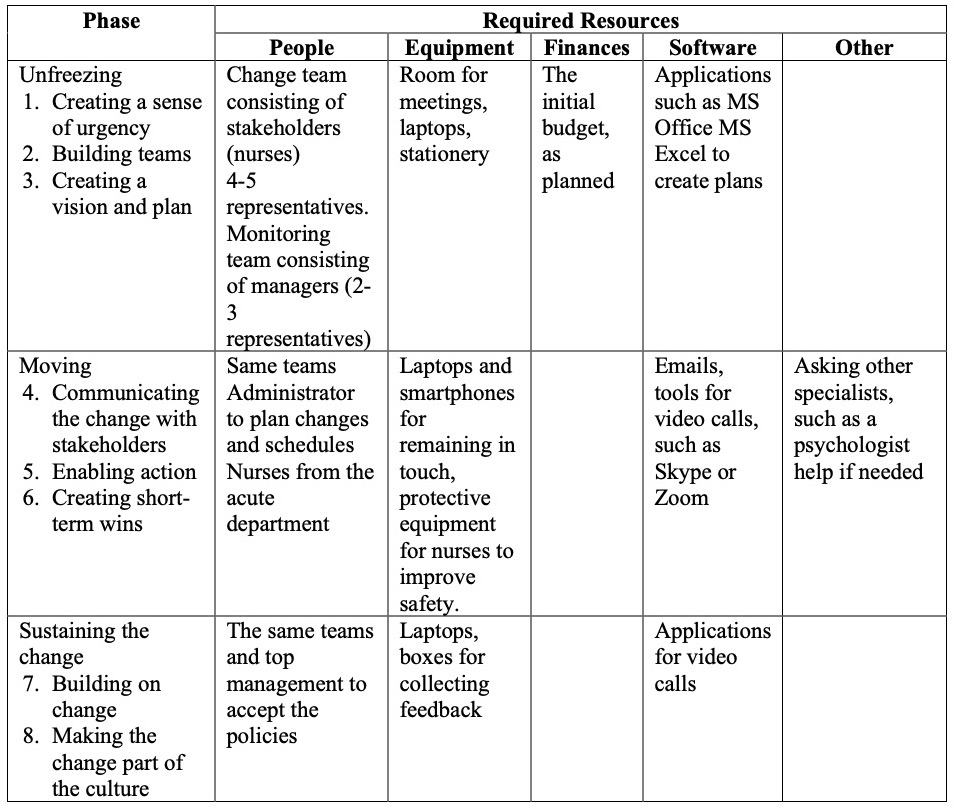
The project requires trained staff, administrators, and managers, as well as specific equipment such as laptops, specialized applications, and protective equipment for nurses to enhance safety. The spending will be part of the initial budget, planned with all factors that should be addressed during the change.
Conclusion
Altogether, the proposed change will help address the nursing shortage problem and improve patient outcomes. At the selected acute care hospital, the shortage of nurses is a critical problem that affects performance and treatment outcomes. For this reason, it is necessary to address it to avoid further deterioration of the situation. The offered organizational change will be guided by Lewin’s and Kotter’s change models. The significant steps imply unfreezing, changing the problem, and refreezing.
It is also essential to secure stakeholders’ support and ensure that nurses recognize the need for change and are aware of the planned alterations. It is critical to address their resistance, as it may increase the risk of failure and undermine outcomes. In this way, the proposed strategy focuses on cultivating a sense of urgency and the need for change, building teams that could support the proposed alteration, establishing the framework for evaluating outcomes, and collecting nurses’ feedback on the planned transformation. In conclusion, changes to the existing environment will help address the nursing shortage, improve motivation to work, and increase retention. It is a systemic approach that explains its effectiveness and ensures that all aspects of the problem under discussion are addressed.
Reference List
Al Yahyaei, A., Hewison, A., Efstathiou, N., & Carrick-Sen D. (2022). Nurses’ intention to stay in the work environment in acute healthcare: a systematic review. Journal of Research in Nursing, 27(4), 374-397.
Barrow, J., Annamaraju, P., & Toney-Butler, T. (2022). Change management. StatPearls.
Bragadóttir, H., Kalisch, B. J., Flygenring, B. G., & Tryggvadóttir, G. B. (2023). The relationship of nursing teamwork and job satisfaction in hospitals. SAGE Open Nursing, 9.
Campbell R. J. (2020). Change management in health care. The Health Care Manager, 39(2), 50–65.
Cheraghi, R., Ebrahimi, H., Kheibar, N., & Sahebihagh, M. H. (2023). Reasons for resistance to change in nursing: an integrative review. BMC Nursing, 22(1), 310.
Haddad, L., Annamaraju. P., & Toney-Butler, T. (2023). Nursing shortage. StatPearls.
Homauni, A., Markazi-Moghaddam, N., Mosadeghkhah, A., Noori, M., Abbasiyan, K., & Jame, S. Z. B. (2023). Budgeting in healthcare systems and organizations: A systematic review. Iranian Journal of Public Health, 52(9), 1889–1901.
Imam, A., Obiesie, S., Gathara, D., Aluvaala, J., Maina, M., & English, M. (2023). Missed nursing care in acute care hospital settings in low-income and middle-income countries: a systematic review. Human Resource for Health, 21(19).
Lasater, K. B., Aiken, L. H., Sloane, D., French, R., Martin, B., Alexander, M., & McHugh, M. D. (2021). Patient outcomes and cost savings associated with hospital safe nurse staffing legislation: An observational study. BMJ Open, 11(12).
Liu, L., & Zhang, C. (2022). Organizational structure change and hybridity: Enhancing uncertainty as a response to competing and changing institutional logics. Frontiers in Psychology, 13.
Maassen, S. M., van Oostveen, C., Vermeulen, H., & Weggelaar, A. M. (2021). Defining a positive work environment for hospital healthcare professionals: A Delphi study. PloS One, 16(2).
Martin, B., Kaminski-Ozturk, N., O’Hara, C., & Smiley, R. (2023). Examining the impact of the COVID-19 pandemic on burnout and stress among U.S. nurses. Journal of Nursing Regulation, 14(1), 4–12.
Nilsen, P., Seing, I., Ericsson, C., Birken, S. A., & Schildmeijer, K. (2020). Characteristics of successful changes in health care organizations: an interview study with physicians, registered nurses and assistant nurses. BMC Health Services Research, 20(1), 147.
Peters, M. (2023). Time to solve persistent, pernicious, and widespread nursing workforce shortages. International Nursing Review, 70(2), 247-253.
Razai, M. S., Kooner, P., & Majeed, A. (2023). Strategies and interventions to improve healthcare professionals’ well-being and reduce burnout. Journal of Primary Care & Community Health, 14.
Shahmari, M., Nayeri, N. D., Palese, A., & Manookian, A. (2023). Nurses’ safety-related organisational challenges during the COVID-19 pandemic: A qualitative study. International Nursing Review, 70(1), 18–27.
Soósová, M. S. (2021). Association between nurses’ burnout, hospital patient safety climate and quality of nursing care. The Central European Journal of Nursing and Midwifery, 12.
Tamata, A. T., & Mohammadnezhad, M. (2023). A systematic review study on the factors affecting shortage of nursing workforce in the hospitals. Nursing Open, 10(3), 1247–1257.
Willmington, C., Belardi, P., Murante, A., & Vaineri, M. (2022). The contribution of benchmarking to quality improvement in healthcare. A systematic literature review. BMC Health Services Research, 22(139).
Yoon, S., Cho, S. I., Shin, S., Lee, W., Ko, Y., Moon, J. Y., & Lee, H. J. (2022). An analysis of judicial cases concerning analgesic-related medication errors in the republic of Korea. Journal of Patient Safety, 18(2).