
Introduction
Companies strive to achieve competitive advantage through different means, yet they are all rooted in their foundation. The examination of a major firm’s structure can provide vital insights into modern business operations and reveal the reasons behind its success. This essay will analyze the organizational design of Starbucks, discuss its weaknesses and strengths, and provide a recommendation. The core values of Starbucks are well-reflected in its formal and informal structure, giving the firm a solid foundation for continuous global expansion.
The Organizational Structure
Due to its size, Starbucks has a multitude of divisions that deal with specific aspects of the firm’s activities. Starbucks uses the matrix structure, which works through the departmentalization of functional and product-related activities into pooled groups of employees that focus on a specific aspect of the business (Robbins & Judge, 2014). As seen in Figure 1, Starbucks presents a mechanistic model where the firm’s Chief Executive Officer (CEO) is in contact with the rest of the department heads with short control spans.
The specifics of each division make it essential for the organization to pursue formalization and outline each position explicitly. Despite the separation of various business activities, the CEO is able to direct the entire firm’s attention in the desired direction through the complex chain of command that connects all hierarchical levels. In turn, this strategy ensures that teams of employees working on the same aspect can share ideas and activities without any unnecessary barriers.
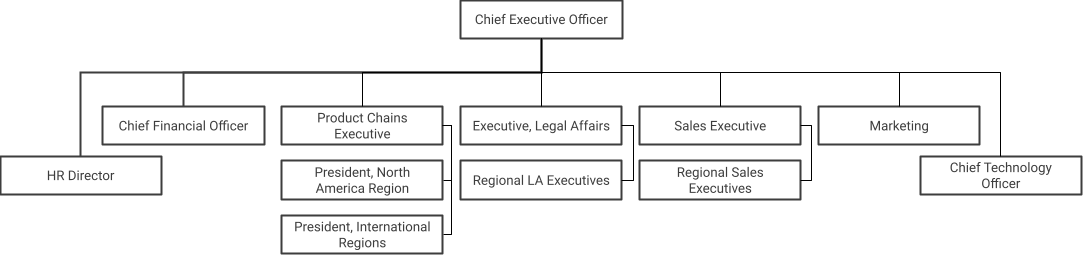
Due to the need to manage different products simultaneously, Starbucks uses departments for semi-independent goods. Aside from coffee and baked goods, Starbucks also manages Evolution Fresh juices and Teavana bottled teas, each requiring a separate product chain (“Menu: Starbucks,” n.d.). This addition further divides the organizational culture of Starbucks, adding new divisions. While they remain tethered to the organization, the development these cells conduct is driven by themselves, creating a partially open system (Narasimhan et al., 2012). This notion also adds value to Starbucks’ global expansion efforts. The firm’s organizational structure is reflected in each region to ensure that the basis for Starbucks’ operations is suitable for its location.
The Informal Structure
While Starbucks possesses a strict organizational structure, its work environment presents a unique culture that is focused on communication. The firm is known for its employee empowerment, which leads to high motivation among workers and gives them an opportunity to affect the company’s performance through autonomous decision-making (Meyer, 2022). The entire corporate culture on lower hierarchical levels prioritizes ensuring that every person feels like they belong to a close-knit group that works on the same goals and provides shared input. Through such an approach, barriers to communication within each cafe are eroded to ensure that workers have sufficient freedom of individual choices.
Intrateam relationships are what genuinely drive the company’s revenue and create value for customers. Informal groups that are formed naturally within the company have a significant impact on Starbucks’ performance, as the firm is known for its friendly environment (Robbins & Judge, 2014). In turn, such relationships boost other aspects of the firm’s performance.
Starbucks utilizes its informal culture to promote revenue-increasing practices through customer hospitality, such as repeating orders to ensure that they are correct (Powers, 2019). Starbucks’ cafe employees, regardless of their position, are trained to excel at customer relationships. This strategy lessens the loss of information during communications, motivates employees to socialize both with their peers and clients and increases the company’s profits.
Dealing with Differentiation and Integration Issues
The firm performs well due to its solid structure, which enables it to avoid major crises. Starbucks produces a variety of products, and each one requires a different supply line, marketing, and facilities. As seen in Figure 1, Starbucks deals with issues that may arise from this notion through divisions that govern the majority of processes related to a single product. At the same time, its functional departments create a brand image that unifies the qualities of each good Starbucks has in markets. The matrix structure can be viewed as dividing, yet under strong leadership, it can implement cross-department communication strategies that will promote integration sufficiently.
Strengths and Weaknesses of Starbucks’ Design
The strengths of Starbucks’ organizational structure enable it to perform well on a global scale. For example, by sharing its blueprint for departmentalization with regional divisions, Starbucks can collect business data in a uniform pattern that enables it to analyze the situation in markets and juxtapose it to other locations. Moreover, such a design optimizes resource allocation within the firm by making it apparent which divisions provide the highest return on investments. In addition to these factors, disseminating information among employees is more accessible in a matrix structure, which allows people to cooperate efficiently on a single goal.
In turn, Starbucks’ structure relies significantly on the communication abilities of its CEO and regional executive leaders, who might be unable to find common ground and fail to cooperate. Since power is highly concentrated among top positions, Starbucks may experience a period of power struggles if its current CEO leaves suddenly (Robbins & Judge, 2014). Departments that may have connections to activities performed by other segments of Starbucks may experience a lag in reporting, leading to increased confusion within the firm. Finally, regional sectors of the firm develop different frames of reference if they are not strictly controlled, leading to inefficient communication (Janicijevic, 2013). Starbucks might experience challenges related to its organizational design in the long run.
Recommendation
It is recommended that Starbucks improves the connectivity of employees between various hierarchy levels. Employees’ high level of autonomy may serve as a source of feedback for future improvements. The accessibility of direct forms of communication prevents message distortion and lag, ensures clear goal establishment, and makes employees perceive their value better (Robbins & Judge, 2014). Therefore, such an approach can allow Starbucks to better align its operations with workers’ expectations.
Conclusion
In conclusion, the organizational design of Starbucks provides the company with a solid foundation for global expansion, as both formal and informal design choices are its core values. The firm uses the matrix structure, which enables its employees who work on similar aspects to cooperate efficiently and seamlessly while leaving enough space for inter-team communications. There are numerous executives operating within the firm, with the CEO being the primary decision-maker.
The specialization of departments creates a mechanistic model that possesses high formalization and gives people short control spans. At the same time, Starbucks uses its informal culture to deliver excellent customer service and create a unique atmosphere that attracts customers. While there are weaknesses related to potential failures in the matrix structure, the high level of proficiency of the company’s leaders ensures that the organization continues to use its competitive advantage on a global scale.
References
Janicijevic, N. (2013). The mutual impact of organizational culture and structure. Economic Annals, 58(198), 35-60. Web.
Menu: Starbucks. (n.d.). Starbucks Coffee Company. Web.
Meyer, P. (2022). Starbucks’s organizational structure & its characteristics. Panmore Institute. Web.
Narasimhan, A., Yu, H. H., & Lane, N. (2012). Organizational design: Inviting the outside in. IMD business school for management and leadership courses. Web.
Powers, K. (2019). Workplace psychology: Issues and application. Pressbooks.
Robbins, S. P., & Judge, T. A. (2014). Essentials of organizational behavior (12th ed.). Pearson.